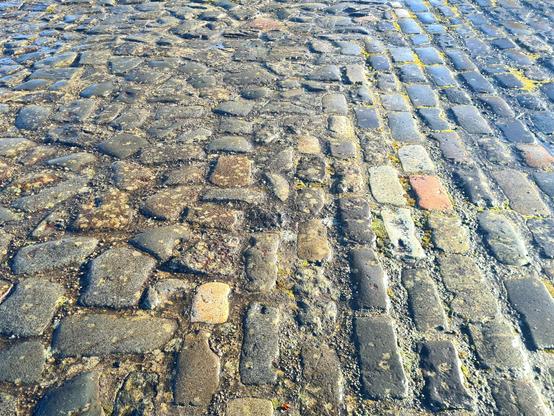
Cobblestones vs Setts. These two types of traditional road surfaces are often confused, but they're easy to tell apart. In this photo from the Applecross Basin on the Forth and Clyde Canal in the north of Glasgow, there are cobblestones on the left and setts on the right. Cobblestones are natural, rounded, irregularly-sized rocks, while setts are quarried and shaped stones, usually made from granite, of a uniform size and shape.

Cont./

#glasgow #glasgowhistory #architecture #cobblestones

@thisismyglasgow
A quick question, what do you mean by granite? Like the actual rock type, or just using the stonemason catch-all term which in general usage means just a worked stone (anyone with a better definitin?)? If the former it would seem rather odd to use granite, even in the 19th century quarrying and stoneworking techniques would have made granite quarreling difficult esp for such a large number of such small pieces. Granite (the actual rock type) is exceedingly hard and difficult to work.
@PhilGopon I mean actual granite (I've never heard the term being used more generally for worked stone over here). We have lots of it in Scotland, and it made for a very hard-wearing surface. In fact, there are a surprsing number of them still in use and in good condition more than a century after the surface was laid. I suspect they started being used when mechanical cutting was invented to allow them to be made in large numbers.

@thisismyglasgow
Hmmm.. Interesting, here (Austria) granite wasn't really widely used until relatively modern times.
I realize Scotland has a fair few granites (esp Aaron if youare near Glasgow) but I really didn't they were widely used until much later. A little surprised you have never heard the wrong usage of granite, in countertops etc they just really mean a nice polished stone, which really gets my geologists goat.

In England as well (esp in the south) limestone and other carbonate rocks were nich more widely used until well into the last century. Not only more widely available but also easier and cheaper to work.
I teach a course geo building materials so genuinely interested (also used to teach field geology in Scotland when I lived in the UK).
Generally granite is not preferable for modern road surfaces because it has a tendency to crack during heavy usage (the downside of being hard) and eats up the machine parts (crushers drills etc) much faster.

@PhilGopon Granite is quite a traditional stone in some parts of Scotland, especially in places like Aberdeen, which is primarily built with granite as that was the local stone. Indeed, a lot of the setts for Glasgow's streets may well have come from the quarries of Aberdeenshire where they had a lot of experience with working with granite. πŸ‘πŸ™‚

@thisismyglasgow @PhilGopon

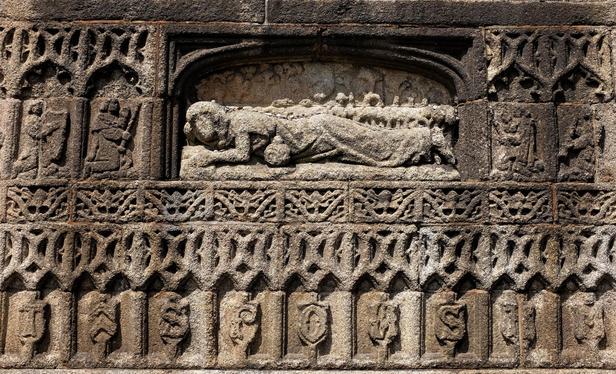
Granite was also used widely for centuries in Devon and Cornwall. It can be beautifully worked, given the patience and skill. Here is a great example in Cornwall, at Launceston St Mary, where the whole of the exterior is highly carved, including this figure of Mary Magdalene.

#Granite #Cornwall #Devon

@NellytheWillow @thisismyglasgow @PhilGopon Hard, hard work carving granite like that!πŸ‘πŸ€©

@FaithfullJohn @thisismyglasgow @PhilGopon

Yes, very hard work indeed. This was paid for by a very wealthy man and I dare say it cost him a penny or two to get all that hard work done. A saying goes that only a Cornishman would attempt to carve intractable granite. In fact, that may have been John Betjeman, if I remember rightly.

@NellytheWillow @FaithfullJohn @PhilGopon You certainly don't get many carvings like that in granite in Aberdeen! πŸ˜€