 Flipboard Tech Desk
Wikipedia has banned its editors from using AI to create articles, @404mediaco reports. @emanuelmaiberg talked to the Wikipedia editor who proposed the guideline about why.
 💡𝚂𝗆𝖺𝗋𝗍𝗆𝖺𝗇 𝙰𝗉𝗉𝗌📱
@TechDesk @404mediaco @emanuelmaiberg
The problem is Wiki already contains a lot of wrong info. I saw an article yesterday which I'm pretty sure was mostly AI slop regurgitaed from a very wrong Wiki page. The problem with it is your next-door-neighbour Joe Blow, who has forgotten the rules of Maths, is totally allowed to admin a page about Maths. Welcome to why I post it here instead. Wikipedia is "like an encyclopedia" in the same way that Madonna is like a virgin
The problem is Wiki already contains a lot of wrong info. I saw an article yesterday which I'm pretty sure was mostly AI slop regurgitaed from a very wrong Wiki page. The problem with it is your next-door-neighbour Joe Blow, who has forgotten the rules of Maths, is totally allowed to admin a page about Maths. Welcome to why I post it here instead. Wikipedia is "like an encyclopedia" in the same way that Madonna is like a virgin
 Furbland's Very Cool Mastodon™
@SmartmanApps @TechDesk @404mediaco @emanuelmaiberg for every troll who edits an article, there’s 5 dedicated editors standing by to correct it. the beauty of wikis is that they’re constantly being fact-checked by tons of experts. @wikipedia even has a dedicated counter-vandalism team!
@SmartmanApps @TechDesk @404mediaco @emanuelmaiberg @wikipedia the problem with traditional encyclopedias is they tend to be biased and can be hard to update. Wikipedia and its many policies bypass all that
@GroupNebula563 @TechDesk @404mediaco @emanuelmaiberg @wikipedia
"for every troll who edits an article" - Professor Rick Norwood isn't a troll https://www.researchgate.net/profile/Rick-Norwood and yet his Maths corrections keep getting backed out by admins. Welcome to why I post my Maths facts on Mastodon, where no-one can back them out https://dotnet.social/@SmartmanApps/110968910722113903
@GroupNebula563 @TechDesk @404mediaco @emanuelmaiberg @wikipedia
"they’re constantly being fact-checked by tons of experts" - and getting backed out again by admins. See previous comment. None of the Maths pages ever cite any Maths textbooks, despite the fact there are many available for free on the Internet Archive
"many policies bypass all that" - including bypassing fact-checking 🙄 so either the policies don't work, or aren't followed. Either way Wikipedia has a facts problem
@SmartmanApps @TechDesk @404mediaco @emanuelmaiberg @wikipedia the policies do work, and are followed. they work quite well, in fact. the articles don't cite textbooks, but they *do* cite papers from credible mathematicians/universities, which IMO tend to be far more authoritative. if this rick norwood is a highly credible mathematician, he himself would likely have a wikipedia article, and unless he died in 1675, he does not. https://en.wikipedia.org/wiki/Richard_Norwood

@SmartmanApps @TechDesk @404mediaco @emanuelmaiberg @wikipedia the only "rick norwood" i can find on wikipedia, unless he goes under another username there, is an avid contributor to the project and seems to quite enjoy it: https://en.wikipedia.org/wiki/User:Rick_Norwood
@SmartmanApps @TechDesk @404mediaco @emanuelmaiberg @wikipedia ...or he was, until he was diagnosed with alzheimer's and begun making disruptive edits to pages, which are probably the ones getting reverted that you're talking about. not to mention, there's zero indication i can find that the wikipedia editor rick and the researchgate rick are the same person
@SmartmanApps @TechDesk @404mediaco @emanuelmaiberg @wikipedia if you have any further concerns about wikipedia or any other wikimedia projects, i highly suggest taking that up with @LucasWerkmeister, the only person i can think of off the top of my head who is more qualified than i to answer this sort of thing
@GroupNebula563 @TechDesk @404mediaco @emanuelmaiberg @wikipedia @LucasWerkmeister
"the policies do work, and are followed" - clearly not, given pages like https://en.wikipedia.org/wiki/0.999... exist
"IMO tend to be far more authoritative" - I see you haven't read any of their blog posts then, where they can't even get order of operations right (spoiler alert: they don't teach it at university, it's taught in high school, which they've long since left - high school textbooks are the references to use)
@SmartmanApps @TechDesk @404mediaco @emanuelmaiberg @wikipedia @LucasWerkmeister ...you can see right here where it cites two textbooks explaining exactly why the article is correct
https://books.google.com/books?id=jWgPAQAAMAAJ
https://archive.org/details/mathematicalanal02edtomm/page/n3/mode/2up
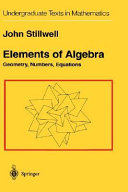
Elements of Algebra
Algebra is abstract mathematics - let us make no bones about it - yet it is also applied mathematics in its best and purest form. It is not abstraction for its own sake, but abstraction for the sake of efficiency, power and insight. Algebra emerged from the struggle to solve concrete, physical problems in geometry, and succeeded after 2000 years of failure by other forms of mathematics. It did this by exposing the mathematical structure of geometry, and by providing the tools to analyse it. This is typical of the way algebra is applied; it is the best and purest form of application because it reveals the simplest and most universal mathematical structures. The present book aims to foster a proper appreciation of algebra by showing abstraction at work on concrete problems, the classical problems of construction by straightedge and compass. These problems originated in the time of Euclid, when geometry and number theory were paramount, and were not solved until th the 19 century, with the advent of abstract algebra. As we now know, alge bra brings about a unification of geometry, number theory and indeed most branches of mathematics. This is not really surprising when one has a historical understanding of the subject, which I also hope to impart.
@GroupNebula563 @TechDesk @404mediaco @emanuelmaiberg @wikipedia @LucasWerkmeister
""you can see right here where it cites two textbooks" - nope. I can see quite clearly they are NOT Maths textbooks, as I said
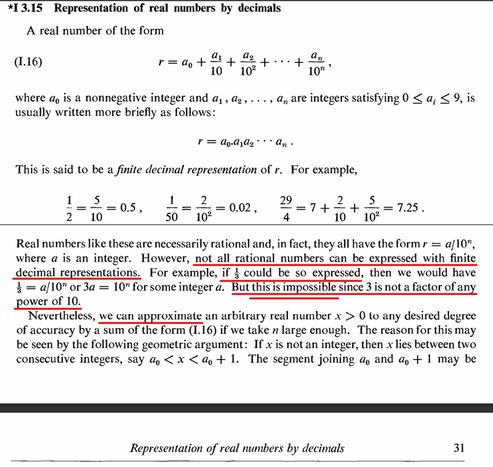
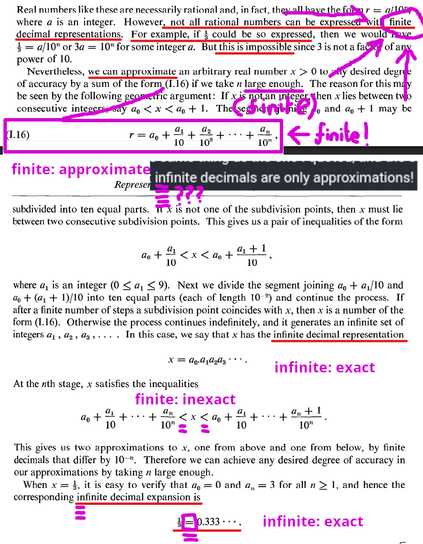
"explaining exactly why the article is correct" - now go read about limits and/or decimal representations in Maths textbooks and you'll discover why it's wrong. Here's a free head-start explaining why 1/3 isn't actually equal to 0.333... and is only an approximation (now multiply by 3)
 Steffi the Redhead
@SmartmanApps @GroupNebula563 @TechDesk @404mediaco @emanuelmaiberg @wikipedia @LucasWerkmeister you have to make the line for "period" over the 3 of 0,3.
@fuchsi @GroupNebula563 @TechDesk @404mediaco @emanuelmaiberg @wikipedia @LucasWerkmeister
"you have to make the line for "period" over the 3 of 0,3" - yes, and is an approximation of 1/3, since it's literally impossible to have an exact decimal representation of 1/3 in base 10, since 3 isn't a factor of 10, as per the textbook
@SmartmanApps @GroupNebula563 @TechDesk @404mediaco @emanuelmaiberg @wikipedia @LucasWerkmeister but it's 3 until infinity. That limes should do that, no?
@fuchsi @GroupNebula563 @TechDesk @404mediaco @emanuelmaiberg @wikipedia @LucasWerkmeister
"but it's 3 until infinity. That limes should do that, no?" - I'm not sure what you mean. Even at 3 to infinity, it's still only an approximation of 1/3, so 0.9 to infinity is only an approximation of 1. ALL non-terminating decimals are only approximations, again as per the textbook. Only terminating decimals are exactly equal to a fraction, such as 0.25 is exactly equal to 1/4, as per the textbook
@fuchsi @GroupNebula563 @TechDesk @404mediaco @emanuelmaiberg @wikipedia @LucasWerkmeister
In other words, no matter how many steps you do your long division to, you're still left with remainder 1 - that remainder 1 literally never disappears, even at preceded by infinite zeroes. It's because 3 isn't a factor of 10, and we're doing it in base ten. In base 3 you can exactly represent 1/3 - it's 0.1 - in base ten you can't. The same thing happens in the other direction converting back.
@SmartmanApps @GroupNebula563 @TechDesk @404mediaco @emanuelmaiberg @wikipedia @LucasWerkmeister That's not how ifinity works. You don't have the remaining 1. That also gets divided by 3.
@fuchsi @GroupNebula563 @TechDesk @404mediaco @emanuelmaiberg @wikipedia @LucasWerkmeister
"You don't have the remaining 1. That also gets divided by 3" - which then also gives a remainder of 1, divide by 3 again, another remainder of 1, ad infinitum. That's EXACTLY how infinity works - a never-disappearing remainder of 1, infinitely repeating 3's. Again, every non-terminating decimal is only an approximation, only terminating decimals are exactly equal to fractions, as per Maths textbooks
@SmartmanApps @GroupNebula563 @TechDesk @404mediaco @emanuelmaiberg @wikipedia @LucasWerkmeister I am not sure that's how it works.
@fuchsi @GroupNebula563 @TechDesk @404mediaco @emanuelmaiberg @wikipedia @LucasWerkmeister
"I am not sure that's how it works" - That's exactly how it works. Sit down with pen and paper and start doing long (or short) division. 3 doesn't go into 1, add a zero. 3 goes into 10 3 times with 1 remainder, repeat ad infinitum. Again, every non-terminating decimal is only an approximation due to a never-disappearing remainder, due to not being a factor of 10
@SmartmanApps @GroupNebula563 @TechDesk @404mediaco @emanuelmaiberg @wikipedia @LucasWerkmeister yeah, but you do that with limit analysis
@fuchsi @GroupNebula563 @TechDesk @404mediaco @emanuelmaiberg @wikipedia @LucasWerkmeister
And the limit is defined as the number it can never reach, hence the name, limit.
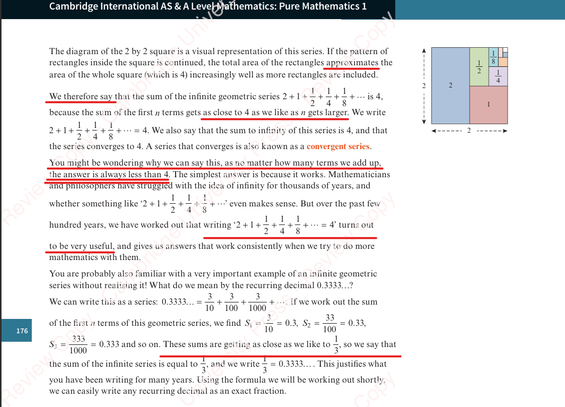
@SmartmanApps @GroupNebula563 @TechDesk @404mediaco @emanuelmaiberg @wikipedia @LucasWerkmeister In your text: read the line with the long term. On the right side you see "=4".
That means if you take the infinite term you can make an integer out of it.
That means if you take the infinite term you can make an integer out of it.
@fuchsi @GroupNebula563 @TechDesk @404mediaco @emanuelmaiberg @wikipedia @LucasWerkmeister
Now read all the underlined parts, especially the double-underlined part. You can lead a horse to water...
"That means if you take the infinite term you can make an integer out of it" - no, had you read it, you would understand that means if you take THE LIMIT you can get an integer out of it. The "infinite term" is still less than it, still less than 4, as per the textbook...
@SmartmanApps @GroupNebula563 @TechDesk @404mediaco @emanuelmaiberg @wikipedia @LucasWerkmeister as far as I understand it it's 4.
@fuchsi @GroupNebula563 @TechDesk @404mediaco @emanuelmaiberg @wikipedia @LucasWerkmeister
"as far as I understand it it's 4" - the limit is 4, yes, the infinite sum isn't - see double-underlined part (I'm starting to think you didn't read any of it and are just a time-waster)
"as far as I understand it it's 4" - the limit is 4, yes, the infinite sum isn't - see double-underlined part (I'm starting to think you didn't read any of it and are just a time-waster)
@SmartmanApps @GroupNebula563 @TechDesk @404mediaco @emanuelmaiberg @wikipedia @LucasWerkmeister And I think you ignored the not underlined parts behind.
@fuchsi @GroupNebula563 @TechDesk @404mediaco @emanuelmaiberg @wikipedia @LucasWerkmeister
"And I think you ignored the not underlined parts behind" - so rather than leave us in any doubt, you decided to confirm you're a time-waster who couldn't take issue with anything the textbooks said and made up an ad hominem instead. Got it. Bye then.
"And I think you ignored the not underlined parts behind" - so rather than leave us in any doubt, you decided to confirm you're a time-waster who couldn't take issue with anything the textbooks said and made up an ad hominem instead. Got it. Bye then.
@SmartmanApps @GroupNebula563 @TechDesk @404mediaco @emanuelmaiberg @wikipedia @LucasWerkmeister Sorry, but I don't have math textbooks in my house. My study time was 20 years ago.
@fuchsi @GroupNebula563 @TechDesk @404mediaco @emanuelmaiberg @wikipedia @LucasWerkmeister
There's plenty of textbooks available for free on the Internet Archive, none of which have been referenced in the Wikipedia page, which is contradicted by what textbooks say https://dotnet.social/@SmartmanApps/115365316775919939 The 2 textbooks I referenced in this thread, which say that infinite decimals are only approximations, and the infinite sum never reaches the limit, are also available for free online, also unreferenced by Wiki
There's plenty of textbooks available for free on the Internet Archive, none of which have been referenced in the Wikipedia page, which is contradicted by what textbooks say https://dotnet.social/@SmartmanApps/115365316775919939 The 2 textbooks I referenced in this thread, which say that infinite decimals are only approximations, and the infinite sum never reaches the limit, are also available for free online, also unreferenced by Wiki
💡𝚂𝗆𝖺𝗋𝗍𝗆𝖺𝗇 𝙰𝗉𝗉𝗌📱 (@[email protected])
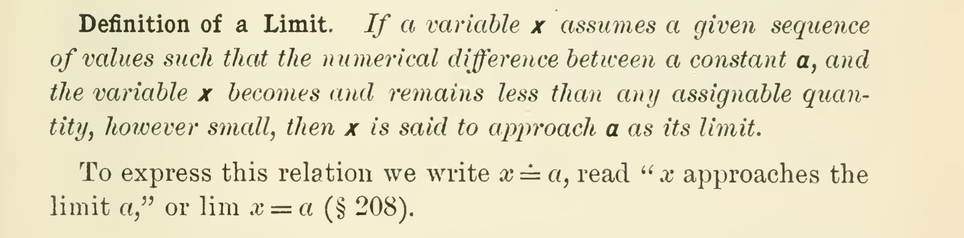
Attached: 1 image 4/5 We can see in this textbook, it uses a dot above an equals sign to show "x approaches the limit a", and says we can also write it as "lim x=a". I have also seen textbooks say x:=a, where := means "is defined as". Note that in all 3 cases, the textbook has quite conspicuously never said x=a, only variations on the limit of x is defined as a, which we do so that we have a finite number that we can perform further calculations with...
@SmartmanApps @GroupNebula563 @TechDesk @404mediaco @emanuelmaiberg @wikipedia @LucasWerkmeister Wait, what? Are you saying I should only read books that are not referenced by Wikipedia?
Isn't that a bit extreme from "I would change one sentence about infinity"?
@fuchsi @GroupNebula563 @TechDesk @404mediaco @emanuelmaiberg @wikipedia @LucasWerkmeister
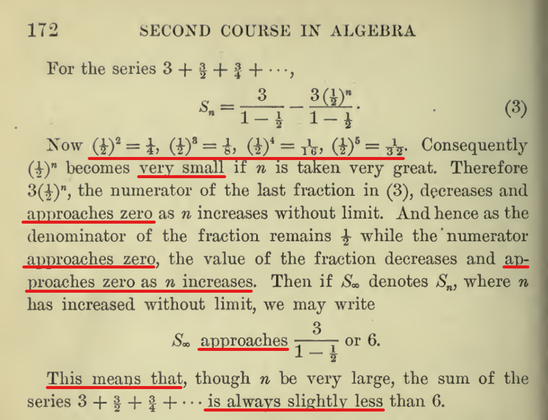
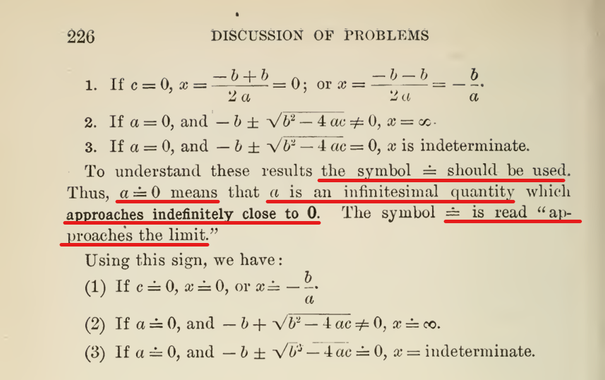
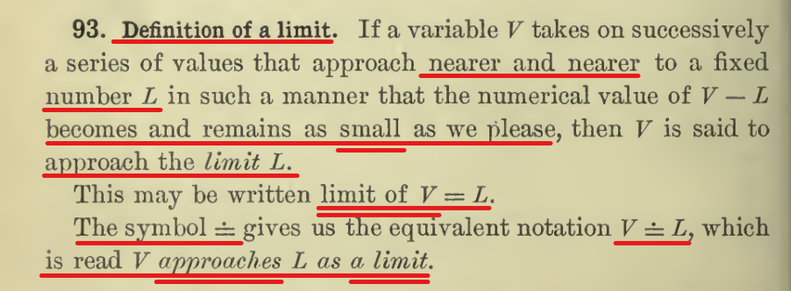
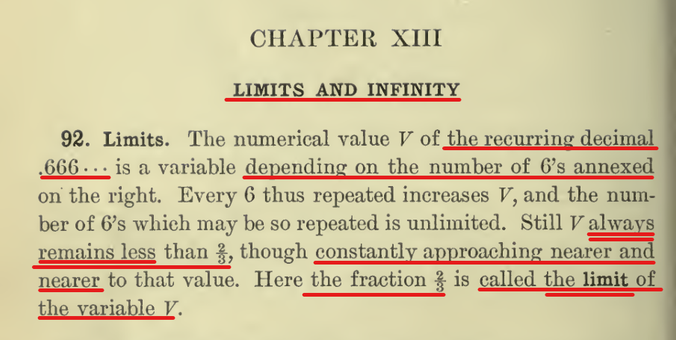
"Wait, what? Are you saying I should only read books that are not referenced by Wikipedia?" - umm, no, and I have no idea why you would say that! I said read Maths textbooks, and the actual issue I'm pointing out is that Wikipedia never manages to reference any. BTW here's some more explicitly stating the the sum is always less than the limit...
"Wait, what? Are you saying I should only read books that are not referenced by Wikipedia?" - umm, no, and I have no idea why you would say that! I said read Maths textbooks, and the actual issue I'm pointing out is that Wikipedia never manages to reference any. BTW here's some more explicitly stating the the sum is always less than the limit...
@SmartmanApps @GroupNebula563 @TechDesk @404mediaco @emanuelmaiberg @wikipedia @LucasWerkmeister I just looked into the page of Limit analysis and there are 15 sources. 10 of it are math books, 4 are study materials for universities, 1 is a wiki intern link to mathematical proofs.
So I think you are very wrong when you claim Wikipedia doesn't link math books.
Link in my language: https://de.wikipedia.org/wiki/Grenzwert_(Funktion)
@fuchsi @GroupNebula563 @TechDesk @404mediaco @emanuelmaiberg @wikipedia @LucasWerkmeister
"So I think you are very wrong when you claim Wikipedia doesn't link math books" - Now go look at the pages that we were actually talking about as being wrong 🙄
"So I think you are very wrong when you claim Wikipedia doesn't link math books" - Now go look at the pages that we were actually talking about as being wrong 🙄
@SmartmanApps @GroupNebula563 @TechDesk @404mediaco @emanuelmaiberg @wikipedia @LucasWerkmeister you didn't link any pages and I talked about limit analysis. So this is a page I was talking about.
Which pages do mean? I just scrolled up, but there were no links. Am I blind?
@fuchsi @GroupNebula563 @TechDesk @404mediaco @emanuelmaiberg @wikipedia @LucasWerkmeister
"you didn't link any pages" - yes I did, here https://dotnet.social/@SmartmanApps/116300348768196192
"you didn't link any pages" - yes I did, here https://dotnet.social/@SmartmanApps/116300348768196192
💡𝚂𝗆𝖺𝗋𝗍𝗆𝖺𝗇 𝙰𝗉𝗉𝗌📱 (@[email protected])
@[email protected] @[email protected] @[email protected] @[email protected] @[email protected] @[email protected] "the policies do work, and are followed" - clearly not, given pages like https://en.wikipedia.org/wiki/0.999... exist "IMO tend to be far more authoritative" - I see you haven't read any of their blog posts then, where they can't even get order of operations right (spoiler alert: they don't teach it at university, it's taught in high school, which they've long since left - high school textbooks are the references to use)
@SmartmanApps @GroupNebula563 @TechDesk @404mediaco @emanuelmaiberg @wikipedia @LucasWerkmeister ah thanks.
Hm ... There are 69 sources and every one of them is wrong?
@fuchsi @GroupNebula563 @TechDesk @404mediaco @emanuelmaiberg @wikipedia @LucasWerkmeister
"There are 69 sources and every one of them is wrong?" - have a look at them and you'll see there's blog posts, and media articles,... and yes, they're all wrong, as proven by Maths textbooks and literal proofs (one of which was bizarrely included as a proof of them being equal, even though in fact it proves they're NOT equal - dude writing it doesn't even seem to understand what he's writing!).
"There are 69 sources and every one of them is wrong?" - have a look at them and you'll see there's blog posts, and media articles,... and yes, they're all wrong, as proven by Maths textbooks and literal proofs (one of which was bizarrely included as a proof of them being equal, even though in fact it proves they're NOT equal - dude writing it doesn't even seem to understand what he's writing!).
@fuchsi @GroupNebula563 @TechDesk @404mediaco @emanuelmaiberg @wikipedia @LucasWerkmeister
Well, as the Gaslighter pointed out, one of them is another book by Apostol, which he said says the same thing as the one I quoted, and the one I quoted quite clearly says that infinite decimals are only approximations! As I said, dude writing it didn't seem to understand any of it
Well, as the Gaslighter pointed out, one of them is another book by Apostol, which he said says the same thing as the one I quoted, and the one I quoted quite clearly says that infinite decimals are only approximations! As I said, dude writing it didn't seem to understand any of it
@SmartmanApps @GroupNebula563 @TechDesk @404mediaco @emanuelmaiberg @wikipedia @LucasWerkmeister Just to make sure:
You do know, that new scientific studies and scholarly articles are published in academic journals, not in textbooks, right?
So it may be very plausible that some niche Wikipedia articles only quote well-known journals or even blog posts of experts in the field?
Edit: I looked and the first two sources are already math books. So exactly what you wished.
 Fish Face
@fuchsi temper your expectations, the second source is one of the ones that he agrees with, yet "they're all wrong" ;)
I also found a wonderfully old article, "Of the Theory of Circulating Decimal Fractions", by John Robertson in 1768. This likely predates the availability of Euler's Elements of Algebra which I believe was published in 1770.
This shows that already 250 years ago mathematicians understood recurring decimals as a representation of a fixed number, not as some kind of variable expression with no fixed value - otherwise the expression 1 - 0.999... would also have no *fixed* value, but could nevertheless be assigned any of the values 0.1, 0.01, 0.001, etc.

@fuchsi @GroupNebula563 @TechDesk @404mediaco @emanuelmaiberg @wikipedia @LucasWerkmeister
"You do know, that new scientific studies and scholarly articles are published in academic journals, not in textbooks, right?" - you do know that the rules of Maths don't change, right?🙄
"So exactly what you wished" - no, Maths books and Maths textbooks aren't the same thing. Secondly, as already mentioned, the second one, as far as I'm aware, clearly states that infinite decimals are only approximations
@fuchsi @GroupNebula563 @TechDesk @404mediaco @emanuelmaiberg @wikipedia @LucasWerkmeister
The first is about algebra, which isn't even relevant to the topic! (unless it maybe has some graphing in it too, but sounds like probably not)
The first is about algebra, which isn't even relevant to the topic! (unless it maybe has some graphing in it too, but sounds like probably not)
@SmartmanApps @GroupNebula563 @TechDesk @404mediaco @emanuelmaiberg @wikipedia @LucasWerkmeister if the rules of math don't change, what do mathematicians in universities do?
Nature's laws also never changed, but our understanding of them has.
@fuchsi @GroupNebula563 @TechDesk @404mediaco @emanuelmaiberg @wikipedia @LucasWerkmeister
"what do mathematicians in universities do?" - research unsolved problems
"Nature's laws also never changed, but our understanding of them has" - that's right, and the rules of Maths modelling Nature has been settled for many centuries now. There's only unsolved issues like Chaos theory
@fuchsi weird that the algebra textbook he quotes is allowed but the one by Stilwell is not. But telling that he has to guess at its contents - he hasn't read it.
I think for him mathematics stops after high school. It would explain his dedication to these old textbooks - back when language for limits was introduced in high school textbooks.
It might also have something to do with his confusion of finite and infinite decimals, despite my helpful purple annotations ^_^
Elsewhere I suggested he doesn't have a maths degree. He contends he has two but I'm still skeptical. If he doesn't (or does but struggled badly) it might explain his attempts to cast mathematicians as such unreliable authors.