 Worthless Bums
i get that they want narrative hooks and degrading "stats/skills" for combat but what starts off as an elegant system quickly becomes a nightmare
even traveller physical characteristics is better than this
this is like the opposite of pulpy s&S combat lol
accountants throwing books at each other and saying "argh! you damaged my filing skill!"
LOOOOOOOOOOOOOOOOOOLOLOL i looked at an old blog post and it basically skipped over combat damage while praising the game
it had one sentence explaining how ranks tick down, does not call attention to how fiddly this is
i can imagine referees liking this because 1) it's incredibly easy to stat out any baseline themed enemy "it's a rogue with good +2 sneak"
and they don't actually do any of the bookkeeping players have to do (7 fucking qualities ticking down just after chargen, more once your character goes up)
this shifts your success curve dramatically, though, because if average is rank 1 then master is rank 4 which is +4 versus their scaled +6
but maybe you want things to be harder in gameplay but not bookkeeping...
that said there's a fairly easy fix for that, too: lower your target numbers
job done
even streamlining the quality ranks in jaws of the six serpents the combat is tedious
i am not surprised people don't play this
i just wanna say that the way i sort of influence my pcs and use their stats similar to this in my homebrew is i just group attributes into physical and mental and have two different hitpoint pools, and then the pools can have their own modifiers that track with attribute style modifers
so you're tracking 4 to 6 numbers (usually just 2-3 for pure physical damage)
not... 21+
you might think, oh but you only take a few damage points an attack so you're just moving a few numbers around
sure. until you get slapped with larger damage numbers
oh and also this is a sword and sorcery rpg so you're refilling these numbers after short periods, then tracking them getting knocked down again the very next fight
people always think it's so sexy to have "realistic" simulationist stuff like this until they have to track hit location hp and degrading armor
i've just never before seen it used for what is ostensibly supposed to be a streamlined s&s game that pretends this is very straightforward
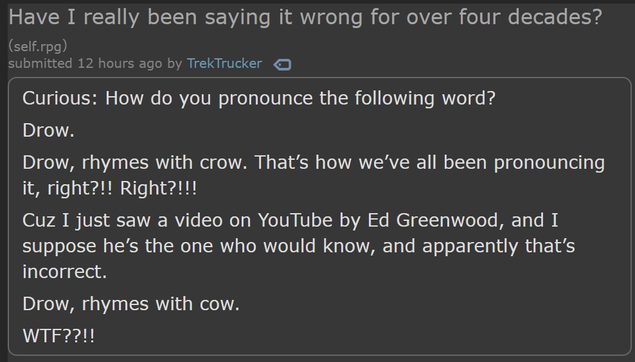
"Why BRP didn't became as popular as GURPS?"
*squints*
video got boosted into my eyes about how to write rpg adventures, and the topic was mostly centered around ease of ref use/reducing prep
the guy wants adventures you buy, pre-writtens, to be able to be skimmed in like 30 minutes and then immediately run at the table, no hiccups
notably he hates prep and his contention is that this is at least one metric of what makes a pre-written "good"
i disagree with this on a general level. this is only going to be possible with a narrow band of scenarios
and in fact he touches on this because while after saying this, he goes on to say that he likes/wants little ref asides like "we tried this at the table, in playtesting we found XYZ"
well yeah and that's not stuff you're gonna be able to pick up in most pre-writtens in just a 30 minute flip through
this is look-ahead stuff. stuff you need to... know ahead of time to run the stuff that comes before, properly. or at least, according to how the pre-written was structured
it's perfectly acceptable if your pre-written is just a constant forward moving, never backtracing, branching choose your own adventure structure
any kind of looping, clues based, hidden information, etc busts this apart instantly depending on what your players do
there's another issue which is playstyle
it's way easier to write, and imo run, adventures that are more sandboxy/open-ended like the way he describes
cyberpunk in particular tends to do this well: "this is the job, haggle over support/reward, here's the situation and setup, you figure it out, get back, get backstabbed, try and get paid"
it works because that's just a really common trope-y genre to run jobs in
it's a lot harder to do this if your system/setting suddenly has rigid rules about all sorts of things, from travel, tech level, MAGIC, order of who you talked to, places you visited or observed, etc
in fact this is a big problem in investigations i rarely see brought up because it's covered by other sort of bandaid "rule of thumb" advice: what happens if your clue is in a place players swept and missed"
and those two schools of thought are "just give it to them" or "move the clue"
i can't run a lot of good pre-writtens in the way this person wants
chariot of the gods is way too fucking intricate and interconnected to just glaze over for half an hour and wing it and that is a goddamn great scenario
the notion that you have to put in (seemingly any) work to get a pre-written to work shouldn't be so controversial
you can only really reach this level of winging it if you already know the material cold or the main thrust is very linear
and there's a third problem where pre-writtens have some awful sense of how people are going to be using their material
it is true that a lot of pre-writtens do not seem to have <running the game> in mind at all, which introduces structural problems, where you are not categorizing information in a way that is helpful to running the game but reading/understanding it
that's definitely a problem (hey i need the statblock here, fucking put it here wtf)
a lot of this seems to be that authors hate the idea of duplicate information, but if you want to reduce prep time for running your adventure, you do actually need to accomplish 1) helping the reader understand the flow and purpose of the game, but also 2) organizing that data in play sequence
this is also why core rulebooks get raked over the coals because picking just one or the other fucks the other camp over
anyway as a point of reference/additional context: i don't hate prep at all, i just don't really go all in on it when i run games for other people
but again that's a heavy style thing. when i do run pre-writtens they're after i ran them solo so i do know how it goes beyond a 30minute flip through
anyway, just to wank off traveller again because it's what i do: the mongoose traveller 760 patrons book has what i consider to be the most open ended/framework for scenario generation
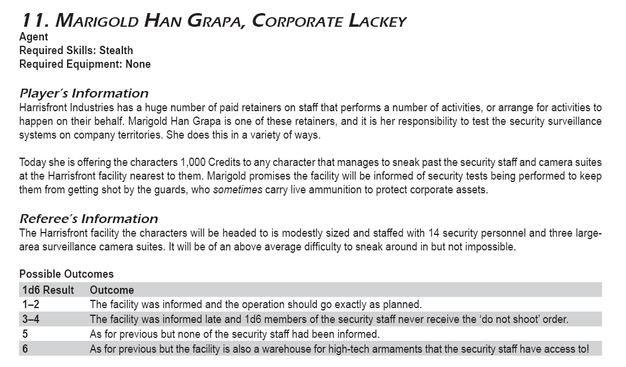
you take this, you slap some mook statblocks together (or 7s across the board, baybeeeeee) and you're done
takes you 5 minutes, tops
for the record this is traveller 2e, but you can do this with every rpg system, it's pretty agnostic
just follow the framework:
job giver npc
requirements
player info
ref into
outcomes/complications
that's also the actual order i use to think of these. you might thing ref info before player, but honestly i don't
player info and presentation is most important anyway, and you can make whatever wild shit you want up in the background. wilder the better, actually
you know how a lot of titles basically just use adjective noun to give you a fast impression of what that thing is?
you can use that in your game prep, too. adjective adjective noun to describe that main quest npc. bam, you're rollin'
dirty cheatin' varmint
unethical cowardly accountant
lowkey ex-specops ganger
fat orange cat
the sky's the limit
now i wish i didn't cancel my traveller campaign
too much to do tho
maybe in 2030...
"The only way to stop this flow of sand is to hurl a chakram into a specific slot hidden in the far wall."
alright xena calm your tits i found another way actually
one thing i've noticed about some ostensibly explicit sword & sorcery adventures is that they... are not good at getting into the genre mindset wrt plot hooks
"do the right thing" is not a plot hook for this genre, really
all you have to do is the literal dnd thing of offering monetary reward. that's it man
rat-god diseased claws fucked me right up, killed two of my pcs :|
got a cool sword tho