 Rxiv mechanobio
https://doi.org/doi:10.1007/s12551-026-01414-1
https://pubmed.ncbi.nlm.nih.gov/41909621/
#Dynamics #Myosin #Force
A song of heads and tails: myosin II conformational regulation and filament dynamics shape force generation in non-muscle cells - Biophysical Reviews
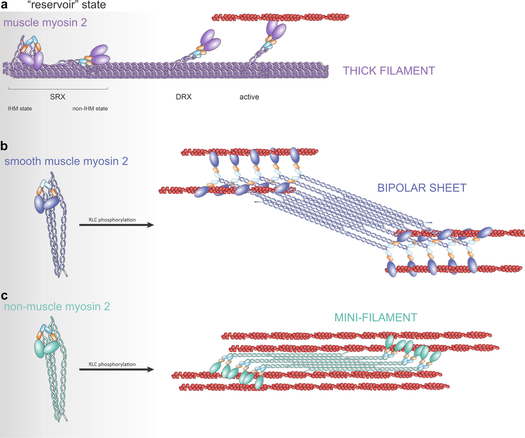
Non-muscle cells generate force without forming sarcomeres, building instead highly dynamic, contractile filaments that assemble, remodel, and disassemble in response to mechanical and biochemical signals. This review focuses on the conformational regulation and filament dynamics of myosin II paralogs as they define diverse types of cytoplasmic structures that produce mechanical forces. Whereas muscle myosin II stably resides in sarcomeres and conserve energy by adopting a super-relaxed state in which myosin II heads interact with each other and the core of the thick filament, smooth muscle and non-muscle myosin II shift between a soluble, folded, auto-inhibited 10S species and filaments, where they adopt an extended, assembly-competent 6S form. Phosphorylation of smooth muscle and non-muscle regulatory light chain triggers the conformational transition from 10S to 6S, leading to filament formation and contractile output. Other phosphorylations in the regulatory light and heavy chains also control filament assembly and dynamics through different molecular mechanisms. Biochemical and mechanical inputs fine-tune filament size, lifetime, and duty ratio, shaping contractile output across diverse cellular contexts. Upstream regulators, including biochemical and mechanical inputs, converge on several pathways, e.g., Ca2+/MLCK and RhoA/ROCK, organizing myosin II activity in space and time and enabling the emergence of stress fibers, junctional belts, cortical networks, and contractile rings that support adhesion, migration, cytokinesis, and tissue-level mechanics.