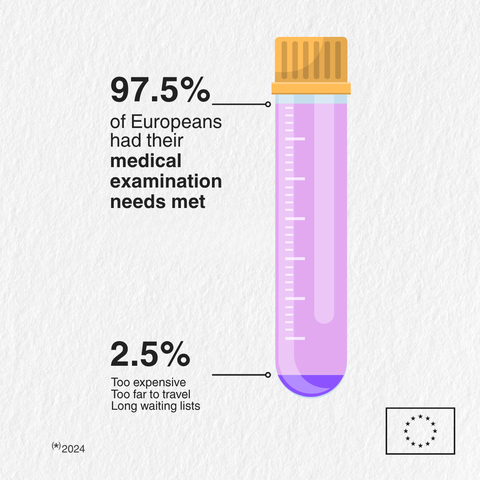
In the EU, healthcare is a public service, not a consumer product.  
  
Our latest report shows how Europeans can benefit from it: 
  
šŸ’¶The average annual healthcare spend per person is €870 
šŸ„68.4% rate their health as ā€˜very good’ or ā€˜good’ 
   
Full report āž”ļø https://link.europa.eu/WHxcQM
@EUCommission €870 may be a bit optimistic, but I gladly pay my medical insurance of around €1800

@pdebruin

thats cheap! even the lowest earning Germans pay more, slightly ok earning Germans pay 11000 - but a billionaire pays the same as someone earning 5000/month - the most unfair part of the whole social system.

but the EU and her very competent president don’t work for normal people… they work for those who can afford lobbying them

@EUCommission

@lazyb0y @pdebruin @EUCommission
Well the core principal of insurance is that you are billed based on how likely you are to need the service.
When we treat everyone equally without discriminating, your insurance bill would only fluctuate based on how likely you are to be sick or injured, and not based on what you have, where you're from or how you look like.
For basic insurance plans, a billionaire is not more likely to be sick than an average corpo worker, so why should he/she be charged more?
@mttn @lazyb0y @pdebruin @EUCommission Your argument treats insurance as a pure risk-based product, but in the EU it isn’t. Healthcare systems are built on solidarity, not just probability. Contributions scale with income because everyone benefits from a stable, healthy society. Wealth isn’t created in isolation, it depends on public infrastructure and social systems. Paying more isn’t about risk, but about fair contribution.
@tdr @lazyb0y @pdebruin @EUCommission
Sure but how can it be called "fair" when you bill someone 2000% more for using the service the same amount?
To me that's just discriminatory.
But I've replied to the comment of another person in the same feed, about I think the EU should go about billing billionaires more. (In a way that makes sense to me)
@mttn @lazyb0y @pdebruin @EUCommission It’s not discrimination, because the system isn’t pricing a service, it’s funding a public good. In solidarity-based healthcare, contributions reflect ability to pay, not usage. ā€œFairā€ here means everyone can access care without hardship. Higher earners pay more because they benefit more from the stable, healthy society that makes their income possible.
@tdr @lazyb0y @pdebruin @EUCommission
Well I guess it isn't a service in the EU, that's true, it's a little hard for me to comprehend because I'm used to how it works in Switzerland where it is service based but with price caps and structures to protect consumers.
@mttn @lazyb0y @pdebruin @EUCommission Switzerland is more premium based, yes, but still not a pure market system in terms of just a buyable service. Insurance is mandatory, benefits are regulated, and lower incomes are subsidized. In most of the EU, healthcare is even more clearly a public good. Fairness does not mean everyone pays the same for the same use, but that everyone can access care, funded according to ability to pay.
@tdr @lazyb0y @pdebruin @EUCommission
Sure, but it is definitely more service based than you think in Switzerland, you have the base insurance plan which has price caps and tries to make it more accessible, but in practice almost everyone just goes through it as a service and there are many things that are not included like the dentist.
You don't just go to the hospital and leave without paying anything like many people think is the image of European healthcare.
@mttn @lazyb0y @pdebruin @EUCommission I know the Swiss system well, I lived there for years and even kept German coverage because some basics like dental prevention were missing. A healthier population reduces overall costs and supports a stronger workforce and economy. And even in Germany you do not just walk out without paying, there are co payments. The key difference is still solidarity, not pure service logic.
@mttn @lazyb0y @pdebruin @EUCommission There is a reason why Prussia introduced public health insurance, to maintain a healthy workforce and ensure social stability, not just to provide a market service.
@tdr @lazyb0y @pdebruin @EUCommission
I know (and you saw with the other person that joined the discussion) that I'll be called a troll, a bot and whatnot for saying the following but I like the Swiss system, I grew up used to it always working and making sense for me. I feel like it's a good balance between private services but while protecting citizens.
I wouldn't trade it for anything else.
It's perfectly fine for others to have a different opinion but that is my (real) human opinion
@mttn @lazyb0y @pdebruin @EUCommission Fair enough, your experience is valid. But the European model is not built around ā€žit works for meā€, it is about ensuring access and stability for everyone, including those with less means. That is exactly where purely market driven logic tends to fail. The goal is not individual optimization, but collective resilience and long term social stability.