
Despite their similar meaning and appearance, the verbs ‘to search’ and ‘to seek’ don’t have any etymological relationship whatsoever.

‘To seek’ comes straight from the Proto-Germanic ancestor of English, while ‘to search’ was borrowed from a French word related to ‘circle’. Searching is going around looking for something.

Click my new infographic to learn all about these word families.

‘To seek’ has the highly irregular past tense ‘sought’. Why does the k become a silent gh? And why ... 1/
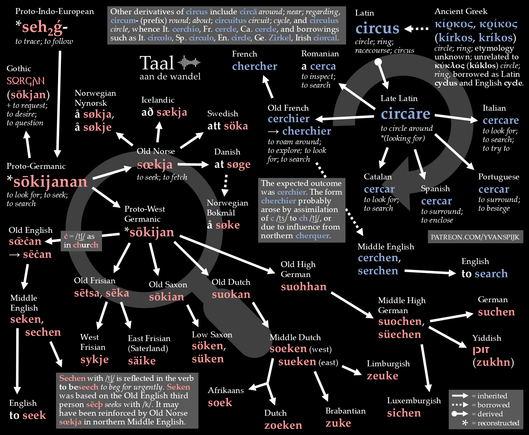

2/ ... does it have ou instead of ee?

In the extra long article on my Patreon (1300 words, tier 1), you’ll learn that this irregular past tense started out perfectly regular but became irregular due to regular sound changes.

You’ll also discover that what happened with ‘to seek ~ sought’ is connected to the irregularities of verbs such as ‘to teach ~ taught’, ‘to think ~ thought’ and ‘to buy ~ bought’.

https://www.patreon.com/posts/to-seek-to-154163511

@yvanspijk What's even more surprising to me is that "cycle" and "circle" are completely unrelated
@yvanspijk Is the word ’to scan’ related? I guess not?
@tml Indeed, 'to scan' comes from Latin 'scandere' (to climb; to scan the meter of poetry), from Proto-Indo-European *skend-.

Fun fact: To visit a circus in German is "einen Zirkus besuchen".

Circare and sokijan in one sentence ☺️

#fun with #linguistics