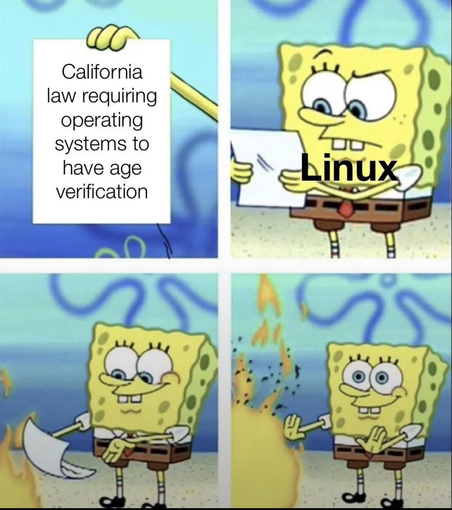
@cmconseils Seriously, so much what even the F...

I'm not convinced that it's even legal for them to have such a law. It probably violates privacy laws or something. Even as limited as our privacy rights are, still, this has to be too much...

And what's with the rush by systemd to comply in advance? And wow, so much is built around systemd it's kind of frightening to find out how hard it is to divest from it. If/until distros do, Linux has NOT rejected this!

My bet is most things will decide this is "too small" to fight and comply. Then the next "small" thing will be some sort of verification — probably online. Then IDs... I know I'm running dangerously afoul of a "slippery slope" argument, but this is literally the recent history of such movements in tech...

Sorry for the rant

@cmconseils @nazokiyoubinbou

SystemD isn't a integral part of Linux as far as I know, but an optional manager most distro's choose to use.

There are quite a few distro's actively shying away from SystemD.

@sarah @cmconseils I'm confused why whenever I say that most distros are built around it people always correct me like that...

I'm not saying all distros.

But one thing I am saying is that a whole lot of stuff is designed assuming you're using it. Especially, as in the example above, userland services. Take, for example, pipewire-pulse. If you install it on an init-based distro such as Devuan it's not going to be running. You're going to have to do some legwork to have sound again in a modern DE.

A few are doing their own fixes here and there. For example, MX Linux has a manual run script and a .desktop in the autostart to run it and this works, but most things don't have this. A lot of packages won't.

Worse, some distro packages require systemd to even install...

@sarah @cmconseils So, to be clear, while Linux can exist without systemd, it's also going to mean a lot of work for a lot of distros to divest from it. It may not be required but it sure is deeply embedded in Linux as a whole.

And most probably won't bother.