 Don Marti
there has to be a meme template for "Mozilla on the Fediverse" vs. "Mozilla on LinkedIn" but I can't think of one
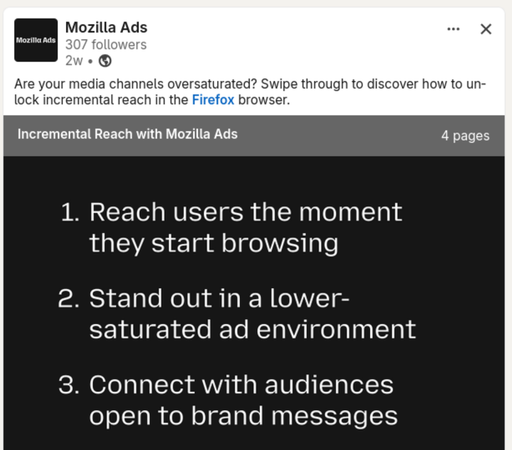
@CppGuy But the ad agencies don't know that. As far as I can tell, there is very little Firefox usage in the advertising business so the ad people get their info from high-production-values sessions by Mozilla at advertising events.
Firefox users as sold to advertising decision-makers are like the old "open source community" from the 90s—a mythical set of people who love to help out big corporations with no benefit to themselves
@huronbikes Computer Shopper was a thing—if the advertising medium is designed to be a credible signal of the advertiser's intents in a market and assessment of their own product, people do pay attention (my entrance to a very deep behavioral economics research rabbit hole was: why does the same person run a web ad blocker and also pay for Computer Shopper?)
https://en.wikipedia.org/wiki/Computer_Shopper_(American_magazine)
@nblr They already know that ad blocker usage "has a positive impact on user engagement with the Web" -- but afaik haven't done a similar study for the built-in Firefox ads. https://research.mozilla.org/files/2018/04/The-Effect-of-Ad-Blocking-on-User-Engagement-with-the-Web.pdf
(The company to watch in this situation will be IBM (Red Hat). They need a browser for RHEL, but won't want to impose the costs and risks of in-browser ads and slop on corporate customers—IBM has its own "AI" to sell)
@vonxylofon @nblr It pre-dates any particular hire, though. Every so often, Mozilla goes on an ads-in-the-browser kick, then pulls back, and tries again.
This time they're doing "programmatic" ads in "partnership" with a conventional adtech firm, which is pushing the boundary a little more https://www.adweek.com/media/mozilla-index-exchange-first-programmatic-partner/
 Jason Parker (he/they)
 C++ Wage Slave
 tyzbit
 Andrew Golding
 soup
soup

 ~n
~n Von Xylofon