EVs are made with metals smelted with ~2 tonnes of coal, making about 4 tonnes of CO2. The coal is transported with diesel derived from oil. Which is extracted with steel. Which is made with coal.

EVs use fewer resources over their lifetime than infernal-combustion. So that’s good, assuming all the oil products they rely upon throughout their lifetime (e.g. bitumen) continue to flow.

But we’re probably past peak diesel. Perhaps we can examine our predicament more fully?

#climateDiary #iran

@urlyman it irks me when people claim EVs are green. Getting rid of a slightly used ICE powered car for an EV is far from green. Buying an EV is not green. EVs use rarer metals and toxins to process them. My 20 year old diesel to do less than 1000 miles per annum is far less polluting.

@EF @urlyman And this is THE greatest urban legend out there for the past decade: "My ICE car is less polluting than an EV".

No, no it is not! Especially when you count in the whole supply chain behind your ICE engine... No even close!

And lets not forget the fact how dependant you ICE engine makes you - and you whole economy - on the external powers, who can then manipulate you into you dancing how they sing... 😏

@theron29 @EF

I’m not much interested in pronouncing on absolutes.

An ICE car that does less than 1,000 miles at, say, 30 miles a gallon, is consuming about 1 barrel of gasoline a year and that’s bad but better than 5 barrels.

But an EV that runs on electricity generated by gas or coal is differently bad. And if that probably heavier EV is doing 10,000 miles per year then its very much worse tyre pollution is not nothing.

We need to engage with complex reality: https://mastodon.social/@urlyman/116306338040203602

@urlyman @EF Although your argument is very valid, it makes actually no sense to blame EVs for not being "eco" enough because of your countrie's anti-eco energy mix. 🤨 Especially with this changing heavily.

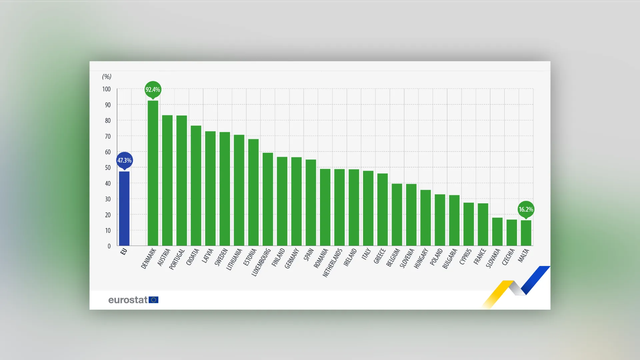
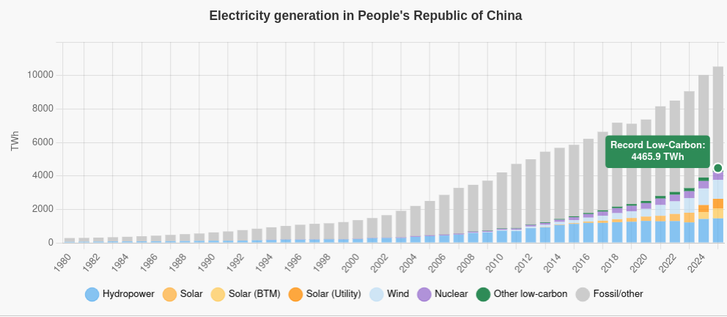
So this issue is progressively getting better everywhere. E.g. in EU almost 50% of all electricity got generated from renewable sources, with this number going up every year. And even e.g. China sees very similar renewable growth, going almost 50% renewable now and growing for the future.

@theron29 @EF

The evidence so far strongly points to renewables (which are rebuildables) being additive. That said, obviously a massive super-organism like the global economy is going to take a long time to make a phase shift.

But there’s no escaping that our economics effectively ignores that the recent price of renewables is a function of China having emitted > 240 GT of GHGs to build out the infrastructure that makes it ‘cheap’. The actual cost of that is extraordinarily high…

@theron29 @EF

…I don’t know that things are “getting better”. They might be. But emissions keep going up and biodiversity and soil health keeps being stripped away. And that is waaaay worse than our culture can metabolise. It is effectively disinterested.

I am not anti-electrification. I am not anti-renewables.

I would prefer we see such undertakings for what they probably are

https://mastodon.social/@urlyman/116306475528852817

@urlyman @EF That is some good quality info, thank you. Yes, technology is not free...

And now, when you presented A, why not also presenting B?

How many GT of GHGs would we have to emmit in order to generate the same amount of energy using old fossil technologies?

@theron29 @EF

Thanks. Sorry, sidestepping your question with…

The cost of emitting 240+ GT tonnes of GHGs is staggeringly high. Pretty sure we’ll be able to see in the rear view mirror just how exorbitantly expensive it is even though we can’t now. And our mindset is heavily tinted by what we can see now.

As a very rough proxy, see https://mastodon.social/@urlyman/116271621503375244 which would suggest that the monetary cost might be $240 trillion but that’s not on any balance sheet and is probably too low anyway…

@theron29 @EF

…but also, for the first 17 years of China’s massive economic growth years, any notion of environmental concern wasn’t explicitly on their roadmap. They were just building out the dirtiest of industrial infrastructure for the sake of mandated GDP growth.

It was only from 2007 that they pivoted and thus began to realise that all that dirty infrastructure could *carry on being used in the dirtiest of manners* to produce something notionally ‘clean’

https://mastodon.social/@urlyman/115696539632926605