
CERN uses tiny AI models burned into silicon for real-time LHC data filtering

https://theopenreader.org/Journalism:CERN_Uses_Tiny_AI_Models_Burned_into_Silicon_for_Real-Time_LHC_Data_Filtering

CERN Uses Tiny AI Models Burned into Silicon for Real-Time LHC Data Filtering

CERN has developed ultra-small AI models embedded directly into custom chips to filter massive data streams from the Large Hadron Collider in real time, addressing the enormous data challenge of the world’s most powerful particle accelerator.

TheOpenReader

Might be related:
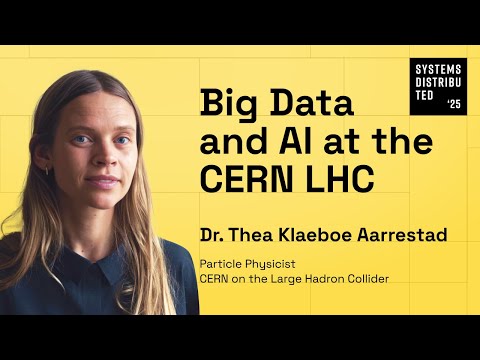
https://www.youtube.com/watch?v=T8HT_XBGQUI (Big Data and AI at the CERN LHC by Dr. Thea Klaeboe Aarrestad)

https://www.youtube.com/watch?v=8IZwhbsjhvE (From Zettabytes to a Few Precious Events: Nanosecond AI at the Large Hadron Collider by Thea Aarrestad)

Page: https://www.scylladb.com/tech-talk/from-zettabytes-to-a-few-...

Big Data and AI at the CERN LHC by Dr. Thea Klaeboe Aarrestad

YouTube
A bit of hype in the AI wording here. This could be called a chip with hardcoded logic obtained with machine learning
Is a LLM logic in weights derived from machine learning?
Well, yes. That's literally what it is.
What what is? The article has nothing to do with LLMs. It even explicitly says they don’t use LLMs.

> Is a LLM logic in weights derived from machine learning?

I was just answering this question. LLM logic in weights is fundamentally from machine learning, so yes. Wasn't really saying anything about the article.

Good one… but Is a DB query filter AI? I forgot to say though is sounds like a really cool thing to do
Strictly speaking, expert systems are AI as well, as in, an expert comes up with a bunch of if/else rules. So yes technically speaking even if they didn’t acquire the weights using ML and hand-coded them, it could still be called AI.

It is 100% valid to label an algorithm that plays tic-tac-toe as "AI"

Much of the early AI research was spent on developing various algorithms that could play board games.

Didn't even need computers, one early AI was MENACE [1], a set of 304 matchboxes which could learn how to play noughts and crosses.

[1] https://en.wikipedia.org/wiki/Matchbox_Educable_Noughts_and_...

Matchbox Educable Noughts and Crosses Engine - Wikipedia

Yup this is exactly my point, in the 80s there were plenty of “AI” companies and “fuzzy logic” was the buzzword of the day.
AI is not a new thing, and machine learned logic definitely counts as AI.
For those that have experience with ML, yes. For those that have recently become acquainted with it (more on business side) they seem to really struggle with this in my experience. '
Yeah, and don’t forget Eliza!

They used a custom neural net with autoencoders, which contain convolutional layers. They trained it on previous experiment data.

https://arxiv.org/html/2411.19506v1

Why is it so hard to elaborate what AI algorithm / technique they integrate? Would have made this article much better

Real-time Anomaly Detection at the L1 Trigger of CMS Experiment

I'm half expecting to see "AI model" appearing as stand-in for "linear regression" at this point in the cycle.
I'm sure I've seen basic hill climbing (and other optimisation algorithms) described as AI, and then used evidence of AI solving real-world science/engineering problems.

Historically this was very much in the field of AI, which is such a massive field that saying something uses AI is about as useful as saying it uses mathematics. Since the term was first coined it's been constantly misused to refer to much more specific things.

From around when the term was first coined: "artificial intelligence research is concerned with constructing machines (usually programs for general-purpose computers) which exhibit behavior such that, if it were observed in human activity, we would deign to label the behavior 'intelligent.'" [1]

[1]: https://doi.org/10.1109/TIT.1963.1057864

That definition moves the goalposts almost by definition, people only stopped thinking that chess demonstrated intelligence when computers started doing it.
The term artificial intelligence has always been just a buzzword designed to sell whatever it needed to. IMHO, it has no meaningful value outside of a good marketing term. John McCarthy is usually the person who is given credit for coming up with the name and he has admitted in interviews that it was just to get eyeballs for funding.

> I'm half expecting to see "AI model" appearing as stand-in for "linear regression" at this point in the cycle.

Already the case with consulting companies, have seen it myself

I'm half expecting to see "AI model" appearing as stand-in for "if > 0" at this point in the cycle.
This is why I am programming now in Ocaml, files themselves are AI ( ml ).
I am sure you did not forget that pattern matching.
Having work with people who do that, I can guarantee that’s not the case.
See https://ssummers.web.cern.ch/conifer/ and HSL4ML, these run BDT and CNN
API Reference — conifer 1.8 documentation

That works well to get around patents btw :)
Because if it’s not an LLM it’s not good for the current hype cycle. Calling everything AI makes the line go up.
LLMs also make the cynicism go up among the HN crowd.
It seems like most of the implementation is FPGA, which I wouldn’t call “physically burned into silicon.” That’s quite a stretch of language
How are FPGAs "bruned into silicon"? Would be news to me that there are ASICs being taped out at CERN
Could they.... have someone else do it for them?

CERN in fact does design custom ASICs for other things: https://indico.cern.ch/event/1115079/contributions/4693643/a...

(Probably not for this here though.)

CERN has been doing HEP experiments for decades. What did it use before the current incarnation of AI? The AI label seems to be more marketing and superficial than substantial. It’s a bit sad that a place like CERN feels the need to make it public that it is on the bandwagon.
It doesn't say LLM anywhere.
Good catch. Corrected. Thanks!