 measurablefunc
Slovenia becomes first EU country to introduce fuel rationing

Yeah as if Europe doesn't have Oil it isn't exploiting because of renewable legislation..
Europe simply does not have enough known oil reserves to put a dent in current prices even if it exploited them all.
There may still be good arguments to do so anyway, such as it being less carbon intensive than importing oil, but there is absolutely no magic lever we can pull that would fix this problem that we're just not pulling due to renewables legislation.
Sure just send the continental german army straight for the oil fields, worked out great last time.
Britain could start extracting oil from its European fields instead of just buying the same oil and gas from Denmark. Sanctions could be lifted on Russian oil. Duties could be dropped. There are levers.
Hasn't Germany and the UK been investing in renewables for years now? They must be feeling pretty happy about that decision right now unlike oil obsessed countries like the US.
For electricity generation, the UK is currently generating 50% via renewables. It goes up and down each day of course, storage is not a solved problem yet.
Nice visualisations of the current status:
https://grid.iamkate.com/
Electricity is only a part of the whole energy sector, but it's relevant to this thread about EVs.

Yes, but it is not enough. It helps a lot when sunny, and weekend mid-day gross market prices for electricity hover just above zero, but there's not enough batteries, flexibility, and other renewables to avoid price spikes in the morning and evening peak, when hydro and gas plants are still covering a lot.
Partly, though both have had periods of right wing governments trying to make this problem worse to benefit their oil and gas industry backers.
And now the same people are saying that the answer is more oil and gas.
A quarter of a century ago, the first quarter of 2001, Britain used 39 TWh of coal electrical generation, 36 TWh of gas and 21 TWh of nuclear.
Today we're lot more energy efficient†, and the renewables made more than 25 TWh, but nuclear is now less than 10 TWh, we of course no longer burn coal, which leaves 30 TWh of gas still and we have a lot more imports (because we have a lot more interconnect, which is also a form of energy security)
† For example back then we mostly used incandescent light bulbs! And a lot of people still used CRT televisions back then!
BYD EVs are affordable. Electricity will get cheaper with more renewables, oil will not.
Define affordable. A €40k Seal is anything but affordable. Eastern Europe (and I don't put Slovenia in this case here, they are much closer to Western Europe in every sense) will not mass change to EVs suddenly when everyone is shopping for 10 years old diesels from Western Europe for maximum €10k
> Define affordable.
Cheaper than the total cost of ownership of a combustion vehicle at $150-$200/barrel for prolonged periods of time.
Are We Approaching an Unprecedented Energy Crisis? - https://thedispatch.com/newsletter/dispatch-energy/iran-war-... - March 26th, 2026
France confirms oil crisis, says 30-40 percent of Gulf energy infrastructure destroyed - https://www.france24.com/en/france-confirms-oil-crisis-says-... - March 25th, 2026
Even the best-case scenario for energy markets is disastrous - https://www.economist.com/finance-and-economics/2026/03/22/e... | https://archive.today/5OhRI - March 22nd, 2026

New cars have questionable affordability for most people. Particularly when you factor in dubious design choices and expensive marketing. Cars and driving are expensive. If that was a barrier there wouldn't be many people on the road.
Also, the Electric polo is supposed to be released at around 25k Euros. Given the lower running costs that seems like a good deal relative to legacy designs. For all those people will to spend 40k on a car you could put the money into solar panels instead.
If you think the Seal isn't affordable then don't buy one.
You can buy a brand new Dacia Spring for only £12,240. Personally I don't think it's a great car but it's certainly doesn't cost 40K.
If it were my money I'd spend a bit more on either a used Jag ePace or a Renault 5 but some people prefer new cars I guess.
Europe would be better served by doing, what France did in 1974.
"As a direct result of the 1973 oil crisis, on 6 March 1974 Prime Minister Pierre Messmer announced what became known as the 'Messmer Plan', a hugely ambitious nuclear power program aimed at generating most of France's electricity from nuclear power. At the time of the oil crisis most of France's electricity came from foreign oil. "
"Work on the first three plants, at Tricastin, Gravelines, and Dampierre, started the same year and France installed 56 reactors over the next 15 years."
https://en.wikipedia.org/wiki/Nuclear_power_in_France#Messme...
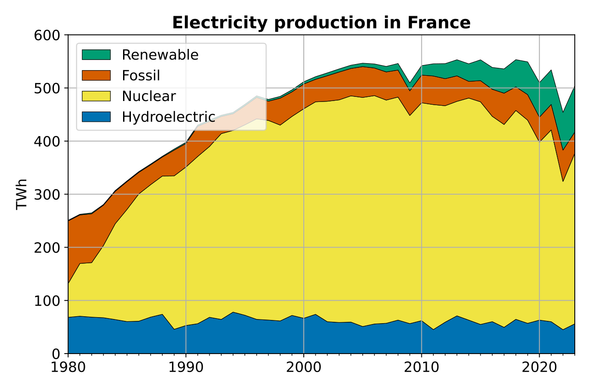
The way the EU forces the electricity market to operate makes them completely unprofitable. Renewables are always given priority in the market, which results in other power plants operating at a capacity factor of 30-40%. Since nuclear power plants are mostly capital expenditure-intensive, this makes the electricity they produce absurdly expensive.
Because the way how the EU electricity market operates first to supply electric power are the power plants with the lowest operating costs. This are usually renewables and nuclear power plants. Both are capital expensive and cheap in operating costs.
Usually the capacity factor of European nuclear reactors is higher than 60%.
olkiluoto-3 nuclear reactor, had capacity factor 70% in the year 2024:
https://world-nuclear.org/nuclear-reactor-database/details/o...
Mochovce-3 had capacity factor 74% in the year 2024:
https://world-nuclear.org/nuclear-reactor-database/details/M...
In the U.S. they really try to get maximum from nuclear reactors.
https://world-nuclear.org/nuclear-reactor-database/details/W...
Sounds like a good plan unless we've invented 2 much cheaper and faster to deploy methods to generate electricity.
You probably mean 3 much cheaper and faster to deploy methods to generate electricity. In Germany, Poland, Balkans it's solar, wind, coal.
Coal is generally more expensive than nuclear if you factor in health and carbon, which you should.
> Europe would be better served by doing, what France did in 1974.
This is 2026. Doing things in 1974 isn't an option because time's arrow points the wrong way.
If you want Europe to do things now that it should have done in 1974 you'd need to explain how it'll stall on all the consequences for years. France, which you held up as a model says it can build a nuclear generator in about 5-6 years, but none of these optimistic projections came true this century, more typically the plant takes 10-15 years and it can be more.
So, suppose they start today likely they'll say the generator goes online in 2032. How does that help with the crisis Trump caused this month ? Worse, come 2032 the date is likely to be 2040 instead.
Now, renewables go a lot faster. For solar it's genuinely possible to get paperwork done in January and be selling electricity made with those panels by summer. It's not easy, plenty of projects will be delayed out a 1-2 years, particularly if local government don't want the project, but with a following wind it can really be the same year. Wind is slower, but still you will almost certainly build it and switch it on in five years, the optimistic guess France never hits for its nuclear plants.
So... why is fuel 25% cheaper in Slovenia than in the neighbouring country while Solvenia is simultaneously having issues with running out of fuel?
Seems like the obvious solution is to raise prices so people stop driving to your country (wasting fuel, ironically) to take your cheap fuel instead of just paying for the fuel in their own country. More than that it's a solution the free market would actually find on its own...
There was an election recently and it’s possible there will soon be another… That’s why the fuel is so cheap.
It's not a free market. Off-highway prices are regulated and were adjusted by the executive govt branch on biweekly basis, now switched to weekly. Slovenia is small and "gas tourism" is common since fossil juices in neighboring countries are priced higher.
Why not raise the prices? Sure, but then don't complain about the inflation, revolt, and stoning of elected representatives.
Price increases tend to be regressive—the poor person who needs a little fuel to get to their job is hurt more than the large business that uses a lot more fuel but has much, much more money overall.
There are things you can do to try and even things out. Etherium has been considering “quadratic voting” to solve a similar problem (in this case, that would look like tracking consumption and increasing the unit price of fuel as you consume more fuel, so that cost goes up quadratically with consumption). That seems hard to enforce, though, and doesn’t help with foreign opportunists.
Scanning some of the early comments here, and acting as-if the oil and LNG disruptions is just a question of renewable investment is naive.
This is the worst energy crisis in modern history, and little of the western world has really started feeling the effects yet:
https://thedispatch.com/newsletter/dispatch-energy/iran-war-...
Petro is pretty much upstream of everything: plastics, fertilizers, pharmaceuticals, cooking oils, lubricants, cosmetics. Dow chemical just doubled the cost of polyethylene as of April 1st. Taiwan relies on LNG for 40% of its energy production and has 11 days of LNG storage--meaning it may have to consider limiting industrial electricity use if things persist. I will clarify based on a reply, this doesn't mean they'll run out in that time, but that they have limited runway that will have deleterious effects as time goes on:
> Yeh Tsung-kuang, a professor in the Department of Engineering and System Science at National Tsing Hua University, said Taiwan's maximum LNG inventory is only 11 days but that does not mean the island will run out of fuel or face outages within that time period.
Even if the Strait saw normal traffic today (and Iran is incentivized and well-positioned to keep it closed for a while), it would take quite a while to recover lost supply. Iran continues to employ a tit-for-tat strategy and Israel just targeted steel industry in the country -- I'm not even taking into account more deliberate damage to energy infrastructure in the Mid east.
This is a scary crisis wherein the most movable actor (the US) is not going to accept Iran's terms. It could collapse the global economy, and that crucially includes the AI industry this forum loves to focus on almost exclusively. The US and the majority of the west has essentially no fiscal room compared to the comparably lesser 1970s crises either. This could easily spiral out of control and cause a level of suffering across the world (esp the global south) most of us on this forum have not lived to see.
Before calling it "the worst", I'd like more detail on how to do the comparison with the oil crises of the 1970's. My guess is that modern economies might be somewhat less oil-dependent than they were then, because the alternatives are more developed.
They are more developed, sure, and the US (from a US centric view) is producing a lot of oil now. However, consider that pretty much all of the goods you see in the supermarket got there via diesel (trains, semi-trucks). The percentage of semi-trucks operating on electricity is still miniscule at this point. Air transport? All petroleum. Consider also other things like fertilizers - we're heavily dependent on nitrogen fertilizers derived from petroleum and planting season in the northern hemisphere is starting right about now. Yes we're producing a lot more electricity with renewables, but demand is also up.
Oil going through Hormuz is 20%, not 80% of global supply. It's true that demand is pretty inelastic, but it's not like it can't be cut at all.
Who mentioned 80%?
During the 1973–74 Arab oil embargo, the disruption removed approximately 4.5 million barrels per day (mb/d) from the market, which constituted about
7% of the global oil supply at the time. This disruption significantly impacted global supplies.
20% is a lot more than 7%. This could be worse than 1973-74.
As a 10year-old in 1973 I remember spending a lot of time in the backseat of the station wagon as we were waiting line line for gas.
For context, during the first COVID spring (March-June 2020) oil demand fell by 20%. Because nobody was driving or flying anywhere. That's what it took to cut 20%.
[flagged]
Yeah, and that's why gas prices in the US have not changed at all in the past month!
> Taiwan relies on LNG for 40% of its energy production and has like 10 days of fuel left--semis are implicated.
The "10 days left" thing seems to be a hoax(?)
https://www.msn.com/en-us/politics/international-relations/m...
https://www.malaymail.com/news/world/2026/03/26/is-taiwan-ru...
Oh I'm sorry, that was actually my mistake, I should have been much more specific, and I will update the comment if I still can. My intention was to emphasize that Taiwan may have to start limiting electricity to its industrial sector based on its current runway. Per the article you listed:
> Yeh Tsung-kuang, a professor in the Department of Engineering and System Science at National Tsing Hua University, said Taiwan's maximum LNG inventory is only 11 days but that does not mean the island will run out of fuel or face outages within that time period
EDIT: updated comment to be more specific.
> Yeh Tsung-kuang, a professor in the Department of Engineering and System Science at National Tsing Hua University, said Taiwan's maximum LNG inventory is only 11 days but that does not mean the island will run out of fuel or face outages within that time period
So he's saying they've got an 11 day supply and that they won't face any shortages during that 11 days... but what about after 11 days? I guess I'm not sure how that's different, how it's a hoax?
11 days of supply in the system. If they can afford it they can add to that with new shipments. It is not like Taiwan is blockaded. Just that global supply from single region is limited.
This might be lot bigger issue if China managed blockaded Taiwan during an invasion. Or destroy port facilities sufficiently.
Not blockaded, sure, but how long would it take for these new shipments to arrive? If these are shipments they hope can come through the SoH even if they got through tomorrow it would take ~10 days to arrive in Taiwan. They can also get LNG from Australia, but a typhoon has shut down some of Australia's LNG terminals today.
I have 30 days of food in my house and I have maintained that since probably 2021. It doesn't mean I will run out in 30 days, since I can still buy food although at higher prices lately. I personally never let it dip below 20 probably.
> Petro is pretty much upstream of everything: plastics, fertilizers, pharmaceuticals, cooking oils,
Really! What petroleum-based oil do you cook with?
Plant-based ones that were harvested by machines that burn petroleum.
That’s a pretty amazing definition of upstream. I imagine you probably understand that plastics, pharmaceuticals, and fertilizers are made out of petroleum derivatives, right?
Since you seem pretty smart: are there petroleum based cooking oils?
The machinery to make them, the fertilisers to grow them, the plastic to package them, the transport to deliver them. It ain’t just cooking oils that will be massively impacted. The entire food chain in the western world is reliant on petrochemicals. The only question is the lag between now and when those impacts start being felt and this translates into bumped prices and/or shortages.
EDIT: corrected an autocorrection.
Here's my definition of upstream: If the petroleum stops, the cooking oil stops, even though the cooking oil is 100% plant-based.
Given that what we're talking about is disruptions caused by a shortage of petroleum, is there any other definition of "upstream" that is meaningful for the conversation?
Just Stop Oil got their wish! Now everyone else gets to suffer the effects.
Could you be any more bad faith?
50L/day - with no other limits - sounds like a lot. Are there really fuel tourists coming in en masse and taking more than this? With zero tracking of enforcement whatsoever, people will just hit up a few different nearby gas stations instead of one anyways and that's it.
Hey man,sometimes you just have to drive 400 miles a day, everyday.
That we me today, Thursday, Monday and last Friday though I suppose a couple of them were "only" 300 miles. I'm not normal though.
And if I gave a crap about western white collar standards for acceptable vehicle loading I'd have had to do it all twice or take a vehicle that uses twice the fuel lol.
Well if you have regulated fuel prices, and free trade and travel with neighboring countries (the whole point of the EU), you're gonna see arbitrage if those countries aren't regulating fuel prices.
Options are to either un-regulate the prices, or ration the fuel sales.