I don’t want to describe what I want to a computer in plain English. I want to express it in a formalised language more akin to mathematics than prose. Unambiguous. Logical. Deterministic.

Even if describing it in English worked perfectly, and had no other downsides, I’d still hate it. Because I wouldn’t be making it, I’d be product managing it, & I *never* wanted to be a PM.

The whole point was to directly make things. To feel the digital clay in my hands. Being a supervisor is not enough.

Some people say it’s just like moving from assembly to a higher level language, like the LLM is a compiler. But it’s absolutely not - compilers are still formal language and completely deterministic: you can trust them to produce a known output for a given input, every single time. With such a guarantee, it truly is just an abstraction, a productivity tool with directly analogous characteristics to the thing it is building on top of. You’re still in control, every action has a traceable outcome
LLMs are deliberately non-deterministic. So in that regard they are more like humans I suppose; semi-random and in need of coaxing. If you like a supervising role in conditions like that I guess you’re fine, but I don’t. I like to make things with tools that do exactly what I say, every time, like clockwork. Even if it takes longer than asking someone / something else to do it for me. Because the making was the point.
I guess the signs have been there for years that I was done with the “industry” part of tech, or it was done with me. It’s been pivoting to things I don’t like for a while: web tech for everything, dependence on big cloud services, gobs of micro dependencies hand-waved through with automation. Even desktop apps have succumbed to it. Gamedev has been a my bolt hole, a niche that still works how I like. I guess I’ve been hiding here from the truth of where the broader tech industry has been headed
Ah well, I started out as a hobbyist - my first 7-8 years out of school I did other jobs and wrote code in my spare time. I guess I will leave the workplace as sort of a hobbyist as well. I’m lucky that I’m older, and eking out a living until retirement is doable, if unglamorous. It’s not a fancy lifestyle but I’m very lucky I can do that. Ultimately I’d rather use my finite remaining time down this path than others. And who knows, maybe the game will sell enough to pay wages one day. Ha

@sinbad you’re right, it’s not really programming anymore. It’s not as hand crafted.

Of course it depends on whether you enjoy programming or making your vision come true.

If I understand it correctly you’re proud of doing everything yourself and LLMs are diluting that.. so you choose not to use them.

For me, the programming part has become tedious a long time ago.

I have an idea and I want to realize it. LLMs give me more agency in that regard by making larger projects viable.

@sinbad

There are other downsides as well:

- it’s hard to get into “flow” if you’re just supervising.

- it’s easy to create slop

- it’s more fatiguing because the execution part is automated but delayed

- it’s much easier to burn yourself out

- it’s much easier to delude yourself as to quality and actual achievement

@frankreiff yeah it sounds *exactly* like product management. It’s not for me; I don’t necessarily love the typing of code, but I enjoy the general hands-on craft of it, the teasing out of the problem space in close conversation with the implementation, the tight feedback loop of action and result. I hated being a manager because being at arms length from the solution and operating on it second-hand is frustrating to me. I like getting to the end result too but jumping to the end loses too much
@sinbad It isn't, and they're trying to kid themselves that it is a form of programming, no really it is, you just have to squint a bit and hold it at the right angle.
@sinbad The math is the point!
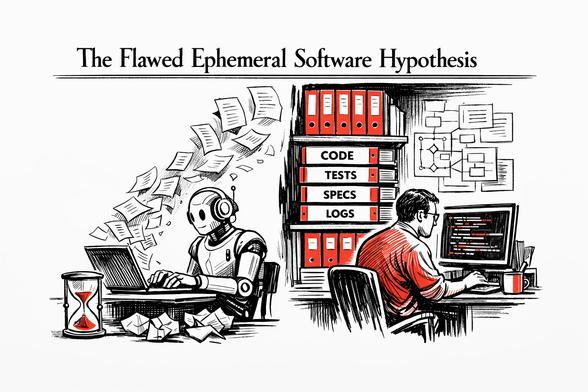
The Flawed Ephemeral Software Hypothesis

Why software won't become disposable despite the rise of agentic AIs for coding

Andreas Kirsch—Research bio & blog
@BuschnicK a well written article - however even if software isn’t ephemeral, and code is still the primary artifact, the idea of manipulating it primarily through asking an agent to do the actual work it is not what I signed up for. I guess I’m probably done with the industry, or it’s done with me. I’ll still write code though
@sinbad same. Artist in the slop factory. Blood in the machine.
@sinbad @BuschnicK Unless they can create actual AGI, then the machines will only create problems. Every time I see anyone who actually cares about how the code is implemented using these things, they end up frustrated and have to do it themselves. And you might say it doesn't matter how something works, if it works - but that's the problem, the more complex a program is, the less chance any vibe change has of "working", and the vibe dev has no clue how their own software works, or how to fix.

@sinbad when i played with stable diffusion, the need for a formal way to define prompts came up very soon. in fact the community started heavily relying on danbooru and score tags to generate images, which is such a formalization.

by which i mean to say remove precision, and it will be reinvented.