 LadyButterfly she/her
We need to make informed choices
By baking, I simply mean I of in the cold food of out hot eat the food, not the entire process before it.
For example, bake pork chop. Put tinfoil on the tray, put the pork chop on, add some salt, put another tinfoil to cover it. You don’t even need to wash the tray.
Cook some rice with a rice cooker to go with the pork chop and you’re done.
There’s a big difference between my post-cook mess and my partner’s.
I clean as I go; not even a hassle. They leave it all to the end; monumental post-meal dread.
A lot of it depends on the recipe. Dishes like Japanese cream stew or beef bourguignon have lots of prep but end with slow-cooking in a single pan, so you have plenty of time to clean before dinner is served.
Compared to something like, I dunno, steak with scratch-made bernaise sauce and buttered kale - it all comes together at the end very quickly, so you’ll have pans and measuring jugs and ingredients on the counter right until the moment you plate-up. No time to clean as you go.
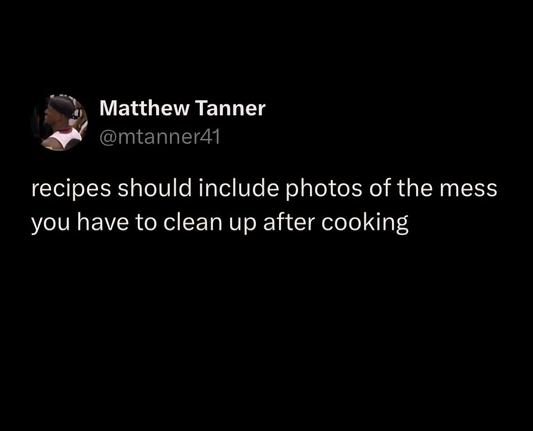
I often choose what to cook purely on the basis of how much mess there will be at the end, because I hate clean-up!
I will always do the cold prep first, then wash and tidy away everything I can before starting to cook.
But having organised prep before you start cooking isn’t necessarily going to lead to zero mess after.
The recipe I chose as an example was specifically because it’s one which makes life difficult. The bernaise sauce in particular wants to be served when it’s freshly made and hot. So you’d cook the steak, and while the steak is resting you cook the sauce.
The sauce requires combining eggs and hot melted butter in a blender and blasting it until emulsified, and then after that adding the fresh tarragon you prepped earlier. Then you serve immediately.
So no matter how much misr-en-place you did, at the end you’ve still got at least a dirty steak pan, butter pan, kale pan, blender, dish for the tarragon, measuring jug, and various utensils…
And oh - the measuring was not used for measuring, by the way, but rather to transfer the hot butter from the pan to the blender.
at the cost of dirtying loads more little bowls
Little bowls are very easy to clean, especially if they just have something like chopped veggies in them.
If you dice your carrots while your onions are sweating, you don’t have time to throw the onion skins etc. in the garbage, or to put any unused onion in the fridge, etc. So, the mess just keeps expanding with each ingredient. And, the worst part is that as soon as you’re done, you want to serve the meal while it’s hot, so all the mess stays out on the counter until after dinner.
If you’re doing everything in one pot, that doesn’t matter too much because you only have one difficult thing to clean, the pot. But, if you’re making a meal with multiple pots and pans, and they’re all sitting dirty while you’re eating, it’s much more of a pain to clean them up after dinner. If you prep everything in advance, you might have a chance to give the pasta pot a rinse while the stuff in the frying pan needs a couple more minutes.
For some things you do have to multitask and keep the plates spinning, so to speak. For example making sure something doesn’t burn while you’re cleaning the last mess.
And that is something that a lot of people need to acclimate to I think. If anyone reading this is one of those people then I’d suggest focusing on reducing the mess as much as possible while you’re cooking, even if you aren’t perfect. Then try to take care of whatever’s left after you finish cooking but before you actually eat. One or two dirty implements is a lot less daunting to take care of than a sink full of stuff.
Another thing I’d suggest is trying to reduce the amount of stuff you dirty in the first place by focusing on single pot recipes or modifying a recipe to be single pot. Frying meat and onions in the bottom of a soup pot before deglazing and adding the rest of the ingredients, for example. This isn’t always possible to do of course, especially if you’re doing something big and fancy, but you should save those kinds of recipes for times when you have all day to dedicate to them.
Depends on how many things you are making at the same time and the volume of mess.per item.
Cleaning as you go is the best, but sometimes you can’t stop stirring or chopping or peeling to do it.
Sometimes there isn’t time to prep before starting, or room to do all the prep, or a ton of other reasons for not doing all the prep ahead of time.
That’s why I said depends.
Some things involve multiple utentils and dishes at the end of the process and there is no amount of preparation that avoids needing to clean multiple things at the end. Like making a cake will have the same amount of dishes when you put it in the oven, more if you do additional prep in small bowls ahead of time.
They are really just complaining about the amount of things to clean and the mess that some stuff makes as part of the process.
Recipes should actually be tested before being published.
Half of them I get half way through and realize that it’s half backwards or uses twice as many dishes or utensils than it needs to.
I actually toyed with the idea of making a YouTube channel dedicated to recreating food from other channels and only showing the clean-up. Like “thanks for the tip Babish now I get to scrape off sticky eldritch bullshit from a ridiculously tiny whisk AGAIN” and “we’re going to soak these plates for at least an hour because we fell asleep as soon as the guests left and the sauce hardened into concrete”.
Any YouTube money would’ve gone into a dishwasher fund. I would’ve reviewed the dishwasher after buying it and that would’ve been the last video on the channel.
Throw in effective cleaning tips for the worst stuck-on crud, and I’m there. Acids, abrasives, bleach, ammonia, detergents, brillo, scotch-brite, magic erasers, scrapers, heat, cold^1^, steam… they all have their place but a lot of people aren’t aware of the best tool for the job. Plus there’s already people watching power washing, lawn mowing, and snow removal on youtube - the audience is already there for a clean sink.
I would’ve reviewed the dishwasher after buying it and that would’ve been the last video on the channel.
That’s begging for a collab with Technology Connections.
^1^ - throw bacon grease into a ceramic coffee mug and refrigerate; other materials may not handle the temperature shock and break. After it’s set it’s easily used as a cooking fat. Also, it’s now solid enough to sit in the kitchen garbage without leaking everywhere.
CAYG
Clean As You Go
This is why the one who does the cooking should do the dishes.
When I am done cooking?
The only dishes are the plates we eat off of, and the utensils.
It is not difficult to clean as you go .
My wife somehow uses every single pot, pan, cutting board, and cooking utensil we own. Like good damn it was just a grilled cheese. What happened
this is okay until you have a partner that cooks every single thing in the house in a manic state over the course of a day and expects you to clean up the aftermath.
if ever i acquire another partner in the future who feels the need to do much cooking, they can clean up afterwards!

Slow cookers have entered the chat.
90% of slow cooker recipes:
Ingredients
Put in slow cooker
Cook for 4-8 hours
Eat for a week
Clean out the slow cooker crock and maybe a cutting board. God-tier appliance and cooking method.
 NorthWestWind
 DosDude
 Janx
Janx merc
merc
 dumbass
 AngryDeuce
 sober_monk
 WIZARD POPE💫
 kazerniel