 Zsolt Zsemba
GOD, The Word You Use When You Run Out of Answers
Because we guess, we don’t know!
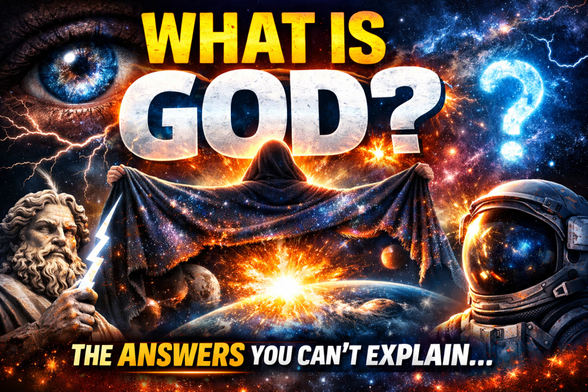
“God is the name we give to the blanket we throw over the mystery to give it shape.”
Before you get up upset, take a deep breath… 1, 2, 3… good. Repeat after me. We do not have 100% definitive prove of God. We read, we analyze and we guess. Just as we hypothesize about the begging of life. You have a belief but don’t know 100%
But this is not actually about God
You use words to control what you do not understand. You name things. You label them. You place them in categories. The moment something has a name, it feels smaller. Manageable. Safe.
Because we guess, we don’t “know”But there are limits to language.
Sooner or later, every person runs into questions that do not cooperate. Why are you here? Why does consciousness exist at all? What started everything? What happens when you die?
At that point people reach for a word that acts like a blanket over the unknown.
God.
“God is the name we give to the blanket we throw over the mystery to give it shape.”
Look across history and you see the same pattern repeat. Ancient civilizations created thousands of gods. Greeks had Zeus and Athena. Egyptians had Ra and Osiris. Norse culture had Odin and Thor. Each culture faced the same mystery of existence and gave it a form that made sense to them.
People feared lightning. So they created a god who threw it.
People saw the sun rise every morning. So they created a god who drove it across the sky.
The unknown became a story.
Religion did not start as manipulation or control. It started as an attempt to explain what people could not measure yet.
Even today the questions remain massive.
Scientists estimate the observable universe contains about 2 trillion galaxies. Each galaxy holds hundreds of billions of stars. Our own Milky Way alone contains around 100 to 400 billion stars.
And every one of those stars could host planets.
Now think about the scale of that.
You live on a small rock orbiting one average star in one average galaxy.
Yet inside your skull sits a three pound organ that can ask questions about the entire universe.
That fact alone should stop you for a moment.
Your brain tries to explain reality, but it evolved for survival, not cosmic understanding. It evolved to avoid predators, find food, and recognize patterns.
When that same brain tries to explain existence itself, it reaches the edge of its ability.
That is where belief enters.
Religion says God created the universe.
Science says the universe expanded from the Big Bang roughly 13.8 billion years ago.
But even science runs into the same wall.
What existed before the Big Bang?
Why do the laws of physics exist at all?
Why does something exist instead of nothing?
The deeper scientists go, the stranger reality becomes. Quantum physics shows particles behaving like waves. Space bends around mass. Time slows near gravity.
The universe refuses to behave like common sense.
So people respond in different ways.
Some choose religion.
Some choose science.
Some sit comfortably with the mystery itself.
Each approach attempts to place a frame around something that may not fit inside one.
History shows that certainty often collapses. For centuries people believed the Earth sat at the center of the universe. Then Copernicus proved the Earth orbits the sun. Galileo confirmed it with a telescope.
Reality expanded.
Every generation believes it understands the world better than the last. Yet every generation also discovers it was wrong about something fundamental.
This pattern should make you careful with absolute certainty.
You might believe God exists as a literal being who created everything.
You might believe the universe formed through physics alone.
Or you might accept that both positions try to describe something far bigger than human language can fully capture.
The moment you admit that, curiosity becomes more important than certainty.
The mystery itself becomes the point.
Consider this simple fact.
You are conscious.
Right now, electrical signals move through about 86 billion neurons in your brain. Those signals create thoughts, memories, emotions, and awareness. Scientists still cannot fully explain how electrical activity becomes subjective experience.
You know what it feels like to exist.
But no one can explain why that experience appears at all.
That question alone keeps philosophers, neuroscientists, and physicists busy.
So maybe the real issue is not whether God exists.
The real issue might be how humans deal with mystery.
Some people cannot tolerate uncertainty. They need answers immediately. Religion can provide that structure.
Others feel comfortable leaving the question open.
Both responses come from the same place. The human mind wants meaning.
You want to know your life matters.
You want to believe your existence is part of something larger.
That instinct shows up everywhere. In religion. In philosophy. In science. Even in art and storytelling.
People search for patterns.
People search for purpose.
The word God often becomes the place where those searches meet.
For some, it describes a conscious creator watching over the universe.
For others, it describes the totality of existence itself.
For others still, it is simply a symbol pointing at something beyond explanation.
None of these views erase the mystery.
They just describe different ways to face it.
So the next time someone says the word God, pay attention to what they actually mean.
They might be talking about a deity.
They might be talking about the universe.
Or they might be doing what humans have always done when facing something too large to describe.
They throw a blanket over the mystery and give it a name.
The mystery remains underneath.
And maybe that is exactly where it belongs.
#god #religion #science #TheUnexlpained #ZsoltZsemba