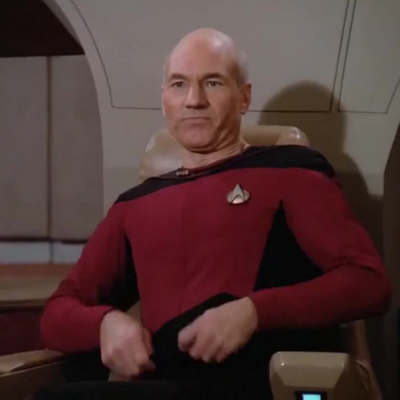
 The Picard Maneuver
I wonder if anyone needs help with anything
We actually have quite a few troubadour “songbooks” from the late middle ages/early Renaissance period, indicating that it was a useful resource for minstrels of the time.
If we’re getting into the Renaissance period, a professional musician would almost certainly be able to read; we have printed music manuals from the period for all kinds of instruments; for example, Arbeau’s Orchésographie is a primer on courtly dance music that we still read today.
There are a couple parts of the court music book Orchésographie that I think would be particularly interesting for a bard character.
Court musicians in the late 16th century frequently traveled to where the work was: either following a particular patron or looking to perform where they could. Most of the dances in the book are bransles, a folk dance popular with the “common folk.” As a D&D bard, this would be a cool way to explain why your music is beloved by all, and why they could move in all social circles.
There’s also a part at the beginning that explains how to play the drum and fife for a marching army: how to improvise a melody or change up the drum pattern while keeping the March going. It seems to imply that the court musicians the book was written for were potentially marching with armies, likely playing music in the camps or stops at night.
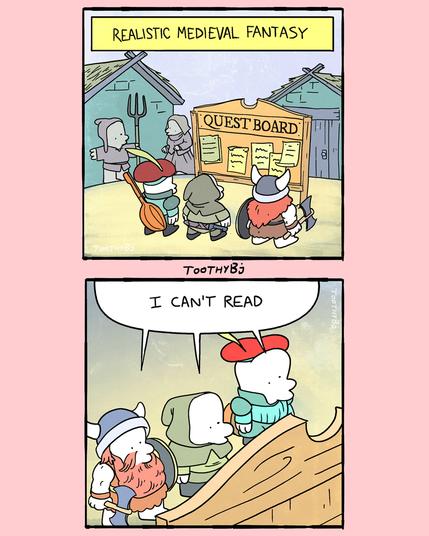
Literacy rates in medieval times were not what they are today, but they’re still routinely underestimated. Most places, including peasant villages, would have had some people around who could read.
Then again, it also depends heavily in what part of the middle ages you are talking about. Early, high and late middle ages were almost different worlds in many regards.
It’s almost as if that term was made up to put a name on something that wasn’t Roman times or now
(Mind you, now being 16th century Italy)
now being 16th century Italy
I think that’s incorrect, actually. By my calculations, we’re at LEAST a dozen years farther along than that!
That would be why this isn’t portraying adventurers …
“Adventurer” is a modern invention, sure, but there are also reasons adventurers would be an exception to the norms of their own worlds. Literacy would be one of many such reasons for many of them, but there are plenty of portrayals of what happens when only one member of a party can read or write as well.
If you want to get even more real, the people who maintain the quests, usually the adventurer’s guild or the hunter’s guild in these stories, would pay for the quest reader. Probably the people who accept the quest requests would just tell the adventurers what to do, and bypass the entire board.
It would be in the guild’s interests to have illiterate people do quests even if they were poor, to control who got what quests, and not to let the adventurers get too smart. The guild would be able to scam them out of so much money that way.
Interpretive this!
sick lute-shedding solo
In the lord of the rings mmo back in the day you could play an instrument and actually play notes and program songs to play them in game but most people would just post up at the inn, like dozens of people, and just play the most discordant faceroll shit imaginable to the point where you had to disable it in the settings.
Kinda broke the immersion a little bit, unless roving squads of bards performing the medieval equivalent of a yoko ono song in everybody’s face was a commonplace occurrence in those days.
There’s a D&D-like game that I used to play that actually has education requirements to read different languages. If your background didn’t give you the trait, you had to learn from someone who knew how to read.
It made for some interesting role-playing when normally intelligent people were playing illiterate characters.
rambling about said gameThere were “basic” and “high” forms of the standard language, but there was a language for most species as well as “lower” speeches that non-sentient beings could use to communicate. Each language except lower one’s had their own written language and associated trait to understand. So if you put all your stats into STR, then you’ll be lucky to read your own language before dying of old age, as your INT modified how easy it was to learn. Learning just entailed being with someone who has the trait and is willing to teach you, you roll and add your modifiers and after a non-specific (up to DM) amount of time, you can put some stat points to learn the trait.
It’s called Dragon Storm, and it’s funny you mention friends inventing it because my family does know the only living creator. It’s been an interesting story with all the legal issues and tracking down business partners.
The game is very much modeled after D&D. It has some basic campaigns you can run, and has some general background lore.
The premise is that there’s are weird magic storms that pop up sometimes (Dragon Storms) and make some people (who have dragon blood) turn into magical creatures like werewolves, unicorns, Pegasus, as well as regular animals like wolves and horses. It’s more than those couple, but it’s been quite some time since I played and am having trouble recalling things I didn’t personally have as characters… They later added dragon-kin that are either full-blooded dragons that take humaoid forms, or descendants of dragons that banged humanoids in humanoid form. Those tend to be more powerful.
You use cards and dice to do things and have character sheets to keep track of stats.
I personally think the game is too rigid in its rules and world building, with the card aspect. I’ve had players argue with me over whether I’m allowed to alter stats of things on the cards for the narrative. I’ve had plenty of players meta-game with their memory of the cards. “Rule 3.14” is the Dragon Storm “Rule of Cool”
It was fun to play growing up, though I wish my family had also played D&D.
Wasn’t it that depending on which mediveal sub-era, every house would have at least one person that knows how to read?
Like similar to how every immigrant household has one or two translators.
 unalivejoy
 Zombiepirate
 bizarroland
 Tonava
 sp3ctr4l
 samus12345
 hark
hark Tattorack
 spankinspinach
 AngryDeuce
 GratefullyGodless
 Miles O'Brien
 MinnesotaGoddam