 Emily Velasco
Does anyone on here know if the capacitor-resistor combo attached to a pwm output pin of an Arduino gives a decent analog output?
People replied a lot while I was sleeping. I''m not going to give the same response to everyone who was asking what its for, so I'll just say it here. I want to use an arduino to spoof the 0-5V analog throttle signal on this ebike i'm building.
As best I can tell, ebike throttle units put out an analog voltage without any kind of data signal, but somehow the e-bike knows the difference between a real throttle, and one made out of an arduino, or even made out of a bench power supply. It will only run when connected to an actual ebike throttle
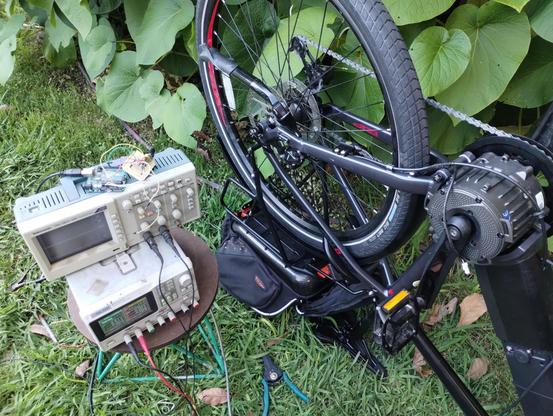
I'm getting somewhere now. It's not giving full throttle but it is giving some throttle.
I had to hook up the throttle unit in parallel with the Arduino for the bike to accept inputs from the Arduino.
This might work out ok because i wanted to have a throttle lever and pedal assist anyway.
More testing to do still!
 Felis_Catus_Domesticus
control a transistor with the potentiometer..
1. ardie -> potentiometer -> transistor -> motor control voltage
not
2. ardie -> potentiometer -> motor control voltage
#1 is probably how it's done inside the hall effect sensor chip. there is probably more than just hall effect sensor + amp etched on that silicon chip. Identify the hall chip if you can and grab the manufacturer's data sheet if possible to verify.