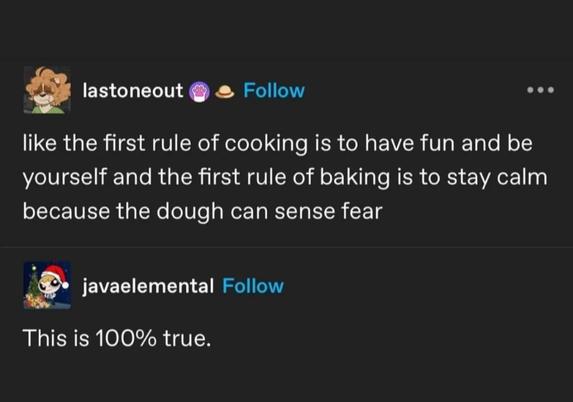
Cooking? Follow your heart. Sure you can add more butter! A bit of garlic! Shit throw a bay leaf in no one knows wtf it does! Throw in some vodka no one will know, maybe a shot for the chef too, fuck it this is your kitchen!

Baking? You will follow the fucking instructions like checklist and double check it like submitting an SAT for college approval and the oven will be testing your answers, because unlike your SAT theres no multiple choice or ā€œfill in the blankā€ only the harsh reality of a zero on your paper and that you didnt add enough butter and now your bread is so blackened and hardened the children are trying to take it from you to build a portal to the Nether.

I bought a high precision scale that does grams to three significant digits and can handle about a pound (because I don’t know that I won’t need that and if I’m getting something nice, might as well go all in), and switched all my baking to weight-based recipes for exactly this reason. It’s the only way I could get my bread maker to produce a halfway decent loaf without collapsing, but it makes a lot of other things more consistent as well.

Thankfully, I haven’t any offspring to use my failure to summon forth the end the world, but it did make decent croutons.

I love baking precisely because it is a science.

The creativity comes later in the proportions of things like how much icing/filling to make.

Yeah. Baking is chill because the ingredients are effectively standardized and fungible so if you just follow the steps it’s hard to screw up. You usually only heat the baked good once and that happens in isolation.

Meanwhile, cooking is anarchy. Just because one piece of chicken breast took five minutes on medium heat doesn’t mean that the next one will. You constantly have to monitor and adapt to changing conditions and everything from ingredients to measurements to the very steps of the recipe itself is up for negotiation. And you have to do half the steps while heating the meal and if you ever take too long for something you burn it and it’s ruined.

When I bake I’m relaxed. When I cook I’m in nonstop crisis management mode.

I’ve found that cooking with lots of veggies, kind of towards East Asian cuisine, is a lot less crisis management.

You can chop your veggies in whatever pace you want, before you start heating anything. Just put them into individual bowls until you’re ready.

But you even can start boiling some water and then later throw in rice+lentils, and it doesn’t require much multi-tasking either, because rice+lentils doesn’t need much attention while cooking.
You can generally just set a timer and once that goes off, pause chopping veggies to turn off the heat. Your veggies can’t get burnt while you do that either. šŸ™ƒ

Are you boiling your rice and lentils together? Does that work? What variety of lentils? Rice? This could be a game changer for my ā€œtoo lazy to do more than boil waterā€ nights.

I do, yeah. I also saw this sentence on Wikipedia earlier today, so I don’t think I’m alone in that:

[Lentils] are frequently combined with rice, which has a similar cooking time.

en.wikipedia.org/wiki/Lentil

And I mean, if you time it right, I imagine you can cook any combination of rice and lentil varieties together.
Well, except beluga lentils, as those turn the water black, which dyes the rice into a rather unappetizing color. 🄓

But if you’re lazy, then I’d generally recommend split lentils. They had their hull removed, which makes cooking them much quicker. You’re also normally supposed to pre-soak lentils and pour the water out, to make them more nutritious and less farty, which you don’t have to do for split lentils.

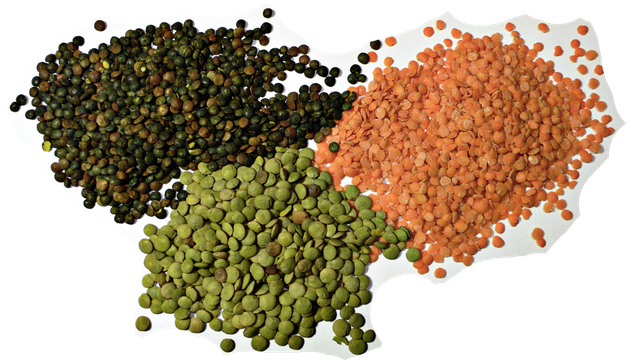
In the shops, you will usually find ā€œred lentilsā€ and sometimes ā€œyellow lentilsā€, which are split lentils. If they look not quite round and a bit frizzy, then they are split lentils. Like this:

And then, yeah, white rice, Basmati rice or Jasmin rice is usually close enough to their cooking time. But both, rice and lentils, don’t need insanely precise cooking times anyways, so a few minutes difference is usually still no problem.

Non-split lentils and brown rice or wild rice also have similar cooking times.

My personal staple is Basmati + split red lentils.

Note: I’m not a huge rice expert and had to actually read up on some of the differences just now. If something seems off, I’m probably just dumb. 🫠

Lentil - Wikipedia

What’s your go to seasoning blend for a basic dish? Sorry for the game of 20 questions, but lentils aren’t the staple in my region that they are elsewhere. I want to be more versatile in how I use them (and other legumes). I’ve got red beans and rice on lock, and I made a mean pot of frijoles charro last night, but, to date, lentils are basically nothing more than a way to bulk out ground meat recipes like taco meat or sloppy joes. I could stand to learn how to enjoy them in a more naked form, so to speak.
Mujadara/megadara is a classic lentil+rice dish. I love it. At its core, it’s burnt/heavily caramalised onions, lentils, rice, salt. Cumin is a must imo, along with a pinch of cinnamon. Add a pinch of baking soda to the onions 2 mins into cooking them, and they’ll caramalise way faster

Unfortunately, I too am from a region that does not really value lentils. We have a singular lentil dish that’s really popular here, but hardly anything beyond that.

The dish also hardly uses seasoning. 🫠
Very basically, you cook some brown lentils and separately, make a roux. Then combine the two. Add salt, a bayleaf and a splash of vinegar. Eat with soft noodles.

As for non-regional recipes that I’m aware of:

  • Lentil curry is great. You can basically just make a normal curry and replace whatever protein you’d use with lentils.
  • The Indian cuisine has tons of dishes under the term ā€œdalā€. I believe, that word does just mean ā€œsplit lentilsā€, but you will find lots of recipes with that term anyways.
    To my knowledge, what many(/most?) of these recipes also share is that they overcook split lentils until they disintegrate and you’re left with a creamy base, which you can then pimp with all kinds of spices.

Probably why I love cooking. I enter a flow state and I get constant sensory feedback in sizzle level and aroma and color. The closer cooking gets to baking (making rice, cooking a roast, etc) the less fun it is.

Granted, I’m probably biased by a culinary upbringing, years in a restaurant kitchen, and some variety of undiagnosed AuDHD, but I thrive in constant crisis management mode. It’s just so much fun. Baking is so boring, and there’s so little room for improvisation.

I’m AuDHD, and I feel like my autism loves baking, and my ADHD cooking.
Honestly this fear is overblown. Unless you’re making pastries, baking is relatively straightforward and forgiving. Breads, cakes and pies ove you and want you to have fun. Experimenting with vegan substitutions, gluten free baking and scaling batch sizes helped me feel much less intimidated by recipes, you learn what role the ingredients are playing and how to adjust if you add too much, too little, or too not the right thing.
Baking is pretty forgiving, so many old baking recipes are written with add flour until it looks right as part of the recipe. If your baking sucks it’s most likely super old ingredients or you did something stupid like substitute strawberries for butter.
Wait, so I shouldn’t be greasing my pans with strawberries?
Brownies are forgiving. Sourdough bread will smack you in the face if you talk smart.
IDK, I’ve been having a hell of time trying to make my pizza doughs rise.
either your yeast is dead or you’re killing it with water that’s too hot, hard to see why else it wouldn’t rise
Water could be overly chlorinated as well. They could try bottled water or let their municipal water sit out in a mixing bowl for 24 hours.
I always use water straight from the tap (unheated) and I’ve tried several brands of soft and dry yeast.
Yeast likes to be warm, cold water will result in slower rising.
Use a thermometer to measure the water temp.
And which is the right water temp?
110-120 F. I also have hard water in my area and I’ve successfully made yeast doughs. I recommend ā€œbloomingā€ your yeast first even if you’re using instant yeast, which just means mixing your yeast, a bit of sugar (like a tsp per 1 packet of yeast) and the water together and letting it sit for about 10 minutes.
I think people forget that bread and pasteries used to be cooked in wood fired ovens with no temp control.

Yeah, there’s just more things to understand with baking. Yeast doing biology, acid/base chemistry, plus the whole ā€œdo everything at the start and hope you balanced things right because you can’t tweak as you go if it starts getting dry or the flavour balance is offā€.

Or maybe I’ve just gotten lucky with my close enough measurements and substitutions so far.

Yeah I regularly bake stupid crap, just throw some ingredients together and make some cookies or pie or some eldritch monstrosity. In my experience it’s difficult to actually make something inedible unless you add something that’s already gross

The only dough that knows my fears was the hamantaschen but every since I started only using King Arthur flour, they’ve never failed again.

Not sponsored

(But if they want to sponsor me, I’m open to this)

This is why I don’t do baking, the art form of cooking simply speaks to me more
Skill issue
Measuring issues. Baking is chemistry.

Yes… But also you do need feeling/experience/skill. For example, one of the bread recipes I’m still often making, I’ve been using completely unchanged since I started learning how to make bread. The ingredients (flour, water, yeast/sourdough, salt) and their amounts have not changed.

Yet the result today is far better and more consistent than back then.

That’s because time, room temperature, humidity,… are just as important. And before you say ā€œthat, too, is chemistryā€: yes, it is, but these are not variables most people can accurately measure or influence in a scientific way.

Instead, you quickly develop an intuition for how these things relate and come together.

A skill, so to speak.

dough can sense fear

The first rule of baking is: accurately follow the recipe.

The first rule of cooking is: the better the ingredients, the fewer processing steps are necessary.