 A.R. Moxon
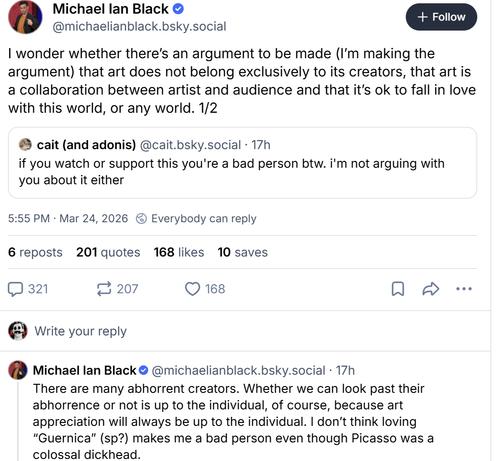
If I knew viewing Guernica would put money directly into the pockets of a still living Pablo Picasso, who had announced publicly that he would be using that money to terrorize, harm, and kill women, not only would I not go view Guernica, it would fundamentally change the meaning of Guernica as art.
It would not only change the meaning of Guernica as an artistic piece from a protest of war to a tool of oppression, but it would fundamentally change what the collaboration between the art and the viewer is, and it would fundamentally change the relationship between viewer and artist.
 lucindacatchlove.bsky.social
It's exhausting to have people who know nothing about culture or cultural criticism floundering around like this as if they understand anything about these things. It's always consumers of pop culture, it's never people who actually care about or support art or even think deeply about pop culture.
This is a result of the defunding of mainstream art and cultural criticism to replace everything with press releases and short blurbs. Making critical thinking about art/culture available to the public helps people learn the skills to think critically about art, culture and society.
Also, while I love to write using poetic and dense language about culture, it's also entirely possible to write about art and culture critically in much more accessible ways in plain language (and a lot of that is helping people understand a work, it's references, why they matter, etc).
This helps deepen the understanding of a work and its meaning. A lot of the "nobody should yuck someone's stanning" is about actively avoiding deeper understanding, it's advocating for shallow consumption and doesn't even care about or respect the art. It's okay to enjoy fluff, that's not the issue
But if it's just fluff you're attached to or your own nostalgia, there's plenty of innocuous fluff out there that's not actively funding harm of others in this very moment and we all have to grow up and recognize some of the stuff we grew up on was less innocent than we thought it was as children.