 A.R. Moxon
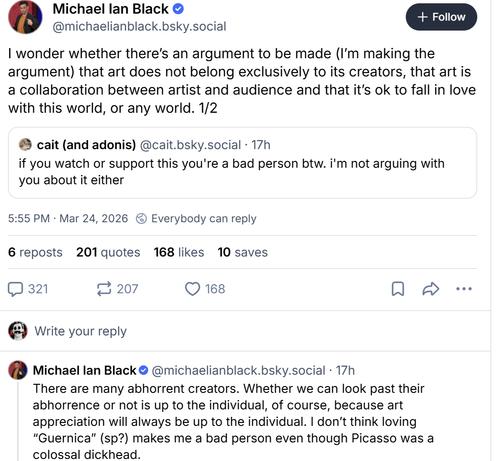
If I knew viewing Guernica would put money directly into the pockets of a still living Pablo Picasso, who had announced publicly that he would be using that money to terrorize, harm, and kill women, not only would I not go view Guernica, it would fundamentally change the meaning of Guernica as art.
It would not only change the meaning of Guernica as an artistic piece from a protest of war to a tool of oppression, but it would fundamentally change what the collaboration between the art and the viewer is, and it would fundamentally change the relationship between viewer and artist.
Anyway HP was once a boarding school/ fantasy story about a boy finding himself embroiled in a wizarding world with an antifascist message, and you could discuss how successful it was at delivering that story (ok imo) and message (not ok imo).
Now it is a tool of fascist oppression. The end.
Sometimes it’s complex. This time it’s not. It’s really not. She’s taking the money and using it to oppress, terrorize, and kill an already oppressed minority currently already being terrorized and killed.
I will not be interacting further with any people unwilling or unable to engage with the actual points being made who nevertheless insist on replying. Thanks and goodnight.
 lucindacatchlove.bsky.social
It's exhausting to have people who know nothing about culture or cultural criticism floundering around like this as if they understand anything about these things. It's always consumers of pop culture, it's never people who actually care about or support art or even think deeply about pop culture.
This is a result of the defunding of mainstream art and cultural criticism to replace everything with press releases and short blurbs. Making critical thinking about art/culture available to the public helps people learn the skills to think critically about art, culture and society.
Also, while I love to write using poetic and dense language about culture, it's also entirely possible to write about art and culture critically in much more accessible ways in plain language (and a lot of that is helping people understand a work, it's references, why they matter, etc).
This helps deepen the understanding of a work and its meaning. A lot of the "nobody should yuck someone's stanning" is about actively avoiding deeper understanding, it's advocating for shallow consumption and doesn't even care about or respect the art. It's okay to enjoy fluff, that's not the issue
But if it's just fluff you're attached to or your own nostalgia, there's plenty of innocuous fluff out there that's not actively funding harm of others in this very moment and we all have to grow up and recognize some of the stuff we grew up on was less innocent than we thought it was as children.
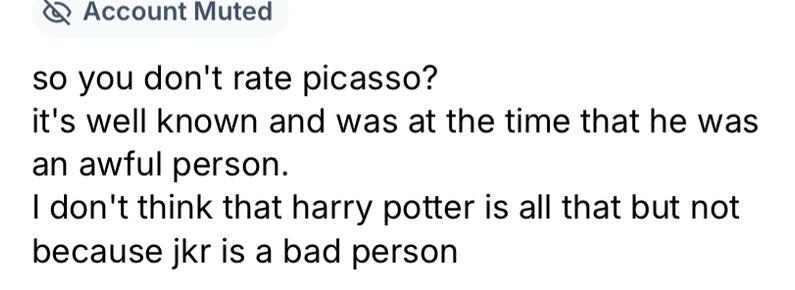
Also, as someone who got to see a lot of Picasso paintings in person as a child, I can tell you that the violence of Picasso towards women is indeed in his work and not separate from it. That an adult man can't see that is about what they don't personally bring to the art really.
Speaking of Picasso and violence towards women, Kent Monkman's use of Picasso-esque female figures in his work is incredibly powerful and masterful. www.elektramontreal.ca/bian-2024/th...
Kent Monkman, The Transfigurat...
Kent Monkman, The Transfigurat...
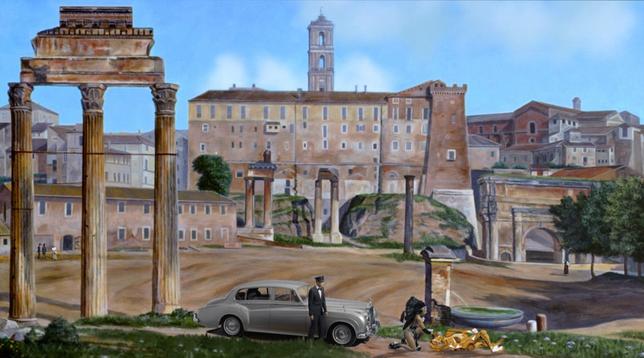
Kent Monkman, The Transfiguration | Biennale ELEKTRA 2024
In The Transfiguration, Miss Chief disembarks from her limo amid a picturesque, painted Italian villagescape to perform a ceremony over the twisted body of a reclining Picasso nude. As the result of her ministrations, the body releases a spirit in the form of an angel. “The Modernists such as Picasso deconstructed, with considerable violence, the female nude,” says Monkman “I have been using Picasso’s butchered female nudes to talk about the European assault on the female spirit. Many indigenous cultures are matriarchal and were not respected or understood by patriarchal European societies.”
 Nathan A. Stine
@juliusgoat.bsky.social I feel like it would be fine to enjoy it after he died.