 The Picard Maneuver
I'll take $1,100 worth
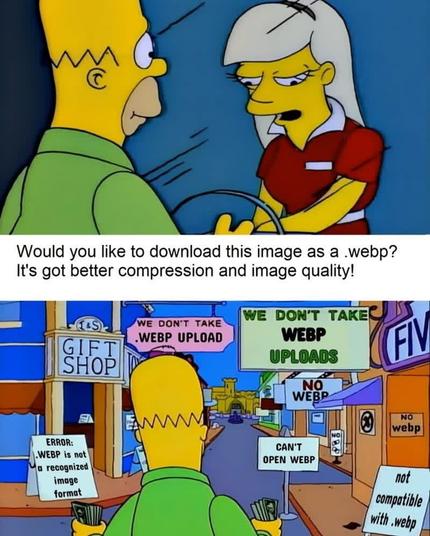
I feel like even five years ago, this was a Windows problem I was too Linux to understand.
I have literally never had a problem opening a .webp. By the time my browser started downloading in that format, all my other software (Dolphin, Gwenview, GIMP, etc.) already supported it too.
A week or few ago, I asked about the issue with certain image posts opening in a new tab instead of expanding when I click. It was in a random post affected by the new tab issue and I never got a response, at least I don’t think I did.
Now that you mentioned avif, I double-checked, and sure enough that’s the reason. I don’t know why I didn’t notice.
A while back it happened with images hosted on something called catbox or shitbox whatever it was called. For awhile the images wouldn’t load at all in my browsers because the certificate for that domain was bad. Then for awhile, I suppose after they fixed the cert, they’d open up in a new tab instead of expand. But, it’s been some time since I’ve noticed and I don’t see many/any shitbox/catbox hosted images anymore.
No, it’s a different format underneath.
Occasionally it’ll work, cause an app will use a library that supports webp but forget to add it to the file picker (or deliberately don’t want it) but generally no.
Apparently Chrome, which i used on my work computer to get some game files, downloads images in .webp by default.
Some servers will serve webp to supported browsers to save bandwidth, even if the URL ends in .png. So its not Chrome’s default, its the website.
Simply changing the extension wouldn’t work because each image type has a specific header - even changing a .png to .jpg wouldn’t work - and organizes the actual image data in different ways.
The header is what actually identifies the file type. For webp, it’s called the RIFF header and it must be 21 bytes (it’s a standardized specification, btw). For jpeg, the header is only 2 bytes and has the values FF D8. In theory, this means that you could even rename the file to image.zip and, if you opened it in an appropriate program, it would read the header and still render it properly
If we made a list of things you could do, that would be on the list.
If that’s the only thing that changed, the data in the file isn’t changed, it’s still a webp file not a jpg, it’s just mislabeled now. I just tried it, Dolphin will let you do it but throw a dialog telling you it’s not actually going to change the file, just the name. Some systems might be smart enough to recognize the intent and run a conversion program in the background. Feels like an Apple thing to do. Also feels kind of Pythonic.
A lot of image viewing software doesn’t know what to do with the webp format so they’ll try to load it and throw an error.
?format=jpeg
I’ve got that shit pinned on my clipboard.
 waigl
waigl loiakdsf
 Redjard
 I Cast Fist
 MinnesotaGoddam
 Swedneck
 switcheroo
 morrowind
 Axolotl
 Captain Aggravated
 🇰 🌀 🇱 🇦 🇳 🇦 🇰 🇮
  Appoxo
 Widdershins