 Patrick Breyer
🇩🇪US-Konzerne & Lobby-NGOs wollen unsere Chats scannen! 🛑 MORGEN (Tagesordnung) können wir die #Chatkontrolle endgültig killen!
📧 Mails gehen unter.
📞 ANRUFE wirken!
Stoppt die Lobby, ruft JETZT Abgeordnete an: https://fightchatcontrol.de

🇩🇪US-Konzerne & Lobby-NGOs wollen unsere Chats scannen! 🛑 MORGEN (Tagesordnung) können wir die #Chatkontrolle endgültig killen!
📧 Mails gehen unter.
📞 ANRUFE wirken!
Stoppt die Lobby, ruft JETZT Abgeordnete an: https://fightchatcontrol.de
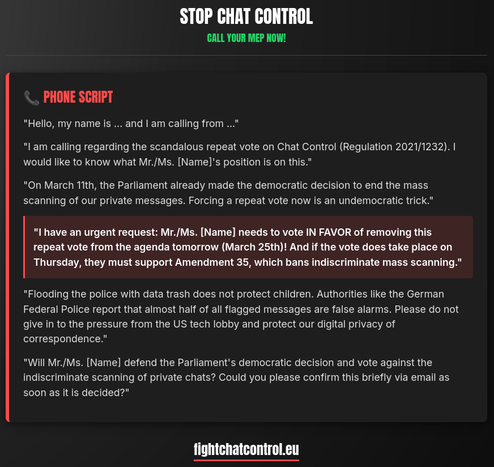
🇪🇺US tech corps & lobby NGOs want to scan our chats! 🛑 TOMORROW (agenda vote) we can kill #ChatControl for good!
📧 Emails are ignored.
📞 CALLS work!
Stop the lobby, call your MEPs NOW: https://fightchatcontrol.eu
@echo_pbreyer Reading the last paragraph in your article makes me think a lot about fire safety.
We don't do fire safety by continuing to build every building out of plywood and putting smoke detectors everywhere, we do it by not building our houses, furniture and stuff out of easily flammable material so fires are less likely to happen in the first place and if one still does break out, it won't destroy as much.
Online safety must be done with a similar approach.
@echo_pbreyer Not to mention the fact that reporting is always AFTER the incident. Even if done automatically and instantaneously.
A city of plywood and smoke alarms everywhere will always burn to the ground eventually because the firefighters were not able to respond fast enough one time. A city made of bricks can never do that.
@echo_pbreyer In short:
Building an environment that is fundamentally safe by design will always be more safe and reliable than continuously policing an environment that is fundamentally unsafe.
 ꓤɔᴉʇɐʇS