 John Regehr
 Austin Kocher, PhD 🌎
New research from UW exposes what it's really like to be under ICE's compulsory surveillance app, BI SmartLINK. The findings are alarming and the researchers conclude the app simply should not be used. 🧵
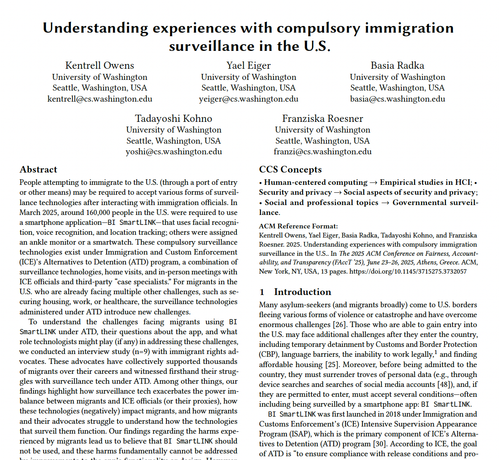
This research makes clear: compulsory immigration surveillance causes documented harm and cannot be fixed by improving the app.
Full study: https://dl.acm.org/doi/10.1145/3715275.3732057
Substack: https://austinkocher.substack.com
Understanding experiences with compulsory immigration surveillance in the U.S.
Kentrell Owens
University of Washington Seattle, Washington, USA
[email protected]
Yael Eiger
University of Washington
Seattle, Washington, USA
[email protected]
Basia Radka
University of Washington Seattle, Washington, USA
[email protected]
Tadayoshi Kohno
University of Washington
Seattle, Washington, USA
[email protected]
Franziska Roesner
University of Washington
Seattle, Washington, USA
[email protected]
Abstract
People attempting to immigrate to the U.S. (through a port of entry or other means) may be required to accept various forms of surveil-lance technologies after interacting with immigration officials. In March 2025, around 160,000 people in the U.S. were required to use a smartphone application-BI SmartLINK-that uses facial recogni-tion, voice recognition, and location tracking; others were assigned an ankle monitor or a smartwatch. These compulsory surveillance technologies exist under Immigration and Custom Enforcement (ICE)'s Alternatives to Detention (ATD) program, a combination of surveillance technologies, home visits, and in-person meetings with ICE officials and third-party "case specialists." For migrants in the U.S. who are already facing multiple other challenges, such as se-curing housing, work, or healthcare, the surveillance technologies administered under ATD introduce new challenges.
To understand the challenges facing migrants using BI SmartLINK under ATD, their questions about the app, and what role technologists might play (if any) in addressing these challenges, we conducted an interview study (n=9) with immigrant rights ad-vocates. These advocates have collectively supported thousands of migrants over their careers and witnessed firsthand their strug-gles with surveillance tech under ATD. Among other things, our findings highlight how surveillance tech exacerbates the power im-balance between migrants and ICE officials (or their proxies), how these technologies (negatively) impact migrants, and how migrants and their advocates struggle to understand how the technologies that surveil them function. Our findings regarding the harms expe-rienced by migrants lead us to believe that BI SmartLINK should not be used, and these harms fundamentally cannot be addressed (text truncated).
CCS Concepts
Human-centered computing→ Empirical studies in HCI; .
Security and privacy Social aspects of security and privacy;
Social and professional topics Governmental surveil-lance.
ACM Reference Format:
Kentrell Owens, Yael Eiger, Basia Radka, Tadayoshi Kohno, and Franziska Roesner. 2025. Understanding experiences with compulsory immigration surveillance in the U.S.. In The 2025 ACM Conference on Fairness, Account-ability, and Transparency (FAccT '25), June 23-26, 2025, Athens, Greece. ACM, New York, NY, USA, 13 pages. https://doi.org/10.1145/3715275.3732057
1 Introduction
Many asylum-seekers (and migrants broadly) come to U.S. borders fleeing various forms of violence or catastrophe and have overcome enormous challenges [26]. Those who are able to gain entry into the U.S. may face additional challenges after they enter the country, including temporary detainment by Customs and Border Protection (CBP), language barriers, the inability to work legally,¹ and finding affordable housing [25]. Moreover, before being admitted to the country, they must surrender troves of personal data (e.g., through device searches and searches of social media accounts [48]), and, if they are permitted to enter, must accept several conditions often including being surveilled by a smartphone app: BI SmartLINK.
BI SmartLINK was first launched in 2018 under Immigration and Customs Enforcement's (ICE) Intensive Supervision Appearance Program (ISAP), which is the primary component of ICE's Alterna-tives to Detention (ATD) program [30]. According to ICE, the goal of ATD is "to ensure compliance with release conditions and pro- (text truncated).
 Omnivore
 Book
Book 🏴🏳⚧🏴☠
🏴🏳⚧🏴☠