tanelpoder
So where are all the AI apps?
https://www.answer.ai/posts/2026-03-12-so-where-are-all-the-ai-apps.html
So where are all the AI apps?
https://www.answer.ai/posts/2026-03-12-so-where-are-all-the-ai-apps.html
I deleted vscode and replaced with a hyper personal dashboard that combines information from everywhere.
I have a news feed, work tab for managing issues/PRs, markdown editor with folders, calendar, AI powered buttons all over the place (I click a button, it does something interesting with Claude code I can't do programmatically).
Why don't I share it? Because it's highly personal, others would find it doesn't fit their own workflow.
Me, and photo editor tool to semi-automate a task of digitizing a few dozen badly scanned old physical photos for a family photo book. Needed something that could auto-straighen and auto-crop the photos with ability to quickly make manual adjustments, Gemini single-shotted me a working app that, after few minutes of back-and-forth as I used it and complained about the process, gained full four-point cropping (arbitrary lines) with snapping to lines detected in image content for minute adjustments.
Before that, it single-shot an app for me where I can copy-paste a table (or a subsection of it) from Excel and print it out perfectly aligned on label sticker paper; it does instantly what used to take me an hour each time, when I had to fight Microsoft Word (mail merge) and my Canon printer's settings to get the text properly aligned on labels, and not cut off because something along the way decided to scale content or add margins or such.
Neither of these tools is immediately usable for others. They're not meant to, and that's fine.
I built a small app to emit a 15 kHz beep (that most adults can't hear) every ten minutes, so I can keep time when I'm getting a massage. It took ten minutes, really, but I guess it's in the spirit of the question.
For 20 minutes of time, I had a simple TTS/STT app that allows me to have a voice conversation with my AI assistant.
More than that. Building a throwaway-transient-single-use web app for a single annoying use kind of makes sense now, sometimes.
I had to create a bunch of GitHub and Linear apps. Without me even asking Codex whipped up a web page and a local server to set them up, collecting the OAuth credentials, and forward them to the actual app.
Took two minutes, I used it to set up the apps in three clicks each, and then just deleted the thing.
Code as transient disposable artifacts.
I posted it recently, but now this works differently https://xkcd.com/1205/
You can get a throw away app in 5 mins, before I wouldn't even bother.
It's not worth 100 bucks a month for me to have my own shopping app, but maybe it's worth 100 bucks a month to have ready access to a software garden hose that I can use if I want to spew out whatever stupid app comes to my mind this morning.
I'd rather not pay monthly for something (like water) that I'm turning on and off and may not even need for weeks. But paying per-liter is currently more expensive so that's what we currently do.
I think the future is going to be local models running on powerful GPUs that you have on-prem or in your homelab, so you don't need your wallet perpetually tethered to a company just to turn the hose on for a few minutes.
Technical people (which is by far the minority of people out there) building personal apps to scratch an itch is one thing.
But based on the hype (100x productivity!), there should be a deluge of high quality mobile apps, Saas offerings, etc. There is a huge profit incentive to create quality software at a low price.
Yet, the majority of new apps and services that I see are all AI ecosystem stuff. Wrappers around LLMs, or tools to use LLMs to create software. But I’m not really seeing the output of this process (net new software).
There is no money in mobile apps. It came out in the Epic Trial that 90% of App Store revenue comes from in app purchases for pay to win games. Most of the other money companies are making from mobile are front end for services.
If someone did make a mobile app, how would it get up take? Coding has never been the hard part about a successful software product.
> Wrappers around LLMs, or tools to use LLMs to create software. But I’m not really seeing the output of this process
Because it's better to sell shovels than to pan for gold.
In the current state of LLMs, the average no-experience, non-techy person was never going to make production software with it, let alone actually launch something profitable. Coding was never the hard part in the first place, sales, marketing & growth is.
LLMs are basically just another devtool at this point. In the 90s, IDEs/Rapid App Development was a gold rush. LLMs are today's version of that. Both made developer's life's better, but neither resulted in a huge rush of new, cheap software from the masses.
I've been getting close to that myself, I've been using VSCode + Claude Code as my "control plane" for a bunch of projects but the current interface is getting unwieldly. I've tried superset + conductor and those have some improvements but are opinionated towards a specific set of workflows.
I do think there would be value in sharing your setup at some point if you get around to it, I think a lot of builders are in the same boat and we're all trying to figure out what the right interface for this is (or at least right for us personally).
> Anyone who has been doing this professionally will tell you that the "last step" is what takes the majority of time and effort.
This is true, and I bet there are thousands of people who are in this stage right now - having gotten there far faster than they would have without Claude Code - which makes me predict that the point made in the article will not age well. I think it’s just a matter of a bit more time before the deluge starts, something on the order of six more months.
Exactly, there have been loads of tools over time to make software development easier - like Dreamweaver and Frontpage to build websites without coding, or low/no-code platforms to click and drag software together, or all frameworks ever, or libraries that solve issues that often take time - and I'm sure they've had a cumulative effect in developer productivity and / or software quality.
But there's not one tool there that triggered a major boost in output or number of apps / libraries / products created - unless I missed something.
Sure, total output has increased, especially since the early 2010's thanks to both Github becoming the social network of software development, and (arguably) Node / JS becoming one of the most popular languages/runtimes out there attracting a lot of developers to publish a lot of tools. But that's not down to productivity or output boosting developments.
> It is incredibly easy now to get an idea to the prototype stage
Yup. And for most purposes, that's enough. An app does not have to be productized and shipped to general audience to be useful. In fact, if your goal is to solve some specific problem for yourself, your friends/family, community or your team, then the "last step" you mention - the one that "takes majority of time and effort" - is entirely unnecessary, irrelevant, and a waste of time.
The productivity boost is there, but it's not measured because people are looking for the wrong thing. Products on the market are not solutions to problems, they're tools to make money. The two are correlated, because of bunch of obvious reasons (people need money, solving a problem costs money, people are happy to pay for solutions, etc.), but they're still distinct. AI is dropping the costs of "solving the problem" part, much more than that of "making a product", so it's not useful to use the lack of the latter as evidence of lack of the former.
Software engineering is not “coding” though.
Before AI for the last 8 or so years now first at a startup then working in consulting mostly with companies new to AWS or they wanted a new implementation, it’s been:
1. Gather requirements
2. Do the design
3. Present the design and get approval and make sure I didn’t miss anything
4. Do the infrastructure as code to create the architecture and the deployment pipeline
5. Design the schema and write the code
6. Take it through UAT and often go back to #4 or #5
7. Move it into production
8. Monitoring and maintenance.
#4 and #5 can be done easily with AI for most run of the mill enterprise SaaS implementations especially if you have the luxury of starting from the ground up “post AI”. This is something you could farm off to mid level ticket takers
I spent about a week doing an "experiment" greenfield app. I saw 4 types of issues:
0. It runs way too fast and far ahead. You need to slow it down, force planning only and explicitly present a multi-step (i.e. numbered plan) and say "we'll do #1 first, then do the rest in future steps".
take-away:
This is likely solved with experience and changing how I work - or maybe caring less? The problem is the model can produce much faster than you can consume, but it runs down dead ends that destroy YOUR context. I think if you were running a bunch of autonomous agents this would be less noticeable, but impact 1-3 negatively and get very expensive.
1. lots of "just plain wrong" details. You catch this developing or testing because it doesn't work, or you know from experience it's wrong just by looking at it. Or you've already corrected it and need to point out the previous context.
take-away:
If you were vibe coding you'd solve all these eventually. Addressing #0 with "MORE AI" would probably help (i.e. AI to play/validate, etc).
2. Serious runtime issues that are not necessarily bugs. Examples: it made a lot of client-side API endpoints public that didn't even need to exist, or at least needed to be scoped to the current auth. It missed basic filtering and SQL clauses that constrained data. It hardcoded important data (but not necessarily secrets) like ports, etc. It made assumptions that worked fine in development but could be big issues in public.
take-away:
AI starts to build traps here. Vibe coders are in big trouble because everything works but that's not really the end goal. Problems could range from 3am downtime call-outs to getting your infrastructure owned or data breaches. More serious: experienced devs who go all-in on autonomous coding might be three months from their last manual code review and be in the same position as a vibe coder. You'd need a week or more to onboard and figure out what was going on, and fix it, which is probably too late.
3. It made (at least) one huge architectural mistake (this is a pretty simple project so I'm not sure there's space for more). I saw it coming but kept going in the spirit of my experiment.
take-away:
TBD. I'm going to try and use AI to refactor this, but it is non trivial. It could take as long as the initial app did to fix. If you followed the current pro-AI narrative you'd only notice it when your app started to intermittently fail - or you got you cloud provider's bill.
Comprehension Debt
Maybe the top 15,000 PyPi packages isn't the best way to measure this?
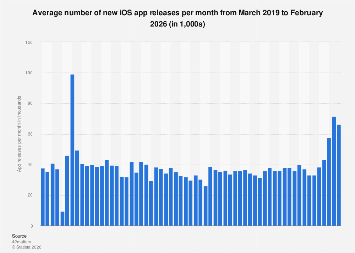
Apparently new iOS app submissions jumped by 24% last year:
> According to Appfigures Explorer, Apple's App Store saw 557K new app submissions in 2025, a whopping 24% increase from 2024, and the first meaningful increase since 2016's all-time high of 1M apps.
The chart shows stagnant new iOS app submissions until AI.
Here's a month by month bar chart from 2019 to Feb 2026: https://www.statista.com/statistics/1020964/apple-app-store-...
Also, if you hang out in places with borderline technical people, they might do things like vibe-code a waybar app and proudly post it to r/omarchy which was the first time they ever installed linux in their life.
Though I'd be super surprised if average activity didn't pick up big on Github in general. And if it hasn't, it's only because we overestimate how fast people develop new workflows. Just by going by my own increase in software output and the projects I've taken on over the last couple months.
Finally, December 2025 (Opus 4.5 and that new Codex one) was a big inflection point where AI was suddenly good enough to do all sorts of things for me without hand-holding.
I think this article is making a pretty big assumption: that people making things with AI are also going to be publishing them. And that's just the opposite of what should be expected, for the general case.
Like I've been making things, and making changes to things, but I haven't published any of that because, well they're pretty specific to my needs. There are also things which I won't consider publishing for now, even if generally useful because, well the moat has moved from execution effort to ideas, and we all want to maintain some kind of moat to boost our market value (while there's still one). Everyone has reasonable access to the same capabilities now, so everyone can reasonably make what they need according to their exact specs easily, quickly and cheaply.
So while there are many things being made with AI, there is ever-decreasing reasons to publish most of it. We're in an era of highly personalized software, which just isn't worth generalizing and sharing as the effort is now greater than creating from scratch or modifying something already close enough.
Agree. There's also a weird ideological thing in open source right now, where any AI must be AI slop, and no AI is the only solution. That has strongly disincentivized legitimate contributions from people. I have to imagine that's having an impact.
There's a very real problem of low effort AI slop, but throwing out the baby with the bathwater is not the solution.
That said, I do kind of wonder if the old model of open source just isn't very good in the AI era. Maybe when AI gets a lot better, but for now it does take real human effort to review and test. If contributors were reviewing and testing like they should be doing, it wouldn't be an issue, but far too many people just run AI and don't even look at it before sending the PR. It's not the maintainers job to do all the review and test of a low-effort push. That's not fair to them, and even discarding that it's a terrible model for software that you share with anyone else.