 Track_Shovel
Supply and demand
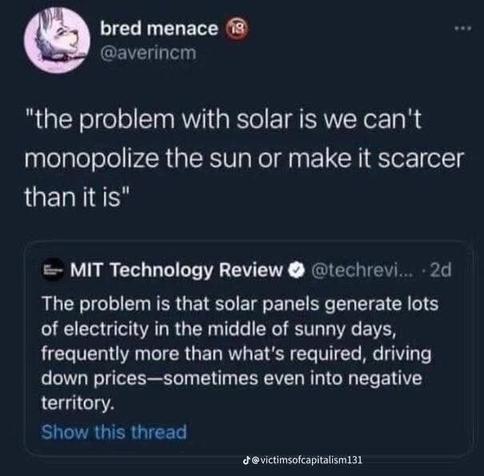
I addition to what others noted, this can also create an equality issue. Say you are a working class renter in a town of well-off home owners who have solar panels on their houses. They are likely as dependent as you on the grid when the sun isnt shining, but because they can sell back to the grid. They contribute much less to paying for the grid.
The grid that everyone relies on is therefore disproportionately funded by poorer individuals. Its the same problem with all the subsidies on electric cars and solar installations; you have to be decently wealthy to be able to take advantage.
Transitioning to EVs is better for everyone in the long term. Improved technology and greater marketshare among new EVs today means more and better used EV options in the future, with the effect increasing as the economics of scale make budget models more viable.
It’s not that we shouldn’t subsidize solar and EV, it’s that we should also use incentives and regulations to make these options work for renters. We should be requiring rental properties to add outlets to parking spaces. We should be pushing policies aimed at getting solar on apartment buildings for the benefit of the tenants.
Honestly, we should be working towards getting every building to have solar and battery and reducing our dependence on the grid.
Transitioning to EVs is better for everyone in the long term.
I dont believe this (but I’m open to being wrong). I think giving the same amount of money invested into EVs to public transit and ebikes instead, we’d be better off.
incentives and regulations to make these options work for renters
Yeah, strongly agreed there. I basically just want my tax dollars to go towards equality and resilience. Instead, it seems that the best the party not 100% controlled by fossil fuels can do is enact policies that still disproportionately benefit the wealthy. I’ve heard a lot of well-off people talking about getting a $7500 dollar rebate on an EV, which seems silly when there’s a lot of people who have never even owned a car worth that much.
I dont believe this (but I’m open to being wrong). I think giving the same amount of money invested into EVs to public transit and ebikes instead, we’d be better off.
I’m all for investing in public transportation, and ebikes certainly have their place as well. But realistically, those will reduce the need for cars, not replace them entirely. We aren’t going to have trains and buses constantly running between every small town in the US. People will still need to haul big items or large amounts of stuff. And even where public transit is readily available, there is still going to be an advantage to being able to go where you want, when you want, in a vehicle you already own. Unless we ban private ownership of cars, people will still buy them because they offer much greater flexibility than public transportation.
I also don’t like that most incentives aren’t set up in a way to support poor people buying EVs. But that wasn’t going to be a realistic possibility until cheaper EVs hit the market and enough older EVs declined in value to the point that there could be truly cheap options out there. Unfortunately, the political will does not exist to simply mandate the switch to EVs. And even if we had done it that way, without developing the market for EVs the transition likely would have meant raising costs at the low end instead of gradually lowering costs at the high end.
Regardless of how we accomplish the transition from internal combustion to electric, it is better for everyone if the vehicles we use are electric. Even if we ignore the environmental side of things, EVs are much cheaper to operate and are much lower maintenance. If that first beat up old rust bucket that someone buys is an EV, that car will cost less to own and maintain, and will be less likely to die because of some hidden mechanical issue.
And of course, there’s also the massive amount that we as a society spend supporting ICE vehicles. There’s the obscene amount of money that goes into finding, extracting, refining, and distributing oil, and the billions in profits that the fossil fuel companies pocket on top of that. And then there’s the added cost to everything else because of the increased transportation costs. And the geopolitical costs. Every dollar saved by someone driving an EV is a dollar not being drained out of us by the fossil fuel industry.
 evasive_chimpanzee