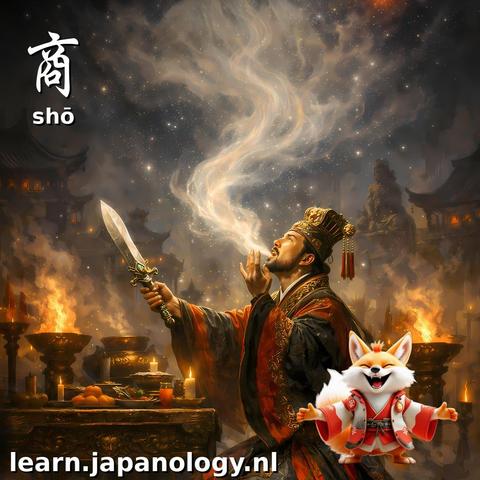
A ritual knife. A mouth. A conversation with the gods. That is what 商 (shō) meant before it ever meant "commerce."
In the earliest oracle bone inscriptions, 商 (shō) had nothing to do with money. It was a sacred act: 辛 (a blade, a symbol of ritual power) and 口 (a mouth, speech). Together they described the moment when someone stood before the divine and demanded clarity. Shirakawa Shizuka called it "clarifying the will of the gods. " The Shang dynasty made this ritual the beating heart of their capital.
And when the dynasty fell, the conquerors supposedly forced the Shang people into trade, stripping them of power and putting them behind market stalls. Modern scholars call this a myth, a story invented long after the fact. But the word stuck. 商人 (shōnin) still means "merchant. " Literally: "person of Shang. " The real shift was quieter and stranger. "To consult the gods" became "to deliberate. " Deliberation became calculation. Calculation became commerce.
A word born in temples ended up on price tags. 「われわれの売ってる商品はゲームのアイテムもアバターの洋服、畑も家も原価はタダ。 」 Wareware no utteru shōhin wa geemu no aitemu mo abataa no yōfuku, hatake mo ie mo genka wa tada. "The products we sell - game items, avatar clothing, land, houses - cost nothing to produce. " What's the most dramatic origin story you've found hiding inside a kanji? Kiko teaches you 商 (shō) and 1,977 other kanji with their stories on learn.japanology.nl.
 Loek van Kooten, MA