 Egon Willighagen
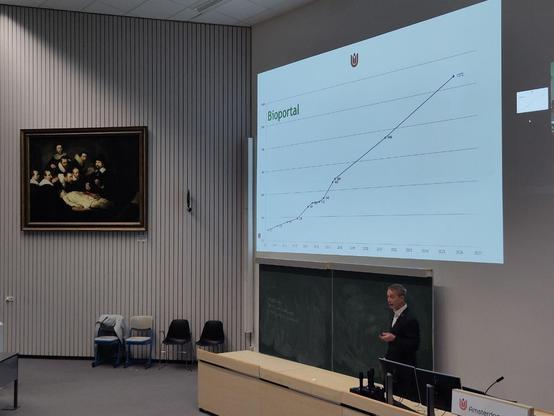
@Andrawaag is kicking off the #swat4hcls main symposium. yesterday was the tutorial day, but all the talks (including a short talk by me) will be today.
Plz ping me if you read this and are also at SWAT4HCLS!
@Andrawaag is kicking off the #swat4hcls main symposium. yesterday was the tutorial day, but all the talks (including a short talk by me) will be today.
Plz ping me if you read this and are also at SWAT4HCLS!
first speaker is Ronald Cornet (https://qlever.scholia.wiki/orcid/0000-0002-1704-5980) talking about the history of ontologies, reasoning, and more
"we have been talking about reasoning over patient data for more than 20 years, but we still have not solve it"
second speaker is Ömer Durukan Kılıç from Maastricht University. He is talking about MIMIC-III, which I think is described here: https://doi.org/10.1016/j.ijmedinf.2026.106297
third speaker is Pedro Paulo Favato Barcelos, of Health-RI about ontologies in patient history provenance
he quotes: "the opposite of an ontology is not a non-ontology, but a bad ontology" -- someone
second session just started with the first talk by Sabine Österle and Jan Armida about sharing health/patient data in Switzerland, across 26 kantons and legislations and 4 national languages
the second talk in the session also shows that RDF in hospitals is there. Enough that people are now focusing on querying across databases, and no longer just aligning ontologies.
Also, it shows that writing efficient SPARQL queries is something that requires tweaking SPARQL queries. The order of instructions matter, but a SPARQL query does not have a clear linear direction
we're back from lunch (no signs, so not clear what I had), and now started the first session after lunch by Samaneh Jozashoori and Nirmal Raman Kannaiyan using KGs and LLMs on literature for the purpose of drug repurposing
I stepped out from the session bc of a cough from last week that doesn't want to go away, and because my batteries were running out and I have a demo to give later this afternoon
I am sitting in the biohackathon area, with a RDF4RiskAssessment poster from four people from the German BfR
@bfr, is Taras Guenther or one of the other authors also on the #fediverse
after my Scholia demo (during the poster session), now listening to two talks before the final keynote of today.
First, Yael Tirlet is speaking about SPARQL modules, so that people can focus on what they want to query, rather than how.
Thinking about my talk and that of others, we need a higher level SPARQL "programming language" indeed.
second speaker is Kristina Vodorezova about FDPcrawleR, working in the ERDERA project on rare diseases
I wonder what the results are for the @wikipathways FDP
@wikipathways more on Vodorezova's FDPcrawleR can be found here: https://github.com/vodor001/FDPcrawleR
the last speaker today is Hannah Bast talking about QLever, now showing how it compares to alternatives