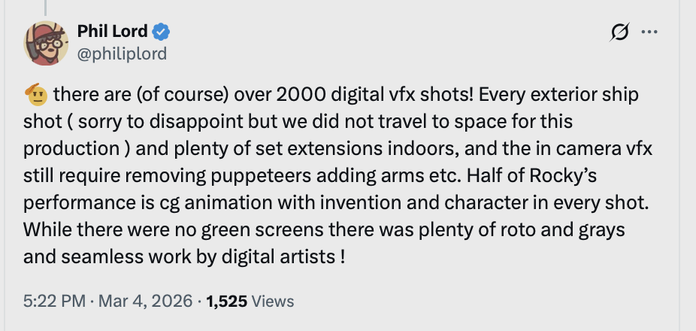
you can all stop asking me to comment now

"Project Hail Mary" (2026)
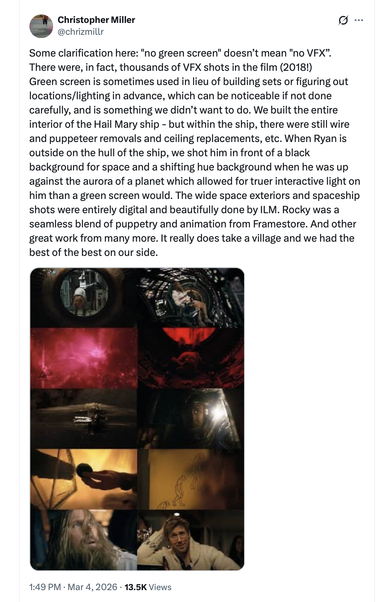
First Christopher Miller clarifies, now Phil Lord. I am extremely grateful for them putting out this information.

The discourse is still so bad. It's one thing when internet bozo film bros spread misinformation, but when the trades just say stupid stuff like this it's just so overwhelming and depressing.

Fun fact: even those movies that you think "rely on 'CGI'" have gigantic practical effects work!

the piece is worse than the headline and deeply misleads

TO BE CLEAR:
- in half the shots in which he appears, Rocky is computer graphics animation
- Project Hail Mary used LED screens
- Top Gun Maverick had all-CG jet sequences, the Dune films had all-CG sequences, Alien Romulus had all-CG aliens
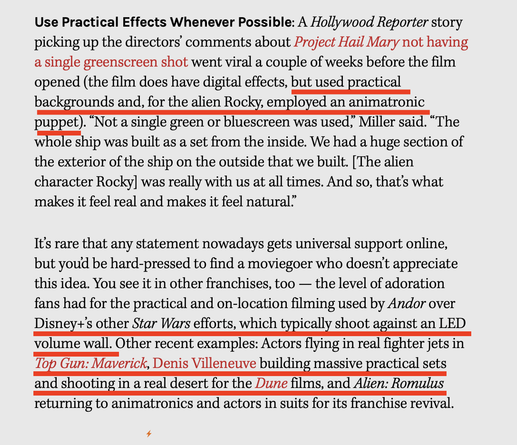
I guess writing an piece that says "good filmmakers use the right tools for the right job" —— which has been true since the dawn of cinema itself —— is just too boring for the trades

it's almost as though this happens ALL THE TIME and it's totally exhausting

https://fxrant.blogspot.com/2024/12/correcting-some-skeleton-crew.html

like I said, exhausting

(Grogu, in this shot for a piece whose theme is “CGI BAD”, is computer graphics made by computer graphics artists)

@tvaziri stopped trying to guess long time ago
Love watching the behind the scenes features instead to be amazed
@tvaziri I’m sure someone (in the industry) has/had reached out to the author(s) to correct this right? On any of these false claims? How does it continue?

@airboss yes

It continues because ignorance sells
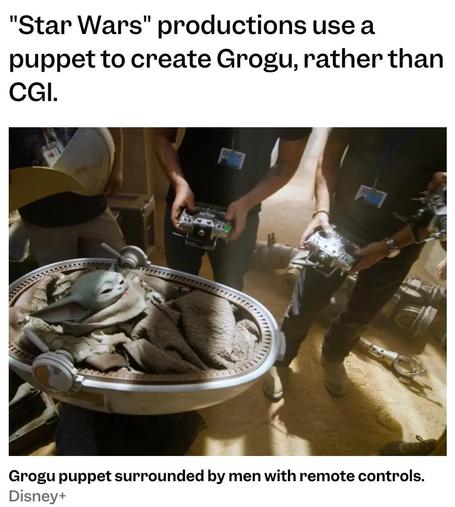
@tvaziri I had to scroll a bit: Bahr's piece is from 2019. Back then, in "The Mandalorian", Grogu was a mix of animatronics, puppetry and CGI, she even wrote about it later on. Wouldn't know how else that crib would appear to fly. But yeah, unfortunately the shorthand for "$production uses a mix of methods to animate characters" is "no CGI", just like in the screenshot below.
@tvaziri but I’m just a nobody…the movie industry seems like “big pharma”
@tvaziri maybe we need better language for what these folks are trying to convey. There was a frustration with overt CGI used in place of traditional techniques (sets that look like they are just green walls and boxes) and now that there is a bit more of a blending of the two (practical backdrops that can be digital altered later, practical standins for characters or scenery for what will later be replaced or altered digitally), as filmmakers learn how to incorporate both for the best result, that is being preferred. Having someone with your insight into the process has been helpful to my understanding and I'm less in the "CGI bad" camp than I would be without your insights.

@Alpacheez “as filmmakers learn how to incorporate both for the best result”

Why are we discussing this like it’s new?

Terminator 2 was 1991, Death Becomes Her was 1992, Jurassic Park was 1993 — all had combinations of animatronics/puppets and computer graphics

@tvaziri I think people have seen movies that do CGI badly and assume that's "normal" CGI because they noticed it. Good CGI should be so good you don't notice it. Think of how many shots with CGI you've pointed out where nobody would have known how much CGI was used for it without your insight (the Madmen 'unmaster' upscale fiasco for example that let through a bunch of shots without CGI applied). It shouldn't be done in a way that actors are confused about what they're reacting to, it shouldn't be whatever was done in much of the Clash of the Titans reboot. Sometimes things can look too slick/clean with improperly implemented CGI. Those are some of the things I think people are complaining about. But then it swings too far and people think "we have to do all practical!" Which isn't a realistic business or technical decision nowadays. Finding the right balance of practical with CGI is the key and it depends on the project/scene/movie/vision etc.
@tvaziri Also Dark Crystal had so much CGI character work in it, as well as face replacement and augmentation of characters. Such bad examples