 gaytabase
no, absolutely not.
@xarvos @dysfun I’m sorry if I fail at phrasing it correctly, but basically, if the question is:
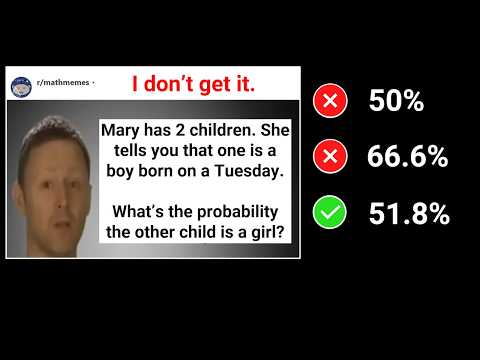
“given a very large pool of randomly selected people who have 2 children, assuming that 50% of children are boys and 50% of children are girls, and that children are born with equal probability on any of the 7 days of the week, what is the probability that a person selected from this pool, who has a boy born on a Tuesday, also has a girl?”
@evin @xarvos @dysfun if you imagine a large pool of people with two children and the assumptions about gender (unfortunately binary) and weekday of birth, then you can put them in a 14×14 grid, where each cell will have the same expected number of people in it as any other, determined by the gender and weekday of birth of each child (first child in rows and second child in columns, for example).
then, when you filter for people who have a boy born on a Tuesday, not specifying whether that boy is the first child or the second child, you filter out the union of one row and one column from the grid. a row is 14 cells and a column is also 14 cells, but they intersect in one cell, and you can’t count it twice, so that’s just 27.
 Mira
Mira 
 xrvs
xrvs evin
evin