no, absolutely not.
@dysfun I’ve seen that. the phrasing is misleading.
@mira @dysfun is it based on birth rate?
@xarvos @dysfun no, the hidden detail is how you select people

@xarvos @dysfun I’m sorry if I fail at phrasing it correctly, but basically, if the question is:

“given a very large pool of randomly selected people who have 2 children, assuming that 50% of children are boys and 50% of children are girls, and that children are born with equal probability on any of the 7 days of the week, what is the probability that a person selected from this pool, who has a boy born on a Tuesday, also has a girl?”

@xarvos @dysfun …then the answer should indeed be 51.8%
@mira @xarvos @dysfun i... have tried and still do not get this. why does the birth date make a difference?
@dysfun @xarvos actually 51.9% because apparently the person making the meme can’t round properly, the exact fraction is 14/27
@mira @xarvos @dysfun where are you getting 27??

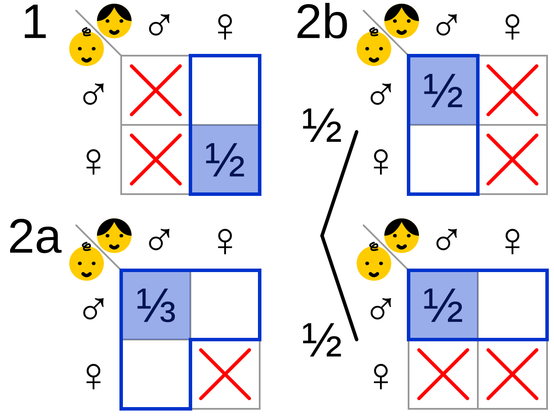
@evin @xarvos @dysfun if you imagine a large pool of people with two children and the assumptions about gender (unfortunately binary) and weekday of birth, then you can put them in a 14×14 grid, where each cell will have the same expected number of people in it as any other, determined by the gender and weekday of birth of each child (first child in rows and second child in columns, for example).

then, when you filter for people who have a boy born on a Tuesday, not specifying whether that boy is the first child or the second child, you filter out the union of one row and one column from the grid. a row is 14 cells and a column is also 14 cells, but they intersect in one cell, and you can’t count it twice, so that’s just 27.

@mira @xarvos @dysfun holy shit this is mindblowing i have to think about this

@evin @xarvos @dysfun the video explains the calculation but not the thought process, unfortunately. the YouTube comments are a bit more helpful.
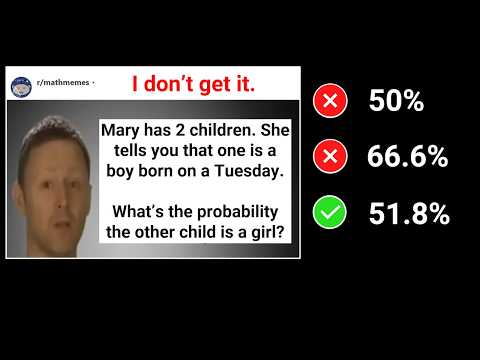

https://www.youtube.com/watch?v=JSE4oy0KQ2Q

Yes, The Probability Really Is 51.8%

YouTube
@evin @dysfun @xarvos the phrasing in the thumbnail is really misleading. if Mary is just a random person you met, and nothing about her children played a role in her selection, then 50% would be the right answer, I think.
@mira @xarvos @dysfun i... honestly am now thinking it would still be 51.9%? there's still the same 14x14 grid of possibilities, right? all equally likely?
@evin @xarvos @dysfun I, uhh… I don’t know! but surely, if you meet a random person, and they say that they have two children, and then they keep adding details about one of the children… since the details had no weight on you meeting that person, it’s absurd that this would gradually change the probability of the other child being a girl from 66.7% to 50%… right?
@mira @xarvos @dysfun hmm... well in that case you never found out that one child is a boy...
@mira @xarvos @dysfun okay i made a simpler table to teach myself and i'm now pretty convinced you're right that it's 51.9%. i'd forgotten a broader truth about this kind of probability, that if you take away the day of week it actually is 2/3. it'd be half if you knew that a specific child was a boy (like, "the older", the specific distinction doesn't matter, i think). so i was looking for a reason the day of the week would make it more likely the other is a girl when it actually makes it less likely... huh
@evin @xarvos @dysfun yes, I also found a Wikipedia page explaining the problem: https://en.wikipedia.org/wiki/Boy_or_girl_paradox
Boy or girl paradox - Wikipedia

@mira @xarvos @dysfun ah, i see. it's 50% if the selection is independent of finding out that one is a boy