 Track_Shovel
Supply and demand
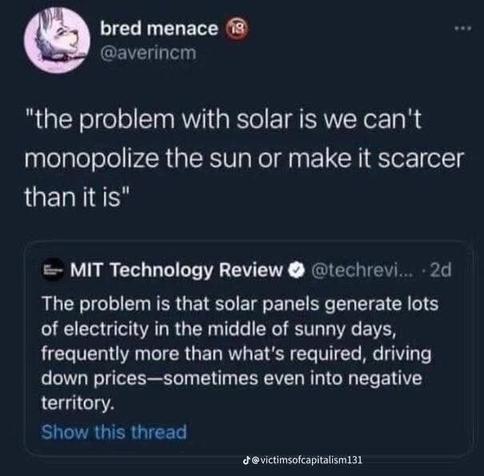
Here’s the article this is responding to if anyone wants to read it. Here’s the study it’s reporting on.
I’d say the tweet is at least a little bit disingenuous because the article is not arguing against the adoption of solar power, rather the focus is on what the challenges to California’s solar goals are and what possible solutions might be. The tone is “economic constraints might slow down solar, how can that be addressed?” This is all from 2021, and it looks like since then the slowdown in solar capacity increase it cites as a concern has not materialized, still lots of consistent growth since then. I haven’t read enough to know whether this is because the study was wrong somehow, or that it’s premise that solar installation costs might not continue to drop just didn’t pan out, or that the increased subsidies it suggested came through, but it’s an interesting topic.
Becsuse we aren’t deploying it enough, because we are entertaining a return to coal or and fighting wars over oil still.
When we should be converting to solar and wind, reguardless of cost or return on investment.
You are missing the point. Why have you, RamenJunkie not personally set up enough solar panels to provide everyone with all the energy they need? You can’t afford it? Well, surely there must be a bank somewhere that would loan you the money. All that electricity would be really valuable. Oh, the bank doesn’t think the economics make sense.
One way or another the economic problems need to be addressed and, in order to do that, they must first be acknowledged and understood. That’s what the article was trying to do. You can’t just sweep it under the rug and figure some sucker will pay for it for the rest of us.
And you don’t think some kind of economic analysis is necessary before deciding if the private sector can “handle it” or exactly how the government can beat interveine?
You’re not exactly wrong about anything, but understanding exactly how the economics break down is important, regardless of how we break down responsibility between the public and private sectors.
Of course this is all academic when the country elects Republicans and the Democrats keep nominating neoliberals. At least with a private marketplace solution it wouldn’t get shredded the moment Republicans win power.
It’s not a binary question though. There is nothing wrong with the government interceding in a dysfunctional market, but the first step should be understanding what broke down and why.
Should the government intervene on the production side or the consumption side? Do we need more windmills and nuclear to compensate for Solar’s instability, or just more storage?
Spain did an incredible job converting over to renewals. Then they had an extended outage because they hadn’t properly considered reactive power difference between generators and solar/wind generation. Then, of course, the fossil fuel industry turned that into propaganda. Studies matter.
Well there is one problem with negative electricity prices though. It’s that you’re gonna have to pay to produce electricity, charge batteries you might not have, or disconnect from the grid. I suspect fancy new inverters allow doing the latter automatically, but people with older setups will have to either do it manually by the hour when prices go negative, or upgrade their setup.
Good news is that negative electricity prices also apply to fossil fuels so there’s incentive to reduce production there too.
Here is an idea.
What if we do something becsuse its a net food, and who cares if there is a positive or negative price because tying everything ever to monitary value is cancer on society.
 chicken
 NocturnalMorning
 RamenJunkie