Note that products derived from palm oil should be avoided if you can. www.wwf.org.uk/…/8-things-know-about-palm-oil
8 things to know about palm oil

Palm oil is one of the most efficient and widely used vegetable oils that comes from the fruit of oil palm trees. We've broken down they key facts.

WWF

That article you linked seems to be saying that palm oil is actually really good?

It says that it is a major driver of deforestation because people are tearing down trees to grow more of it because it’s a very useful and versatile oil.

It later says that switching away from palm oil isn’t a solution because palm oil is actually such an efficient crop that if you used something else the amount of land needed to produce enough oil would drive far more deforestation.

The article is a call for more regulation on deforestation, not a call to not use palm oil. It in fact almost argues the opposite.

It’s not just deforestation, especially in Orangutang habitats that are endangered. They are also rife with forced labor, ie slave labor. They lure desperate foreigners with promises of good jobs, baiting and switching them with a life of slavery doing hard, very hard labor, including kids. The families can sometimes bail them out by paying several thousand dollars, a lot of money to these impoverished bangladeshis and Indians and the like.

Many of the desparate migrants that can speak english well are now sold to chinese gangs to run romance scams from slave compounds, a 40 billion dollar a year industry just in S. Asia they figure now, pig butchering and the like.

For sure. But the problem isn’t palm oil itself, which seems like something of a miracle plant when compared to other sources of vegetable oil. It’s that the supply chain for it is rife with abuse. Similar to coffee, or honestly, most things that are harvested predominantly in poorer countries with less oversight.

But, like coffee, it seems there are organizations that certify certain palm oil suppliers as “cruelty free,” so it’s probably better to try and hunt those out in favor of foregoing palm oil entirely, which seems like a pretty incredible product otherwise.

Even aside from environmental impacts, palm kernel oil is actually really bad for your cholesterol. It’s used as a filler in a lot of foods (many peanut butters, for example).

If you decide not buy the omnicidal product because palm oil is an ingredient, that’s good.

Unfortunately only a tiny fraction of people are ethical. The rest are not just unknowingly buying things with things like palm oil in it, but are actively choosing to speed-run us towards a mass-extinction event.

That is not really true and is more fear mongering. Palm oil is much better than any alternative that can be grown in the same regions. The issue is not palm oil but amount of consumption. Palm oil actually takes up less land than other crops that can produce that type of oil.

Palm oil is much better than any alternative

Palm oil does what palm oil does. And it’s useful in food manufacturing because you can create the same products without using butter or transfats. That’s pretty much the only reason it gets so heavily used.

But the actual alternative to palm oils is to stop consuming or manufacturing products using palm oil. That means some products should just be pulled from the market. Oreos, for example.

But Oreos are mostly vegan and most of their competition uses babies in their recipes.

Palm oil actually takes up less land than other crops that can produce that type of oil.

I think this is a little bit of a false equivalence, though. A hectare of borneo jungle ≠ a hectare of Saskatchewan prairie. It’s probably an impossible thing to accurately calculate, but I’d like to see kind of control for ecological cost. E.g. is 1 hectare of borneo as important to the earth as 2 hectares of prairie?

It also seems a bit obvious that an ecosystem on the equator would be capable of greater production than one closer to the poles. It always bothers me when people compare like “x crop takes 2 times as much water as y crop” when crop x might be grown somewhere that water isnt an issue.

Yes, but palm oil is a hard fat, it’s used for cookies and anywhere that needs to be solid. alternatives are coconut oil and butter. Neither are better in yield vs land use.
But if butter can be produced in abundant habitat like the midwest prairie instead of threatened species-dense places like Borneo’s jungle, I’d prefer to go with the higher land use but ultimately less ecologically destructive option.
Sure, it’s an alternative. It’s also much much more expensive and less healthy than palm oil (butter has more saturated fats and cholesterol).
But why do we need to grow oil in these regions?
Can we start doing this with everything?
When I was a kid, in my country all machinery and electronics were accompanied with full mechanical and electrical schematics.

A lot of times it’s because those things required maintenance, and it was possible to do with basic tools.

Most things these days aren’t built with maintenance in mind, mostly because they’re obsolete before they need to be fixed.

There are certainly things that doesn’t apply to, but for a lot of consumer products, it is.

I wish. That would be rad.

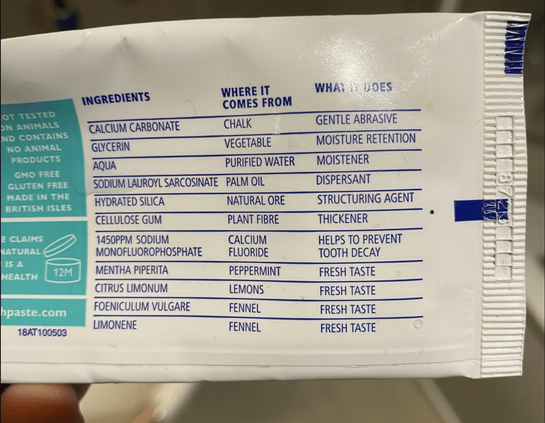
The problem is a lot of nasty things come from less scary sounding things. For example:

Ingredient: Ricin, Where it comes from: Castor beans, What it’s used for: Poison.

I assume there’s a better example to make your point because at least here you’re explicitly stating ricin is used for poison, an objectively good thing to know.

My point being that knowledge of where something comes from doesn’t tell you if it’s a good thing or a bad thing.

I could have rephrased “what it’s used for” to be “laxative”. A true statement which doesn’t expose the fact that ricin is a pretty powerful poison.

People are biased to think “chemical name bad, common name good” and that’s the problem I’m exposing. You can pull out a lot of toxic stuff from things that sound harmless.

This is still an improvement, let’s leave it at that.
The calculus here isn’t strictly whether it’s “healthy” or not. There are quite a few ingredients that can be derived from both plants and petroleum, for example, and I would choose the one derived from plants every time
Ingredient: Hydroxyl acid Where it comes from: Deep underground well What it’s used for: Industrial solvent

There’s actual truth to this. In toothpaste no less.

Ingredient: Asbestos

Comes from: naturally occurring mineral

Used for: mild abrasive

To be fair here though, how much toothpaste do you dry and snort these days?
ingredient lables can be pretty long. I think we need a QR code with this and much more information. it should be able to back track where you product came from and such.
Either that or it creates an incentive to use fewer, simpler ingredients.
Can QRs fit enough text to hold all the ingredients and their descriptions?
I’d hate it if they were just links to some crappy government website that’ll inevitably go down couple of years down the line
Maximum 4296 alphanumeric characters, but that’s with the largest-sized code and low/no error correction (so not always practical).
QR code - Wikipedia

And with only the English alphabet, just like in the good old days of ASCII.
this is one of those things where distributed ledger would be useful as it should at least track chain of custody then there should be enough room left over for the ingredients table.

Remember when toothpaste came with [microplastics, on purpose?

](beatthemicrobead.org/myth-buster-toothpaste-still…)

Myth Buster: Toothpaste still contains microplastics! - Beat the Microbead

To date, we have registered 589 dental care products. Out of those 349 contained either microplastics or sceptical microplastics & in some cases both.

Beat the Microbead

Mmm, peppermint

squirts the entire tube into my mouth

psst… you can just buy peppermint

Need to find one without any palm oil, boycott palm oil.

Also where is the wintergreen?

Note that products made with aqua contain dihydrogen monoxide
That’s a chemical. It’s also an acid: To some, it’s better known as hydroxic acid.
It has the highest pH of any known acid!
Technically the majority of strong bases are also weak acids. Those have higher pH.
Hahahah, I guess that depends on which definition of acid you want to go with.
May contain traces of dihydrogen monoxide
Imagine this on a bar of chocolate. Ingredient: cocoa powder, what it does: flavouring, where it comes from: child labour and exploitation.

JFC can we make this list obligatory on all products?

It’s so amazing to finally just read in plain English what an ingredient is supposed to be doing.

Maybe even add a few columns?

I would like to see this but for laws as well. Just cut down all that self-important job security and say what it is in plain english

There is actually a law for that (in the US)(apologies for linking to a currently fascist source)

www.congress.gov/bill/111th-congress/…/946

H.R.946 - 111th Congress (2009-2010): Plain Writing Act of 2010

Summary of H.R.946 - 111th Congress (2009-2010): Plain Writing Act of 2010

“Spices, natural and artificial flavors”

Mmm tastes like freedom and definitely not a corporate hellscape.

Peanut butter:

  • ingredient: Peanut
  • Where it comes from: Peanut
  • What it does: Peanut
What it does: adhesive (sticks to the roof of your mouth)

Fennel?!

huPBlarrrgh! 🤮

But where does calcium fluoride come from?..

If you bring calcium within sniffing distance of fluorine, you get calcium fluoride… just make sure you don’t have anything else close to the fluorine, including you.

Also, it’s basically just mined and purified as-is, it’s pretty common.

The Big Bang
“To bake a calcium fluoride, you must first invent the universe.”
Calcium Fluoride, 95+%, 2.5kg: Amazon.com: Industrial & Scientific

Calcium Fluoride, 95+%, 2.5kg: Amazon.com: Industrial & Scientific

I have bad news about the first ingredient, calcium carbonate. It contains lead!
tamararubin.com/2025/01/toothpaste-chart/

Chart Comparing the Toxicant Profiles of Popular Toothpaste and Tooth Powder Products Tested by an Independent, Third-Party Lab in 2025

Portions of this article last updated: February 21, 2026 Lead Safe Mama, LLC Community Collaborative Laboratory Testing Initiative   The Lead Safe Mama, LLC (LSM) team has been conducting independent, community-funded, scientific testing of consumer goods since 2009. Prior to 2024 our work primarily focused on testing consumer goods (including dishes, toys, household items, furniture,...


Lead Safe Mama
I question their methods if they’re also afraid of fluoride