 Track_Shovel
Supply and demand
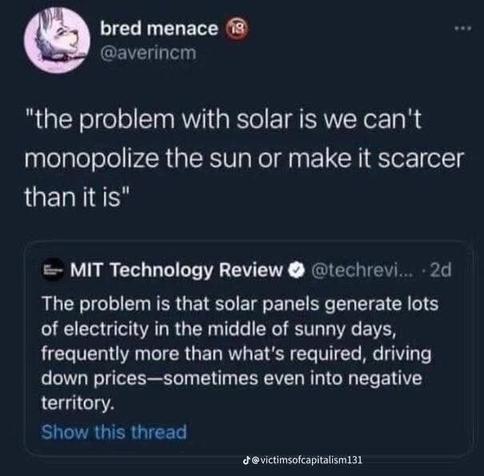
I addition to what others noted, this can also create an equality issue. Say you are a working class renter in a town of well-off home owners who have solar panels on their houses. They are likely as dependent as you on the grid when the sun isnt shining, but because they can sell back to the grid. They contribute much less to paying for the grid.
The grid that everyone relies on is therefore disproportionately funded by poorer individuals. Its the same problem with all the subsidies on electric cars and solar installations; you have to be decently wealthy to be able to take advantage.
Is that 85% based on the flat rate, or an actively changing rate? If it’s the flat rate, thats a super good deal. The cost of generation can easily vary by 10x throughout the day, so if the average price is $0.15/kWh, they might be paying you 13 during the times it only costs 1.
I know in some places the meters are smart enough to track when the usage is occurring, though.
 evasive_chimpanzee