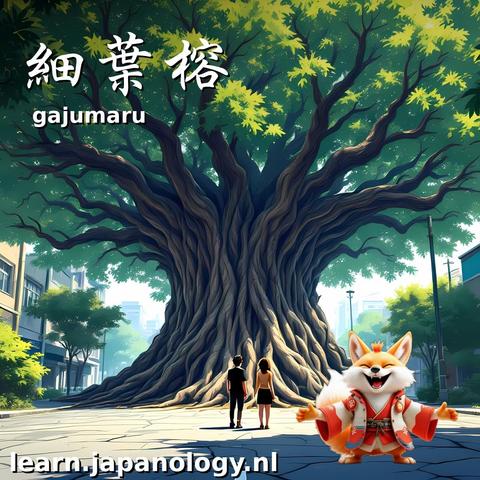
This tree eats cities alive.
The 細葉榕 (gajumaru, the Chinese banyan) drops roots from its branches. They grab walls, crack pavement, and fuse into massive trunks. One tree can look like a whole forest. The word gajumaru is pure Okinawan. The characters tell a Chinese story: 細 (fine) + 葉 (leaf) + 榕 (banyan). That last kanji combines tree (木) with 容 (form), because once you see a gajumaru, you never forget it. In Okinawan folklore, a kijimuna (a red-haired tree spirit) lives inside every old gajumaru.

Befriend it, and it brings you fish. Anger it, and it sits on your chest while you sleep. 舗装を突き破るほど強靭な気根を伸ばす細葉榕 (gajumaru) を前に、人は自然の力を思い知らされる。 Hosō wo tsukiyaburu hodo kyōjin na kikon wo nobasu gajumaru wo mae ni, hito wa shizen no chikara wo omoishirasareru. "Standing before a gajumaru with aerial roots strong enough to crack pavement, you feel the raw power of nature. " What's the most awe-inspiring tree you've ever stood in front of?
Kiko practices 30,000 words with you on learn.japanology.nl, including gajumaru. We start with the easy stuff, but trees like this are waiting further down the path. #Japanese #LearnJapanese #Kanji #JLPT #WordOfTheDay #Japanology #Banyan #Okinawa #Nature #Trees #GajumaruTree #ChineseBanyan #JapanCulture #Folklore