 James Logan
New gear!! Time to find out if there's anywhere I've made unintentional antennas!
With 3 switching converters, a 48MHz CMOS clock, and ethernet, there's a nonzero chance of gremlins in here...
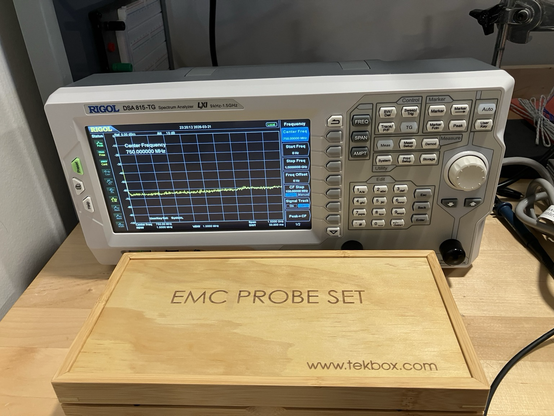

New gear!! Time to find out if there's anywhere I've made unintentional antennas!
With 3 switching converters, a 48MHz CMOS clock, and ethernet, there's a nonzero chance of gremlins in here...
Deimos DAQ EMC sweep is done!
End result:
* No detectable E-field signals
* Some noticeable B-field signal, but all decays within <1cm distance of sources
* SMPS, CMOS clock, micro, and RMII traces are the notable emitters
* No notable signal near cables (power converter input filters are working!)
* Whisper-quiet near the precision voltage references, all analog frontends, and even active PWM outputs
Actionable bits:
* Move RMII routing to inner layer
* Series resistor for CMOS clock? maybe
* Maybe copper tape over SMPS for prod
* Maybe copper tape over micro and clock if damping doesn't work
@ponderingpothos Buck converters couple switch noise to their inputs, adding a damped LC filter is the trick.
https://www.ti.com/lit/an/snva886/snva886.pdf?ts=1774094776683
@0h00000000 Thanks! Right now, I just have a lightly damped RC filter on the input, and am leaning on the power supply cable's ferrite for inductance.
This particular board only pulls about 100mA max, so I can probably afford to add a little inline damping from a ferrite.
@ponderingpothos You want to avoid power cable and input traces acting like an antenna and impacting your measurements. Check out the TI Web Bench tool for your part, there is a check box to add a EMI filter.
Basically more inductance very close to the VIN on the IC is best, maybe 2.2uH or something, and then if the part needs maybe 4.7uF input capacitance, then you add a damped capacitor (~1-3 ohms) that's 4x that size between the inductor and the input cap, and add bulk capacitance on the other side of the inductor with the power line. This will slow down the edges coming into the IC and force it to use more of it's input capacitor.
 Ben
Ben