
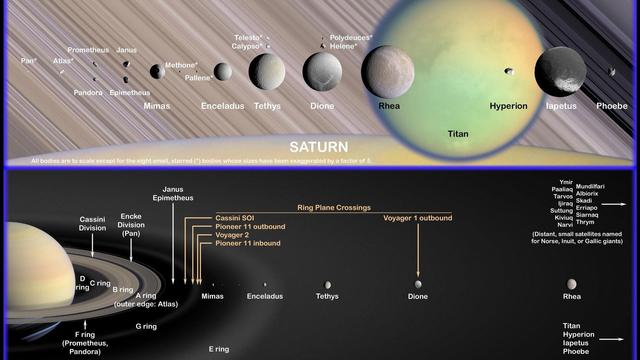
Astronomers have discovered 11 more moons around Saturn, bringing its total to 285--by far the most of any planet in the solar system.

The true number may be unknowable, if you count every ring particle as its own little moon.

https://minorplanetcenter.net/mpec/K26/K26F14.html #space #science #nature #math
@coreyspowell Yeah, I think we might need a scientifically useful definition of a moon to go with the currently scientifically useless definition of a planet.
@StarkRG @coreyspowell PLUTO IS A PLANET. Now get off my hill.
@dancingtreefrog @coreyspowell I honestly don't care whether the definition include Pluto, I think it probably should, but what I really care about is that it be a *useful* definition, not one mired in legacy. The existing definition is both too narrow (it doesn't include rogue planets or planets orbiting other stars) and too broad (gas giants should absolutely not be in the same category as rocky planets, and ice giants should probably be considered a different category from normal gas giants).
@dancingtreefrog @coreyspowell Pluto, Titan, and even Ceres have more in common with Earth than it does with Jupiter or Neptune. Maybe stop using the word "planet" entirely, and use "world" for things you could theoretically go to and walk around on without accidentally reaching escape velocity. World is a perfectly cromulent word and does the job of putting in our mind the idea of a place we could go and exist. Even with floating habitats, Jupiter is different enough to not really be a world.

@StarkRG @coreyspowell I agree, although probably many people think of "world" as one that has life.

Also: what about dual planets orbiting each other, or near-duals like the Earth-Moon system?

@dancingtreefrog @coreyspowell I dunno, when astronauts walked on the Moon, they often remarked that it was a world with it's own stark beauty. Looking at pictures of the surface of Mars, Titan or Venus always make me think "world." Even if the environment would kill us instantly, we can imagine walking around there. Gas and ice giants much less so, though more than stars. Large enough asteroids and comets could be worlds too. Too small and they're just rocks, even if they're mountain-sized.
@StarkRG @coreyspowell I think maybe the concept or feeling of "world" is built directly on personal experience or indirectly on learning about someone else's personal experience?
@dancingtreefrog @coreyspowell Is that any different from other words and concepts?
@StarkRG
Probably not. Although someone such as a child raised on a "mountain-sized rock" might think of it as a world while an adult might see it as a rock.
@coreyspowell