Please don’t be shocked, but I’ve been reading old #UNIX Review magazines on Archive.org, as one does. I’ve been finding a number of interesting artifacts throughout. This June 1984 ad by Cadmus Computer Systems listed a #USENET address: !wivax!cadmus.

This is a UUCP bang path, for the kids who don’t know. The ! separates relay hops, it’s a literal routing instruction. Get to the backbone, reach wivax, forward to cadmus.

No DNS.

Machines screamed at each other to swap data.

#unix_surrealism

wivax was a VAX at Wang Laboratories in Lowell, MA where Cadmus was based.

The TELEX number printed right next to it is also interesting. This represents telegraph infrastructure and the infant internet, side by side in a transitional moment.

Here’s an ad for cross-compilers and assemblers for UNIX environments.

My favorite detail here is this brag: “Over the past 3 years, we’ve built over 1MB of working code.” Cross-compilers, assemblers, simulators, and debuggers targeting six architectures across a dozen hosts. This code was dense.

The 80’s #UNIX wars were a wild time.

It’s also very fun to read the articles from the time and see what they were predicting for the future. “UNIX for the masses” was a popular topic.

This is an original ad for a #UNIX computer company.

No AI art here! You can see the artist’s signature over the dragon’s wing.

The art in these ads is incredible. This one for ChipCrafter by SeattleSilicon is pretty great.
This is some proto- @prahou art right here.

To think all of this amazing art is buried in 40-year-old computer magazines.

This one is from the July 1988 issue of "VLSI Systems Design."

@occult strong Memphis style energy <3
@neauoire new Radiohead album art just dropped (1988).
There’s an LLM coding joke in here somewhere.

@neauoire we need to normalize Lisp fan art like this.

#lisp

Editor: quick! I need art to accompany the article on internationalization of #UNIX for our Dec 1985 issue!

Illustrator on shrooms: say no more.

Boss: I need art for an article on #UNIX networking technologies for the next issue of UNIX WORLD.

Artist: come back tomorrow.

Computing in the year 2029 as depicted in UNIX WORLD magazine, 1985.

#UNIX

From a 1991 SunExpert magazine article about “What’s to come” for network protocols. The article depicts a man traveling into the 2020’s, seemingly unaware of the chaos he’ll find.

He’s going to pass @prahou traveling back in time to 1991 to get some mint condition Sun workstations.

#SunMicrosystems #UNIX

Hey #Fediverse! See you all at the 1985 California Computer Show.

#UNIX #RetroComputing

Oh, this is good...

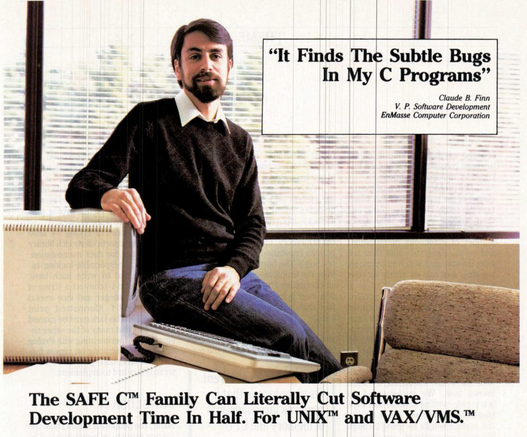
From UNIX World, 1985: "It finds the subtle bugs in my C programs" - Claude B. Finn.

40 years later, people are using Claude to find bugs in programs. What's old is new again.

#Anthropic #LLM #Claude #ClaudeCode #AI #Security #Programming #UNIX #C

@occult Every new language, tool, platform, library, and framework in the last 40 years was going to cut development time in half. Must be close to zero already even without Claude.
@bit101 @occult Those promises have proven to be bullshit ever since Synon/2 was first inflicted on me in 1986

@rozeboosje @bit101 @occult wow. I just read up on synon, dug into a bunch of screenshots of yhe development process.

I guess this is one of those things that demos amazingly well when you want to build a somple crud application.

It's still not clear to me how you do things outside of the templates. You write a separate program in COBOL and just call into it?

@loke @bit101 @occult We used Synon/2 on the AS/400 35 years ago so my memory is a bit patchy but you had a choice of "templates" for commonly used design patterns. These produced a Synon/2 code framework that you can't drill into but that "did the job", but it also contained points into which you could insert chunks of RPG/400. You saved a day not having to code the basics. Then you lost a week hacking around how Synon/2 never did exactly what you wanted it to, losing more time than you saved.
@loke @bit101 @occult And this pattern has repeated itself with every 4GL or other product that claimed to "magically" do most of your work for you ("Clarion") and allow you to "Develop 10 times faster" (right, PCSoft, "WinDev" and "WebDev") and I see no reason whatsoever to believe that modern "AI" tools like "CoPilot" or "Claude" would be any better. Claude will be very impressive until it just won't do what you need it to, and Claude, and DEFINITELY you, will have no idea why.
@rozeboosje @bit101 @occult right. As someone who has seen the marketing from products like this for at least 40 years, it sure seems similar.
@loke @bit101 @occult PCSoft, in particular, always annoyed the living shite out of me with their advertising full of scantily clad young women in suggestive poses. Merde, my French friends, this is not 1960 any more and sexism and misogynism have not been acceptable in advertising for decades. Then again, the advertising is as shitty as their product so at least it's not "false"...

@loke @bit101 @occult

We, thankfully, haven't used #PCSoft's WinDev and WebDev for more than a decade, and good riddance to it, too.

But, for old time's sake, and also for shits and giggles, I just looked them up, and whadyaknow they are STILL using that same obnoxious advertising model.

@rozeboosje @bit101 @occult I checked it out as well. I couldn't believe what you said, but it's true. It's truly something out of 1988. But they seem to have bolted an llm on top of it now?

I love it how they promote their security scan, that, among other things, checks for "use of IE ActiveX"

@loke @bit101 @occult If you scroll down you'll see a banner "They are using WinDev", listing a few big companies with the one common attribute: none of them are IT. Some manager types in those companies decided to use their "magic beans" to develop their in house applications, and now they're saddled with a technological debt that prevents them from ever unshackling themselves from PCSoft.

Poor sods. But that's how I suspect PCSoft somehow manages to keep its head above water.