The proton, 1836 times heavier than the electron, is made of two up quarks and a down, with two of their spins aligned and one pointing the other way.

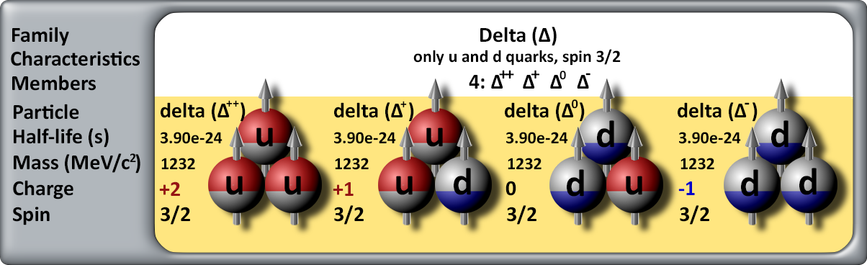
The same quarks with all spins aligned give a new particle, the Δ⁺, that's 2411 times heavier than the electron!

But the Δ⁺ is just the first of many 'excited states' of the proton: particles made of two up quarks and a down, but arranged in different ways, with higher energy and thus more mass. They quickly decay, often turning back into a proton.

There are two main kinds:

• If two quarks have spin pointing the same way and one points the other way, you get a particle with total spin

1/2 + 1/2 - 1/2 = 1/2

It could be a proton, but there are lots of others. Any particle of this kind is called an N*⁺.

• If all three quarks have their spins aligned, you get a particle with spin

1/2 + 1/2 + 1/2 = 3/2

Any particle of this kind is called a Δ⁺.

When we want to be precise, the Δ⁺ I mentioned before is called Δ(1232)⁺, because its energy at rest is 1232 MeV. That corresponds to its mass being 2411 electron masses. But then come a family of increasingly overweight relatives: the Δ(1600)⁺, Δ(1620)⁺, Δ(1700)⁺, Δ(1750)⁺, and so on, all of spin 3/2.

Similarly the proton can be called N(939)⁺, though it'd be like calling water dihydrogen monoxide. Then come the N(1440)⁺, N(1520)⁺, N(1535)⁺, N(1650)⁺, N(1675)⁺, N(1680)⁺, and so on - a seemingly endless series of increasingly heavy relatives, this time all of spin 1/2.

Physicists started studying these excited states, or 'resonances', in 1952. By the late 1960s, people were cranking them out. How to understand them???

(1/n)
Gell-Mann and others came out with quarks around 1964, which were extremely useful in organizing our understanding, but of limited use in computing particle masses!

You need quantum chromodynamics (QCD), invented around 1973, to understand how quarks interact and have a chance at computing the masses of the particles they form.

But even with QCD it's incredibly hard to do the computations! So even now, many things remain mysterious -- and those who love this subject have lots left to do.

For example the lightest spin-1/2 excited state of the proton, the N(1440)⁺, has a mysteriously low mass. It defies simple explanation! It's called the 'Roper resonance' after the guy who found it in 1964, and people have been struggling with it ever since:

https://en.wikipedia.org/wiki/Roper_resonance

For the epic quest to understand the Roper resonance, read this:

• Volker D. Burkert, Craig D. Roberts ,Roper resonance -- solution to the fifty year puzzle, https://arxiv.org/abs/1710.02549

"This is a prodigious task, but a ten-year international effort, drawing together experimentalists and theorists, has presented a solution to the puzzle."

But don't bet on it being the final word!

This physics of particles made of quarks -- called 'hadron physics' -- is in some ways a lot like nuclear physics, or chemistry. The underlying laws are known. Applying them can be very hard. You wind up needing supercomputers, physics intuition, and rules of thumb.

But nuclear physics is less useful than chemistry, and hadron physics is even less useful. So past a certain point you do it, if at all, for love.

(2/2)

Roper resonance - Wikipedia

@johncarlosbaez What is especially interesting here is that the difficulty seems to lie not only in the equations themselves, but also in the enormous space of hypotheses, regimes, and effective descriptions between the fundamental theory and the observed resonance.
One possible path, perhaps, is not to try to calculate everything directly from the outset, but first to compress that space: to distinguish where an almost “pure” configuration dominates from where mixing, thresholds, and competing channels already become essential. Then the heaviest computations would not be launched blindly, but only after such a structural filtering step.
To do that, one would probably need to account separately for external sources of excitation and internal sources of the state’s structural complexity.