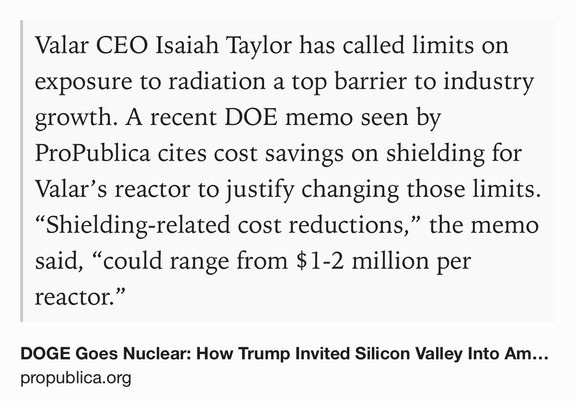
DOGE Goes Nuclear: there is stiff competition from every other paragraph in this parade of WTF, but “protecting people from radiation is just soooo expensive!” is the last thing I want to hear from people responsible for nuclear safety.

Maddening. Terrifying.

https://www.propublica.org/article/trump-nuclear-power-nrc-safety-doge-vought

»A chief cause of Japan’s Fukushima accident, investigators found, was the cozy relationship between the country’s industry and oversight body, which opened the door for thin safety assessments and inaccurate projections overlooking the possible impact of a major tsunami.
“We knew regulatory capture led directly to Fukushima and to Chernobyl,”«

https://www.propublica.org/article/trump-nuclear-power-nrc-safety-doge-vought

DOGE Goes Nuclear: How Trump Invited Silicon Valley Into America’s Nuclear Power Regulator

In its rush to boost nuclear energy, the Trump administration is rapidly rewriting rules to ease regulations and provide financial breaks for industry. “The safety culture is under threat,” a former head of the Nuclear Regulatory Commission said.

ProPublica
@allochthonous The fact that the phrase, "time, distance and shielding," puts shielding last doesn't mean it's a lower priority (said an old man who once upon a time worked for a company that dealt with nuclear waste.)
@allochthonous This is actually why the Chernobyl disaster happened. The Soviet government skimped on secondary containment and other safety measures because they thought like this.
@allochthonous
Now imagine how they’ll handle the waste.

@allochthonous Lovely, just lovely.

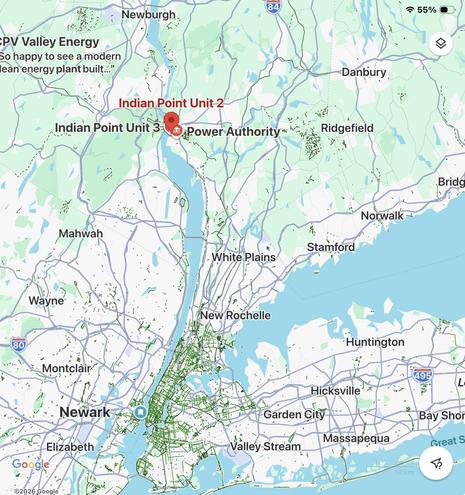
Indian Point, which sits ~40 miles north of NYC, is currently shuttered, but deranged donny wants to re-open it and Rep’s like Mike Lawler are pushing hard to make that happen.

#whatcouldgowrong #radiation

@allochthonous

Is Valar yet another company with a lord of the rings name which is just doing awful shit?

@gbargoud oh geez, I hadn’t even noticed that.

Of all the works to mine for names for your ruinous and corrupting technology companies.

@allochthonous

It's become a cliche at this point

@allochthonous
There's definitely value in further investigating the validity of the linear no threshold (LNT) model of radiation protection (the current basis of regulating worker and public radiation exposure, also known as ALARA, "as low as reasonably achievable").

A lot of data over many decades supports alternative models, the most notable (and politically charged) probably being hormesis. One interpretation of this model suggests that small doses of radiation trigger immune system responses which make the body better at repairing damage from radiation. Analogous to a vaccine.

This isn't to say one should start intentionally dosing himself.

The LNT has one definite benefit: it's very easy to implement. It requires little technical understanding of radiation. For example, suppose I can reduce the dose by putting in more shielding. LNT says I should.

This adds material cost and increases time to complete the job using a model that *assumes* any radiation insult is increased risk. The cost is of course passed on to the customer.

Protesters to this model want to further examine the nature of low radiation doses and determine if the ALARA concept is actually correct. (Note, I'm not taking a position.)

One desired outcome is finding out whether we are indeed wasting time and money on unnecessary protection measures.