

#MOTIS v2.9 is out! 🎉 🤩

Highlights include:

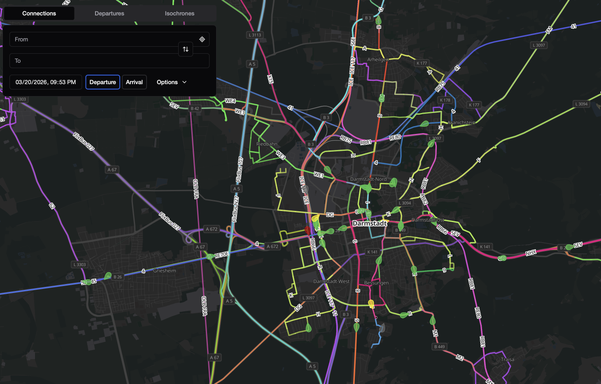
We now have the option to compute shapes (exact line geometry) on import. Before, buses would sometimes pass through buildings on the map if the #GTFS dataset doesn't provide shapes. Now, everything (buses, trains, etc.) is routed based on OSM data. The development was supported by MOBIDROM 🙏

#MOTIS also gained initial support for OJP now, Europe's standardized API for journey planners.

SIRI-FM for elevator status updates is also available now 😎
Hi @felixguendling, that's awesome ! Using Pfaedl I guess ?

What about performance though ? Do you have benchmark showing the compilation cost in hours of this new feature, with and without ?

@maeool We couldn't build on Pfaedle because in @Transitous experiments we couldn't make it work for planet-scale processing on the hardware we have. One option would've been to cut out extracts using OverpassTurbo, but since it puts heavy load on the Overpass server, we would've needed to host our own instance which comes with its own complexities and hardware requirements. Since we needed extra features like caching and had the efficient osr routing model anyway, it was easier to start there.

@maeool On our server, it takes ~2.5h to recompute every single shape in the dataset (`all` setting). For production, we keep existing shapes (`missing` setting) which makes it even faster because datasets like FlixBus already come with shapes.

Routing speedups for osr (like Contraction Hierarchies) will likely translate to even faster shape computation 😎 🚀