 ✧✦Catherine✦✧
 fyrfaras
@whitequark @imbl @Elizafox I sea, could you please elaborate why mypy is a net negative for programming? ^_^
 Elizabeth

@whitequark @fyrfaras @imbl I like mypy but I get some people prefer Python to be properly dynamically typed (that’s fine too).
@Elizafox @whitequark @imbl Alrighty, thank you for explaining it to me. ^^ Also I just read a toot thread, below, by @xgranade that mypy doesn't use “mathematical type checking” but rather “linting heuristics” which could lead to this bad reputation you've mentioned earlier I think.
Cassandra is only carbon now (@[email protected])
As I mentioned earlier, it's a bit more difficult to have good exit strategies with ruff, given that the specs around linting are much more loose. It's even harder to have a good exit strategy for ty, even though there's good specs, because there's not a great type checker to use instead¹. ___ ¹As has been pointed out to me, mypy is, for all its strengths and weaknesses, not a type checker. It doesn't follow formal mathematical type checking rules, it follows linting heuristics.
 Cassandra is only carbon now
@fyrfaras @Elizafox @whitequark @imbl Like, I'm not trying to be petty or sarcastic about it. Rather, it's that I think some of my earlier (and admittedly a bit toxic) hate of mypy came from deeply misunderstanding what mypy is and is trying to do. I would have expected from docs and the description, that mypy accepts well-typed programs and rejects programs that violate typing rules — but that's not it. It rejects well-typed programs that are likely incorrect, which is what a linter does.
@fyrfaras @Elizafox @whitequark @imbl In particular, I cannot predict the behavior of mypy given knowledge of Python's type system alone. I have to know about what is and is not likely a logic error in Python.
Which is fine if you want a somewhat more rigorous linter that has the benefit of being developed under the auspices of the PSF itself. But it's not what I want or would want out of a type checker.
@whitequark @fyrfaras @Elizafox @imbl Agree, absolutely.
I made the mistake of thinking of it as one for a long time, but I have been disavowed of that notion.
@xgranade @fyrfaras @Elizafox @imbl however the problem is that the mypy website has this misinformation on the landing page
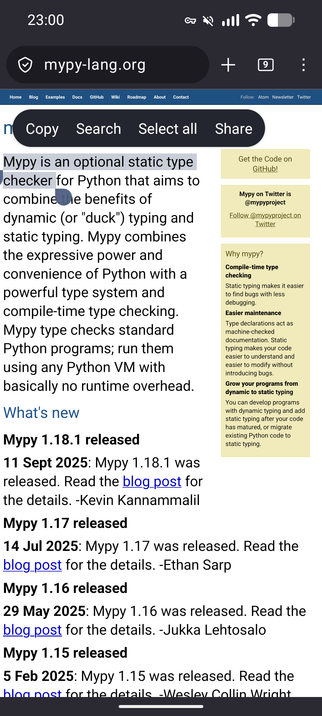
@whitequark @fyrfaras @Elizafox @imbl Ooof, yeah. Were I in the mood to start useless fights, I'd be tempted to PR a change to that page, but it'd just get people hurt for no reason.
I mean, it just isn't a type checker. That's not what it does.
 Alyssa Coghlan
@xgranade @whitequark Would "type aware logic checker" be a more accurate description of what it does?
@ancoghlan @whitequark @glyph suggested "type aware linter" in another branch, and yeah, I think that's much more instructive, and would have reduced a lot of frustrations for me trying to understand what was going wrong.
 Glyph
Glyph@xgranade @ancoghlan @whitequark so I don't think that turning off these warnings *by default* is going to fly (clearly the maintainers feel that they're useful, or they wouldn't be WONTFIX'd), but I wonder if a "--types-only" mode could be added? ty and pyright have a bunch of lints but they have this error/warning distinction that mypy doesn't. modulo possibly a few undocumented [misc]s it seems like the distinction on the behavior of these checks is pretty clear