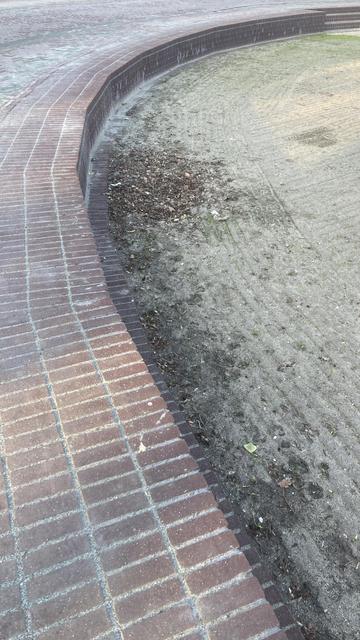
This brand-new brickwork irritates me immensely. Why simulate a curve with straight segments when you could make it truly round?

It brings me back to the early days of digital printing, when @eWalthert complained about how awful printed type looked: curves rendered as polygons instead of smooth outlines.

@dutchstandardalphabets That was one particular case.
HP pushed a new firmware to all Indigo’s that has terrible PostScript emulations. Around 2017.
The printers have been dumbfounded, because they had no idea why this happened.
That was not yet #enshittification but just classic corner cutting and revenue optimization on the costs of quality.
@eWalthert @dutchstandardalphabets Oh, is that why type printed on indigo has jagged outlines?

@klim @dutchstandardalphabets I printed some business cards in 2017 at the same printer as always. Suddenly the outlines were shitty and jagged.
They had no idea why and how to fix it.
So I started to investigate, figured that other HP Indigo’s also turned to shit and finally had a Dutch HP technician on the line, that admitted that they pushed a new firmware to all machines, that all are hardwired to the internet.

The good news is, TTF fonts still look ok’ish.

@eWalthert @dutchstandardalphabets Man, that’s still rough as guts. Such a shame, indigo is a viable, economic process
@klim @dutchstandardalphabets Oh sorry, that was misleading. The image shows CFF OpenType fonts. True type look better, but I have no image.
@dutchstandardalphabets @eWalthert It's all cost driven. You can nail cheap, common straight boards together to make a square frame in just a few minutes and reuse it again on job after job. It would take hours to build a custom curved frame by sawing lengthwise curves in costly wide boards, and then you throw them in the waste pile because it's so unlikely you will need that exact radius curve again, and you can't afford to warehouse them all.