 Dan Kennedy
𝗦𝗲𝗰𝘂𝗿𝗶𝘁𝘆 𝗳𝗼𝗿 𝗔𝗜 𝗶𝘀 𝗰𝗿𝗲𝗮𝘁𝗶𝗻𝗴 𝗮𝗻 𝗲𝘅𝗽𝗲𝗿𝘁𝗶𝘀𝗲 𝗽𝗮𝗿𝗮𝗱𝗼𝘅
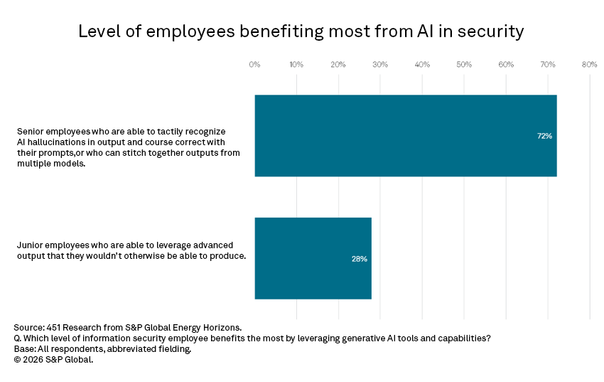
Three years ago, early generative AI integrations in security operations platforms primarily took the form of chat interfaces within their tooling ecosystem. These interfaces enabled natural language queries, incident summarization and the potential automation of routine investigative tasks. Vendors framed early use cases around the ability to uplevel junior or Tier 1 analysts in security operations centers (SOC). Several years into broader GenAI and agentic integrations, that upskilling narrative appears displaced. Security leaders now report that the primary beneficiaries of AI-assisted workflows are senior analysts rather than junior staff. About 72% of respondents to this study note that senior professionals, who recognize hallucinations in output and can course-correct in prompts, benefit most from leveraging AI integrations. Only 28% believe junior employees derive the primary benefit, generating output with AI they wouldn’t otherwise be able to produce. The implications of this are profound in security and beyond. AI may compress the labor hierarchy by automating tasks that were once performed by trained future experts.
Human intervention in AI technology continues to be necessary for optimal results. The results from our Organizational Behavior 2025 survey are not entirely unexpected: If humans will remain “in the loop” to check the results of AI, it will be seasoned experts, humans who have built up tacit knowledge through thousands of repetitions of the work that AI now performs, who will most readily differentiate correct from incorrect results. Moreover, they can offer course correction and evaluate the results of multiple models to determine the best fit for any task. Research also suggests that giving AI models more sophisticated prompts improves the likelihood or receiving comprehensive and correct results.
AI is already affecting the entry–level hiring market, raising several serious questions. If the lower rungs of career ladders are knocked out by AI taking over tasks that were formative learning opportunities for new employees, what will replace this knowledge-creation activity? Who will be the senior employees to provide the necessary human-in-the-loop functions if people do not have paths to gain that experience? Even major AI developers have begun examining this issue. Research released by Anthropic found that programmers who rely heavily on AI assistance perform significantly worse when later asked to explain or reason about the code produced. That suggests that as automation increases, engineers must retain the ability to detect errors and guide model output. This is a skill that will erode, or may never be built up in the first place, if uncritical over-reliance on AI output becomes the norm.
https://blog.451alliance.com/security-for-ai-is-creating-an-enterprise-paradox/
 Wendy Nather