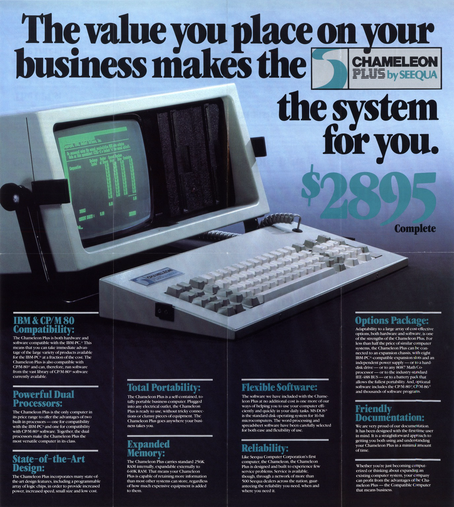
I finally was able to get a high quality scan of the Chameleon Plus advertisement I have! You could get double the memory and double the disk space a $1995 Chameleon could get you for less than double the price!

You can see the rest of my scans and photos regarding Seequa computers at https://seequa.org/gallery !

#retrocomputing #vintagecomputing #seequa

@mcjonestech I find it interesting that in pretty much everything I've ever seen, the math coprocessor was completely optional — virtually never actually included. (I mean I get that they were built from day one to be optional, I'm just saying that virtually nothing actually sold with one already in there.) At least what little I've seen of the various ads for systems of the time anyway. I wonder how often people even really actually sprang for that upgrade later on?

@nazokiyoubinbou @mcjonestech

This was still in the era where you'd typically buy a IBM 5150 or a Seequa Chameleon through a local dealer. Your dealer would be happy to put an 8087 in there for you so you had it day one.

When you pick up an old PC, XT, AT, you'll often find the original dealer's business card or placard or badge attached to the system somewhere.

PC makers were furiously competing on price, so you'd never want to pad out the price of your lowest-cost model, which is gonna be printed in the largest font to catch your eye.

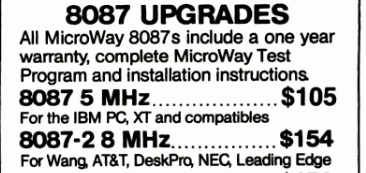
The 8087 was an incredibly complicated chip for the time and fairly expensive when it came out, like several hundred dollars expensive, and not a lot of software actually needed it. Floating-point could be done in software, and was - even in ROM BASIC.

So, at least at first, you only bought an 8087 if you needed floating point to be fast.

I think the longer you held on to your IBM PC the likelier it would be to at some point get an FPU in it, as you tried to trick it out to extend its lifespan. By 1987 they had dropped to $100.

Both of the 5150s I currently own came with 8087's installed, and at least one of them I know was from the original owner. They are not particularly rare, but I could only speculate on the total adoption rate.

@gloriouscow @mcjonestech Oh yeah, people could have them put in, but did any systems come with them already installed?

@nazokiyoubinbou @mcjonestech

I tried to address that point - you wouldn't typically be going into Sears and buying some boxed IBM 5150 off the shelf.

"already installed" implies a retail model that these companies didn't really operate under. Your dealer was the one that decided what kind of PCs they were going to sell and what to put in them, and they were who you went to through for service and warranty concerns.

If you called them up and said you wanted an XT with an 8087 in it, then it by that measure it came with it installed.

If you were a large customer and making a large order directly from IBM they would almost certainly put them in for you too.

Maybe the closest thing would be a Tandy machine, where your dealer was essentially Radio Shack, but i'm scrolling through a few catalogs and the 8087 seems to be optional on every model (and they'd charge you for installation too)

@nazokiyoubinbou @mcjonestech

My dad took me to a lot of computer stores back in the day. They'd have a variety of systems set up, running various applications and demo software , typically with shelving with various software titles along the walls, peg-boards behind the counter hung with accessories like centronics and serial cables.

A store like that was the first time I saw Kings Quest, which blew my mind as I could navigate King Graham behind a tree which just seemed like absolute witchcraft.

So they were free to set up an IBM 5150 and put a 8087 in it and have Lotus 1-2-3 running to show it off, and you could certainly point at that one and take it home. Does that count?

@gloriouscow @mcjonestech I suppose I'm talking about slightly later computers then.

The coprocessor was still optional and frequently not included until well into the 386 era.

By the time I was really into computing they were built in, so I don't know how this felt very well. (My first computer was a 286 when most people had a 486 — most likely without the coprocessor, but I actually don't know — but that was so far behind that it already was severely limited beyond belief in what I could do and I was frequently running into things straight up requiring a 386, so couldn't say how it felt when the 286 was new running software of its time.)

@nazokiyoubinbou @mcjonestech

Even in the 386 era they were pretty niche, but by that point you now have companies like Gateway and Dell selling direct to consumer, so an FPU was just one option on an order form away from showing up at your door, preinstalled in the factory sealed box.

@gloriouscow @mcjonestech Well, the question was if any just came with it. Like basically not optional.

So it kind of sounds like the answer is no.

@nazokiyoubinbou @mcjonestech

Okay, I see what you're getting at. If there ever existed a PC system that required an FPU to function, like it was even soldered in or something, I am not aware of it.

I'd love to know if such a thing existed.

@gloriouscow @mcjonestech Nah, I don't mean required. I just mean were any OEMs just selling a specific model that came with it preinstalled rather than an option one could check to get it with one. Like the kind of thing where they put an ad in a magazine "with math coprocessor already installed for maximum performance" or somesuch silliness.

I really didn't mean for it to be such a complicated question.

@nazokiyoubinbou @mcjonestech

lol, no, you're fine. I'd be astonished if at some point in the PC's long, vibrant history if there wasn't a magazine ad out there that listed a pre-configured model that has an FPU.

I can certainly remember ads that basically went from "here's our cheapest system, it's a 4MHz 286, the keyboard is made out of pegboard and tic-tacs" all the way to "This has a a liquid nitrogen dewar for its overclocked Pentium II and we put seven VooDoo cards in it."

You'd probably want to look at ads from Falcon Northwest and companies that targeted high end configurations.

And if you count workstation vendors - then almost assuredly yes, nobody is going to seriously sell you a CAD workstation without an FPU in it, but I almost consider that is own parallel dimension from the "PC".

@nazokiyoubinbou @mcjonestech

there's something I'm completely overlooking here too - laptops.

You were far less likely to add something like that later on, and it was far more likely to be some sort of SMC package permanently affixed.

@gloriouscow @mcjonestech That's actually a really good point. I wasn't thinking to ask that, but I imagine a lot of laptops simply didn't even have an option, much less coming with one?

@nazokiyoubinbou @mcjonestech

Just started searching, but it feels like most of the 386 laptops i'm seeing had the 386SX or SLC in it, probably for power reasons - and frustratingly they all seem to have the PLCC socket under a cover, making the 387 once again an optional add-on.

@nazokiyoubinbou @mcjonestech

You also now have computer stores trending more to making custom, house brand PCs in beige cases containing god knows what, and almost certainly some of those had FPUs in there because you can talk Grandma into how you need that to make her recipes go fast.