Waymo (@Waymo) on X

Our new safety data is in 📈 Over 170M miles through Dec 2025, the Waymo Driver was involved in 13x fewer serious injury or worse crashes than human drivers in those same cities. At our current scale, that means preventing a serious injury crash every 8 days—a real, positive

X (formerly Twitter)

Anecdotally, both from riding in them and walking/driving next to/around them, this feels obvious. They never get distracted. Sure, they sometimes make mistakes, but the mistakes are never "I didn't see that". They see better than humans in all cases (where they operate). They react faster than humans.

The one case where they hit a child, it was because the child jumped in front of the car. And they showed that they hit the child at a lower speed than a human would have because of the reaction time.

I would rather be in an area where only Waymo's are allowed than an area where they are banned.

Waymo saved my life in LA.

When I visited LA, I rode in a Waymo going the speed limit in the right lane on a very busy street. The Waymo approached an intersection where it had the right of way, when suddenly a car ignored its stop sign and drove into the road.

In less than a second, the Waymo moved into the left lane and kept going. I didn't even realize what was happening until after it was over.

Most human drivers would've t-boned the car at 50+ km/h. Maybe they would've braked and reduced the impact, which would be the right move. A human swerving probably would've overshot into oncoming traffic. Only a robot could've safely swerved into another lane and avoid the crash entirely.

Unfortunately, the Waymo only supported Spotify and did not work with my YouTube Music subscription, so I was listening to an advertisement at the time of my near-death experience. 4.5 stars overall.

I hope you are misremembering. Swerving is most often the wrong choice, and I would be disappointed if Waymo were opting for that. By far the best option is to panic stop. Human or robot, physics is a harsh mistress and swerving is more likely to make you lose control and end up in a much more unforgiving wreck.
This depends a huge amount on car, driver and situation. It was the right advice for a learner driver in the 90s with no stability control, no experience and no side airbags, because if you’re going to hit something, hitting it front on is the least risky way. I’m not convinced it’s the right advice for a competent driver in a modern vehicle.

It is still standard advice today, as far as I know. Tires are better, stability control is better, but all else being equal you are still much more dynamically stable and have a lot more friction with the road when the car is stopping in a straight line than when swerving.

Also, in the case of someone running a stop sign, it is far from a sure bet they are going to hit their brakes at all, so by swerving you increase the odds that you will still hit them, but now it will be while you have exhausted all your adhesion on lateral control. So now instead of a front end collision with all the benefits of airbags and crumple zones, you are at a significant risk of rolling the car or spinning off the road and hitting something immovable with a part of your car lacking crumple zones.

The common mistake is people swerve and brake, which is a terrible combination - you should accelerate through a sudden manoeuvre, as it maintains control through it, much as you should accelerate through corners in general.
Thanks! Now I know why the Waymo didn't slow down.
Wunibald Kamm begs to differ. For his circle, it doesn't matter if the additional force that causes the friction to be insufficient is forward or backwards on top of the side force. In critical situations either use your friction for lateral xor longitudinal action, never both at the same time. Brake hard, but then sail through the curve. You want that vector to move along the circle and never leave it. As that is very difficult for an untrained driver, better switch hard between both modes.

True if we all drove unicycles - but in the real world, tyre wear is uneven, brake wear is uneven, loading is uneven, the surface is uneven, and those differential forces are what modern ABS seeks to control.

The key difference between braking and accelerating is that in the former case, independent, potentially differentially worn brakes, apply force unevenly, making the chance of a loss of traction on one or more wheels higher. With acceleration, that force is applied through a differential, meaning it will be far more likely to be appropriately distributed.

If you want to decelerate while swerving it can be done, but it should be done through engine braking - and the tricky bit there is matching revs as you drop the clutch back in, otherwise you have too much retarding force and overcome the coefficient of friction, resulting in a skid.

Easier for those of us who grew up with double de-clutching and no synchromeshes, but when you’re in a critical situation, it’s still an awful lot easier to apply acceleration.

What about other drivers in that lane? It would have to be 100% sure that any other drivers near it would have enough time to react as well.

Absolutely. I was recently driving on a motorway in Portugal when a boulder (giant chunk of granite, 10+ tonnes) fell off the back of a truck - right in front of us, in a heavily laden (7 pax and luggage) car. Immediate massive cloud of dust, I checked my blind spot, veered across two lanes, and continued our journey, unscathed. I looked in the rear view, to see the car behind us jump on the brakes instead of evading. They caught the boulder.

Nobody killed, according to the news, but several taken to hospital in critical condition.

Oh, I say unscathed but our tyre exploded the next day, as apparently we caught a fragment, and again, that’s not a “slam on the brakes” moment, but rather “trundle to a stop on the shoulder and walk to the conveniently nearby tyre shop”.

In theory, it depends. In practice, slamming on your brakes is the correct call 99% of the time. To a large extent that is because of the "competent driver" part. I'd expect 80%+ of drivers to consider themselves just that, whereas the truth is of course the opposite.

So, the correct advice is to say "brake, don't swerve", so that drivers internalize that their first thought and reaction in any emergency should be to brake. Teach them to actually brake—fully press on the pedal—while you're at it.

A slightly more nuanced advice would be "brake first, swerve as needed as a follow-up".

But I would never in good conscience be able to give anyone advice to swerve instead of braking.

It wasn't possible to stop at the speed the Waymo was moving at.

The Waymo didn't have the stop sign, the other driver did, at a three way intersection.

The other driver decided to suddenly enter the intersection, when the Waymo was like 5-10 meters away. This was after having stopped at the stop sign.

Either they weren't looking or intentionally trying to cause an accident. Swerving prevented the Waymo from crashing at 40 km/h into the driver's door.

For a human this advice is true. But what if a computer can near-instantly calculate a perfect swerve within the performance envelope of the car and driving conditions?

> swerving is more likely to make you lose control

Even if you're not a panicky human but a optimally regulated control system?

The optimally regulated system doesn't know the road conditions that well. When the road surface is more slippery, it has the most profound effect on lateral friction, way more than braking.
The Waymo driver can measure the speed and the acceleration of the offending car and calculate, within at most tens of ms, its range of likely future trajectories. And it can calculate its own likely trajectories under maximum braking. And it can track exactly where all obstacles are that would matter if it swerves. All at once. And it can execute that emergency lane change with the control input that is least likely to cause a loss of control and most likely to successfully avoid the other car. It even has processing power to spare to keep playing that Spotify ad!

> The optimally regulated system doesn't know the road conditions that well.

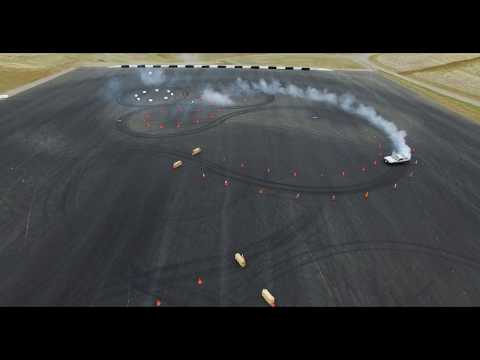
I'd like to introduce you to what autonomous cars were already able to do in 2018: https://www.youtube.com/watch?v=khX0UCqcR3M

MARTYKhana - Aerial View Uncut Footage

YouTube