 Yoïn van Spijk
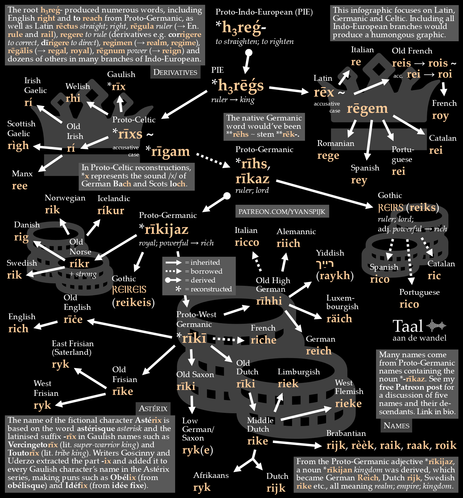
The English word ‘rich’ is related to ‘regal’ and ‘royal’.
‘Rich’ derives from a Proto-Germanic borrowing of *rīxs, the Proto-Celtic cognate of Latin ‘rēx’, meaning “king”.
The meaning “wealthy” evolved from “powerful; kingly”.
Latin ‘rēx’, in turn, is the ancestor of Spanish ‘rey’ and French ‘roi’. Via French, ‘regal’ and ‘royal’ come from ‘rēgālis’, a derivative of ‘rēx’.
Click my new infographic to learn more about this fascinating word family:
1/
 Hraban (fiëé visuëlle)
 Peter Jakobs ⛵
 Gustavo Meneses
 harbeider