https://arxiv.org/abs/2508.11814
#Bayesian #stats #rstats #SBC
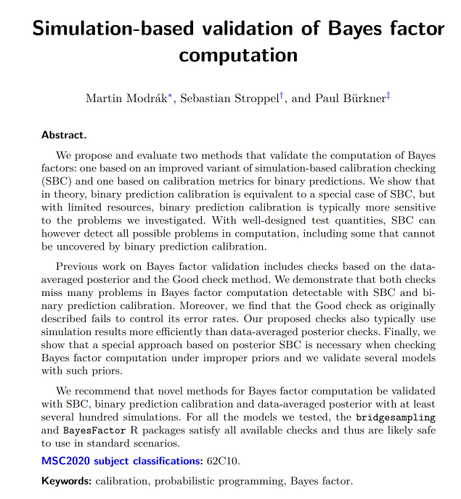
We also show how to leverage posterior SBC to check computation when priors are improper and we thus cannot simulate (we take the BayesFactor package as an example).
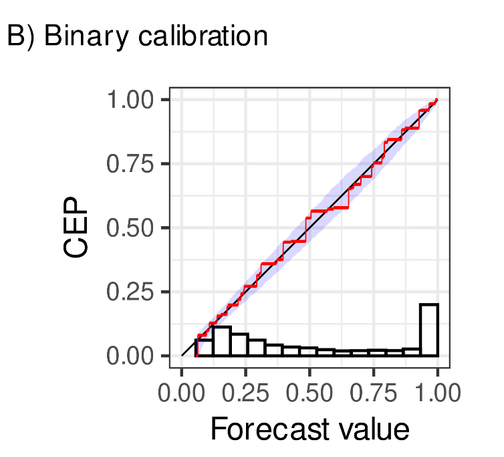
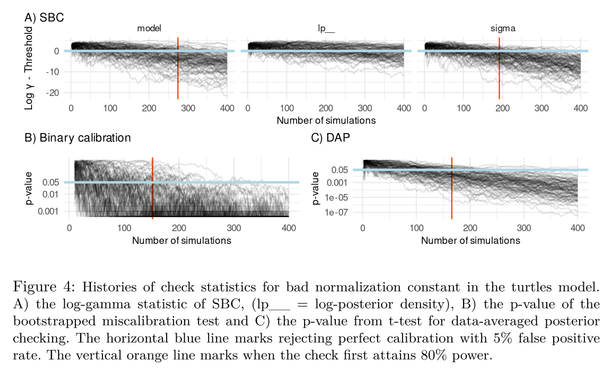
We tried hard to move beyond toy examples and do our evaluations on problems that mimic actual bugs in Bayes Factor computation (omitted normalization constant, improper use of Savage-Dickey density ratio, mismatch between simulation and models. 4/
We do throw some shade on the Good check, but a tweaked version was just published (https://arxiv.org/pdf/2602.19838) which appears to address some of the major problems we report. We didn't manage to include it in our current simulations but we definitely plan to do a head-to-head comparison at some point.
We thank Nikola Sekulovski and @EJWagenmakers for kindly providing feedback on an early version. They also tipped us on the further developments for the Good check. 7/8
My older thread on SBC in general is at https://fediscience.org/@modrak_m/109301406944300548
And there is an R package implementing all of the techniques we discuss: https://github.com/hyunjimoon/SBC/

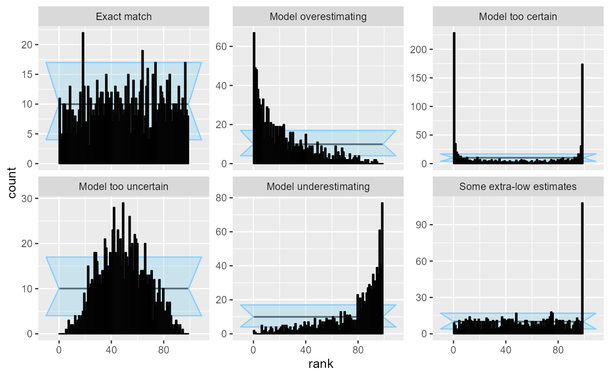
Attached: 2 images The basic idea is that you implement your model twice: beyond a probabilistic program (e.g. in #Stan, #jags, ...) + a sampling algorithm you also need a simulator drawing from the prior distribution - this tends to be easy to implement. You then simulate multiple datasets, fit those with your probabilistic program and compute ranks of the prior parameter values withing the posterior. If you did everything correct, the ranks are uniform. Non-unifomity then signals a problem. 3/