
The United States was not ready for this war.

Secretary of State Rubio publicly acknowledged the structural mismatch before the operation began:

Iran produces more than 100 ballistic missiles per month,
against six or seven interceptors that the United States can manufacture in the same period.

The Shahed-136 drone costs between twenty and fifty thousand dollars to produce.
-- The PAC-3 interceptor that destroys it costs four million.

The THAAD interceptor costs twelve point seven million.

The twelve-day war in June 2025 had already consumed approximately 150 THAAD interceptors
— roughly a quarter of the entire global supply.

The first nine days of Epic Fury burned through an additional 40 THAAD,
90 Patriot, and over 180 carrier-based interceptors.

Current THAAD production runs at approximately eight missiles per month.

The January 2026 contract with Lockheed Martin to quadruple production to 400 per year requires seven years to reach full capacity.

New interceptors will not arrive in meaningful volumes before 2028.

The Stimson Center’s analysts put the timeline to critical arsenal depletion at four to five weeks.

At that point, the United States faces a choice that no American strategic planner has been willing to articulate publicly
— who to defend: Israel, Taiwan, or tankers in the Gulf.

Because defending all three simultaneously has proven beyond American capacity.
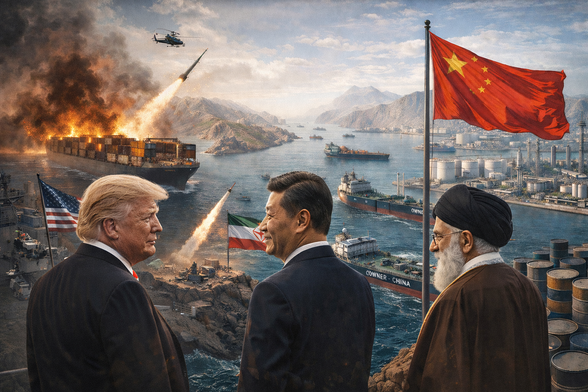
https://medium.com/@cheslavsky/the-hormuz-trap-how-beijing-won-a-war-without-firing-a-single-missile-f68522fe7888

The Hormuz Trap: How Beijing Won a War Without Firing a Single Missile

On June 15, 1900, Major General Stessell sent a dispatch to Vice Admiral Alexeyev reporting the successful storming of the Eastern Arsenal…

Medium

The Winner Who Fired Nothing

The only actor whose strategic position has unambiguously improved as a result of Operation Epic Fury is Beijing.

China entered the conflict with reserves sufficient to withstand a complete cessation of Iranian exports through the decisive months of any hypothetical conflict.

It is receiving bilateral safe passage guarantees from the IRGC
— vessels transmitting “OWNER — CHINA” on their AIS transponders have been transiting the strait.

Its hundred-day reserve buffer insulates it from the price shock hitting every other major importer.

And the depletion of American interceptor stocks over Hormuz directly reduces Washington’s capacity to defend Taiwan
— the only military theater that matters to Beijing’s long-term calculus.

China did not fire a single missile.

It filled its tanks and waited.

This is what preparation looks like when it is done correctly.
https://medium.com/@cheslavsky/the-hormuz-trap-how-beijing-won-a-war-without-firing-a-single-missile-f68522fe7888

The Hormuz Trap: How Beijing Won a War Without Firing a Single Missile

On June 15, 1900, Major General Stessell sent a dispatch to Vice Admiral Alexeyev reporting the successful storming of the Eastern Arsenal…

Medium
@cdarwin I don't know if the Chinese are smarter than us, but they do take the long view, which is pretty much the same thing.
@cdarwin Never interrupt your enemy when they are making a mistake, and all that.