
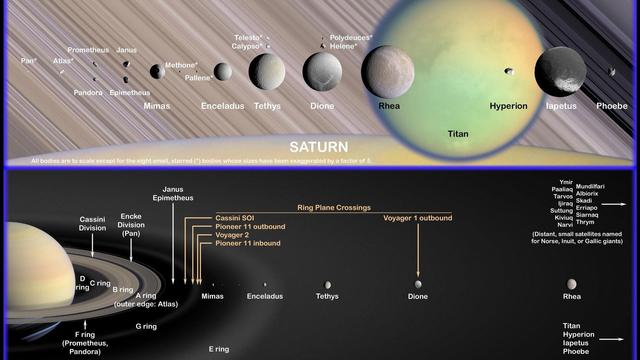
Astronomers have discovered 11 more moons around Saturn, bringing its total to 285--by far the most of any planet in the solar system.

The true number may be unknowable, if you count every ring particle as its own little moon.

https://minorplanetcenter.net/mpec/K26/K26F14.html #space #science #nature #math
@coreyspowell Yeah, I think we might need a scientifically useful definition of a moon to go with the currently scientifically useless definition of a planet.
@StarkRG @coreyspowell PLUTO IS A PLANET. Now get off my hill.
@dancingtreefrog @coreyspowell I honestly don't care whether the definition include Pluto, I think it probably should, but what I really care about is that it be a *useful* definition, not one mired in legacy. The existing definition is both too narrow (it doesn't include rogue planets or planets orbiting other stars) and too broad (gas giants should absolutely not be in the same category as rocky planets, and ice giants should probably be considered a different category from normal gas giants).

@StarkRG @coreyspowell I agree that rogue planets and planets orbiting other stars should be included. At least categorize them as planets even if we can't specifically classify one as rocky/ice/giant.

I still wonder if there aren't cores of rocky planets hiding within gas giants and ice giants.

Is the difference between gas and ice planet simply their distance from their star?

@dancingtreefrog @coreyspowell I think the consensus among astrophysicists is shifting away from Jupiter having a rocky core. I'm not sure about Saturn. But even if they did, the rocky core wouldn't be anything like an actual rocky planet, it would be more like our own solid metal core, pretty much perfectly spherical.