 return2ozma
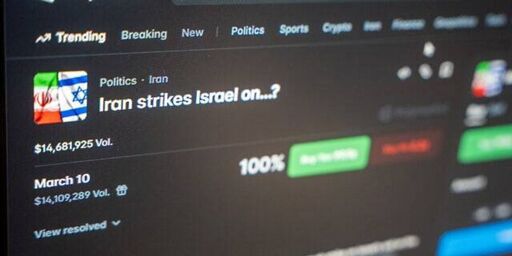
'Bone-Chilling': Gamblers ‘Vowing to Kill’ Journalist Unless He Changes Iran War Report to Help Them Win Polymarket Bet
 certified_expert
Can somebody eli5 me this? I am not sure I am getting it
 🔍🦘🛎
🔍🦘🛎Polymarket is a place to put bets on anything: if the groundhog sees his shadow, if a hurricane makes landfall, if the US bombs Iran. You know just fun betting. Except now people put down huge sums, and just prior to the Iran war, insiders were putting down MILLIONS on the war starting that day. It makes it immediately obvious there are dangerous conflicts of interest.
But, who pays? I could bet you a million I will eat a sandwish today
The platform puts up the bets, and you can “buy” a share in the “future prediction”
Basically you put in a sum on one option, buying a % of the winnings if that option is the one that the platform decides won.
Hold on… so somebody in the company defines the bets? Like bombing dates and stuff? Users just get to pick whatever is available?
If betting on Polymarket, you would actually have to stump up that money first, and the other person would have to do the same with whatever bid they wanted to use. Then, in order to get any kind of reasonable payback, you would need thousands of other people to make a bet for or against, using their own money.
The payout isn’t on someone making a bet on themselves, no-one else would bet for or against that as the stakes are so small. The payout is on large-scale events that are - ostensibly - out of the control of the bettor or bettee.
Oh, so I can post a bet on anything. And the game only starts when somebody picks up the other side: betting against my prediction.
Someone has to take the other side of the bet.
Everything is a yes or no question. You can buy a yes or no option for anywhere between 1 cent and 99 cents. When an outcome is finalized, the side that had the correct prediction has their option goto $1.00
So as an outcome becomes more likely, its price moves towards $1.
So when you buy a contact for less than 50 cents you are buying the underdog, when it’s over 50 cents you are backing the favorite.
Let’s say that the contact is if you will eat a sandwich today. I’m guessing most people will think you will eat a sandwich so the “yes” contract will probably cost 99 cents or so.
If someone pays 99 cents for that option and you do eat a sandwich they get back $1 total, or 1 cent profit.
Well what if I’m your doctor and you come in to me with food poisoning. Now I have inside information and I can buy an option that you will not eat a sandwich today for 1 cent and if you don’t eat a sandwich I’ll get back $1 for every penny I put towards the “no” outcome.
So the big issue is people having inside information and using these prediction markets to illegally make money and it’s really hard to track.
In the article, it appears that only 1 missile landed and that the only source for it was this author’s article. So the people that bet on the “no” outcome are trying to get him to change his article so the outcome is contested and they can maybe win their bet. They are using the position that what landed was a piece of a missile that was intercepted.
There is now a huge financial motivation to report news that isn’t factual.
So now not only the editor can have financial incentives to force journalists to push an agenda, but literally anybody!
The thing I struggle with, is how do they manage ensuring thier is a bet on the other side to balance. I mean someone has to make the first bet. I assume you can offer, but if no one or not enough people take the offer then your offer doesn’t conver to a real bet or something? And if that is how it works, say someone puts up money on a significant underdog. There would likely be a lot of interest, probably more than needed to balance the bet. How do they decide who gets the action and who doesn’t?
The two sides don’t have to be balanced. That’s what “betting odds” are. If there are 3 “yes” bets and 1 “no” bet then there are 3:1 odds. If the “no” wins they will get much more money because they don’t have to split it with anyone.
Sure, but do the odds change constantly with each person buying in? And if so, does that mean somone who bought in at 10 to 1, could end up getting 2 to 1 by the time it pays out?
No, in this case, you own the contract. A winning decision is always worth $1 but the current price that people are offering their yes or no contract for sale change like a stock ticker.
There’s a bid and an ask, and when there are no takers people will adjust their offer or selling prices. Just like stock. The demand on either side changes the current price. In this case there are always two opposite sides with opposite prices in relation to $1
 wolfkin
@Modern_medicine_isnt @cdf12345 balance matters. As Ayy points out odds help incentivize balance. If one person puts a lot of money on heads. They'll give you better odds on tails.
of course you also have to consider likely outcomes like 100k on the hare and they'll be more willing to give you great odds on the tortoise.
no one says the odds have to be even. The house makes money either way on trans fees and other bits of skim. Plus odds are in their favor. They often have money to start too