
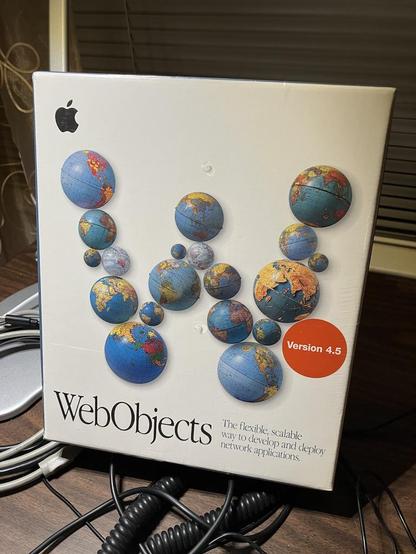
Ah, WebObjects. This set of software frameworks was used to build enterprise-level websites, the iTunes Store being a notable example. 4.5 was the first version to "only" cost $699 instead of the $50,000 that NeXT used to charge. And the last version to use Objective-C... it all got rewritten in Java for the 5.0 release, beginning a slow decline until it was officially discontinued in 2016.

@_the_cloud

We still use WO (but are slowly migrating to our own modern Swift-based framework). We have about 1.5M lines of WO code. It is rock solid (still).

Here one of the WO docs in PDF: https://developer.apple.com/library/archive/documentation/LegacyTechnologies/WebObjects/WebObjects_5/DeployingWebObjects/DeployingWOApps.pdf

@tuparev @_the_cloud My absolute favorite of Apple docs is this one:
https://leopard-adc.pepas.com/documentation/WebObjects/DesktopApplications/WODesktopApps.pdf

291 pages finest documentation of mostly forgotten tech.

@lazarus @_the_cloud

I prefer the Objective-C version 😂

@tuparev @_the_cloud Of WebObjects or of desktop apps?
@tuparev @_the_cloud Well, I love Objective-C and its apps, but it has always been bound tightly to the Apple ecosystem. The Java version is Apple tech (including most Cocoa patterns), but implemented with cross platform ability. Cocoa-like apps running on my Linux machine. I just love it. 😉
Plus: Objective-C WO apps were two tier apps accessing the database directly. Java WO apps are three tier, using the application server and having a nice controller system to create layouts.

@lazarus @_the_cloud

In reality, very few production systems were deployed on non-Apple hardware/software. I was training many teams around the world, and 90%+ used some form of OpenStep. Java was more a marketing move.

BTW, after EOF 3.1 the Obj-C version were 3-tier too.

@tuparev @_the_cloud Uh, interesting. But yes, makes sense, Apple wasn't sure about the success of ObjC.
Ok, never read about Cocoa three-tier apps in the docs though. That always applied to Java clients only.